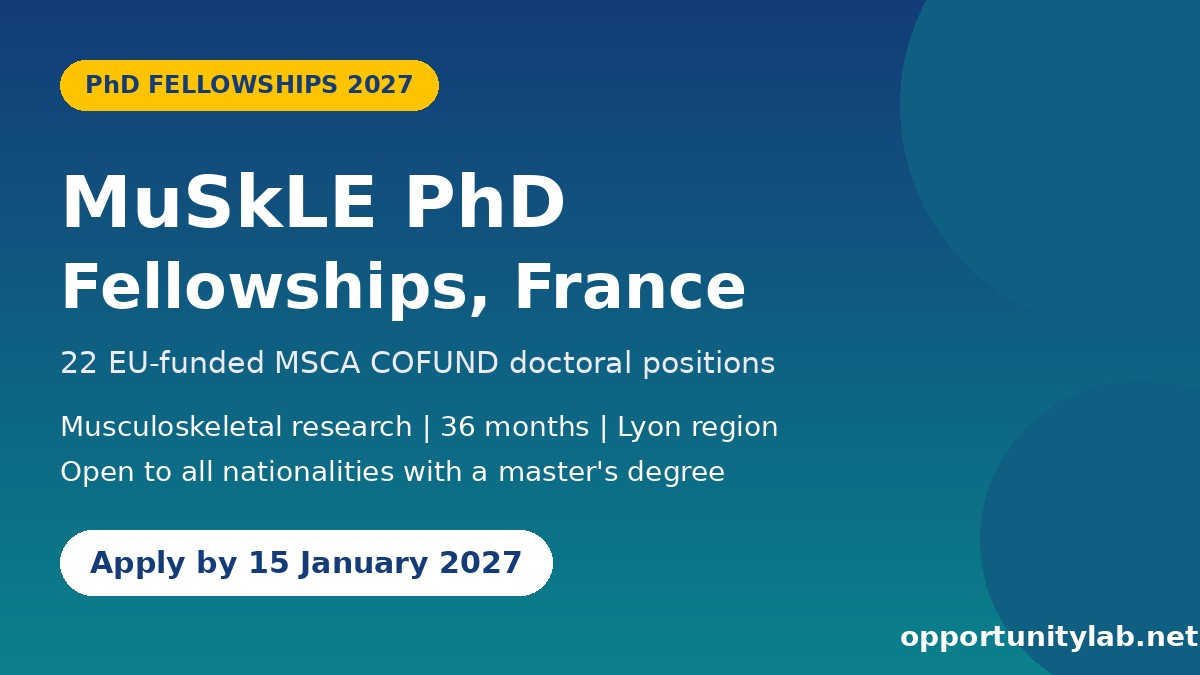
The MuSkLE doctoral programme, an EU-co-funded Marie Skłodowska-Curie (MSCA) COFUND programme led by Université Claude Bernard Lyon 1 in France, has opened its second call for PhD applicants. The call will select 22 doctoral fellows from a list of 23 PhD projects on the musculoskeletal system, from how muscles and bones develop to how they work in adults and how they repair after injury or disease.
The positions are three-year (36-month) doctoral fellowships based in the Auvergne-Rhône-Alpes region of France. The call is open to applicants of any nationality who hold a master’s degree and meet the MSCA mobility rule. Deadline: 15 January 2027 at 12:00 am (midnight) CET, which is midnight WAT, 1:00 am CAT/SAST and 2:00 am EAT on 15 January. In practice, submit by 14 January 2027.
Key Details
- Programme: MuSkLE PhD programme (MSCA COFUND), second competitive call
- Lead institution: Université Claude Bernard Lyon 1, with partner universities and a university hospital in the Auvergne-Rhône-Alpes region, France
- Places: 22 doctoral fellowships across 23 PhD projects
- Duration: 36 months
- Field: musculoskeletal research (muscle and bone biology, health, biomechanics and related areas, including physics, mathematics and social science approaches)
- Call opened: 16 November 2026
- Deadline: 15 January 2027, 12:00 am CET
- Application fee: none mentioned on the official page
Benefits
- A funded three-year PhD fellowship in France under the EU’s Marie Skłodowska-Curie Actions COFUND scheme. MSCA doctoral fellows are normally hired on an employment contract with social security cover; the exact salary is set out in the official guide for applicants, which we advise you to check.
- Interdisciplinary doctoral training that mixes biology and medicine with physics, mathematics and the social sciences.
- Supervision by research teams in the MuSkLE network, plus training and networking with other fellows in the programme.
- The chance to choose up to three projects, or to propose your own project within a supervisor’s research area.
Eligibility
- Open to all nationalities, including Nigerians and other Africans.
- You must hold a master’s degree by the call deadline. If you have finished your programme but have not formally been awarded the degree by 15 January 2027, you are not eligible.
- You must not already hold a PhD. Those who have defended a thesis but not yet received the degree are also not eligible.
- Mobility rule: you must not have lived, worked or studied in France for more than 12 months in the three years before the deadline (compulsory national service and refugee-status procedures are not counted).
- You should be able to write and present your application in good academic English.
How to Apply
- Read the list of open PhD projects on the MuSkLE recruitment page, then download the guide for applicants and read the FAQ.
- Choose up to three projects and rank them in order of preference. One of the three can be your own proposal.
- Prepare one single PDF (maximum 8 MB) in this order: a CV of up to 2 pages (contact details, education, work history, distinctions, country of residence, up to 5 relevant publications, skills, internships and two referees), a personal statement of up to 1 page explaining your motivation and project choices, your master’s diploma or transcript showing the graduation date, and the ethics self-assessment tables if you propose your own project.
- Your CV must clearly show where you lived, worked or studied in the last three years so the panel can check the mobility rule.
- Submit everything through the official MuSkLE application form before the deadline. Applications sent by email or other means are not evaluated. Only one application per candidate is allowed in each call.
- Questions can be sent to recruitment[at]muskle.eu.
Tips
- If your background does not fully match a project, explain clearly in your personal statement why you are still a strong fit. The programme asks for a detailed justification in this case.
- Get your master’s certificate or a transcript that shows the official graduation date early. Many African universities take months to issue final results, and missing proof means automatic rejection.
- Contact your two referees now so they are ready to send letters when asked.
- Keep the single PDF under 8 MB. Scan documents at a moderate resolution and compress the file before uploading.
- Do not wait until 14 January. Network problems and power cuts are common near deadlines, so aim to submit at least a week early.