
Important: only for mid-career or senior academics who hold a full-time post at an African university and earned their PhD at least seven years ago.
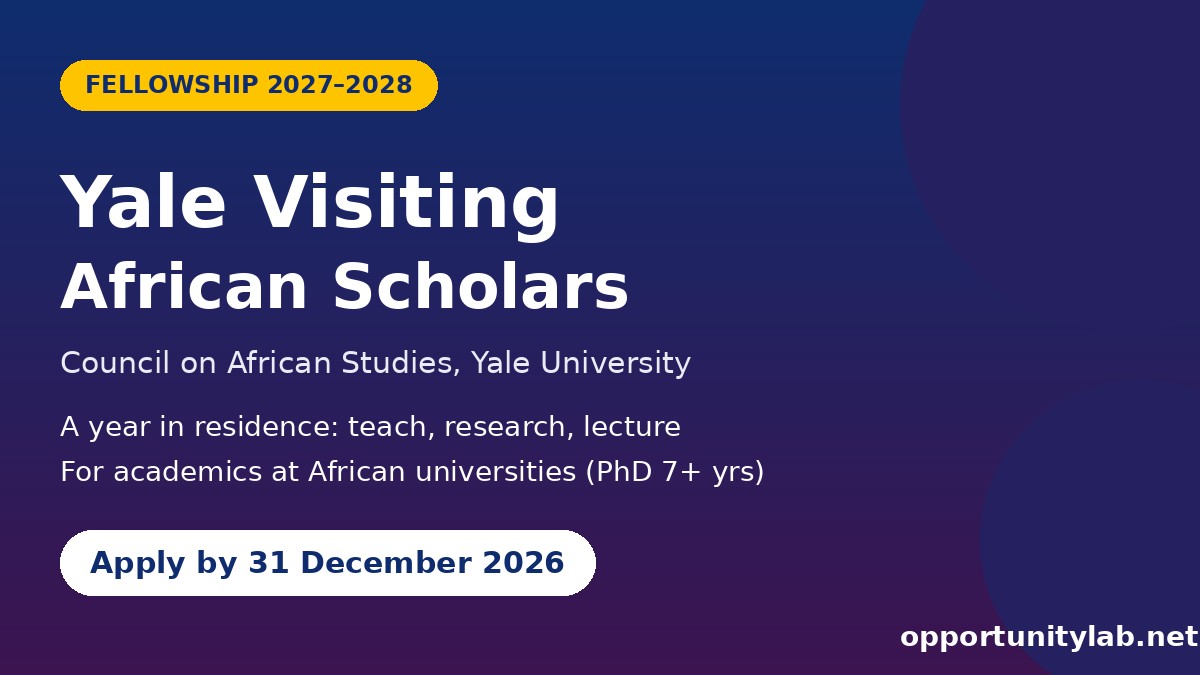
The Council on African Studies at Yale University’s MacMillan Center for International and Area Studies is inviting applications for its Visiting African Scholars Fellowship 2027–2028. Selected scholars spend the academic year in residence at Yale in New Haven, USA, teach one course on an African topic in the humanities or social sciences, develop a research project and give a public lecture.
Yale says the fellowship comes with a generous stipend and research support, including access to Yale’s libraries; the exact amount is not published. Deadline: 31 December 2026, through Interfolio.
Key Details
- Host: Council on African Studies, Whitney and Betty MacMillan Center, Yale University
- Location: New Haven, Connecticut, USA
- Period: academic year starting 1 August 2027, full-time residence
- Teaching: one course on an African topic in the fall or spring semester
- Fields: any humanities or social science field
- Deadline: 31 December 2026
- Application platform: Interfolio (free for applicants)
Benefits
- A stipend described by Yale as generous, plus research support.
- Full access to Yale’s libraries and other academic resources for a year.
- Time and space to develop your own research project.
- Teaching experience at a leading US university and a public lecture to the Yale community.
- Membership in the intellectual life of the Council and the MacMillan Center, with chances to build long-term research links between Yale and your home institution.
Eligibility
- You must currently hold a full-time academic position at a university in Africa.
- You must be a mid-career or senior scholar who earned a PhD at least seven years ago (in practice, by 2020 or earlier).
- Your teaching and research must be in the humanities or social sciences, focused on Africa.
- You must be able to live at Yale full-time during the 2027–2028 academic year.
How to Apply
- Open the official Yale application page on Interfolio and create a free Dossier account.
- Upload a cover letter with your current email address, naming the Yale faculty member you would like to work with and explaining why.
- Upload your current CV with publications.
- Add a 1,000-word description of your proposed research project.
- Add a summary of the course you propose to teach, with the schedule of readings and assignments.
- Give the names and contacts of two referees. Letters are requested only if you are shortlisted.
- Submit by 31 December 2026. Questions go to [email protected] with “Visiting African Scholars” in the subject line.
Tips
- Browse the Yale faculty pages before writing your cover letter and name someone whose work genuinely links to yours. A specific match is more convincing than a famous name.
- Design a course that a Yale student without African experience can follow, with readings that include African authors and recent scholarship.
- Keep the research description practical: what you will do in the year, which Yale resources you need and what you will produce.
- Talk to your university early about leave of absence for the year, as many Nigerian, Ghanaian and Kenyan universities need months to approve sabbaticals.
- Start the US visa process as soon as you get an offer, since J-1 interview waiting times in some African capitals are long.