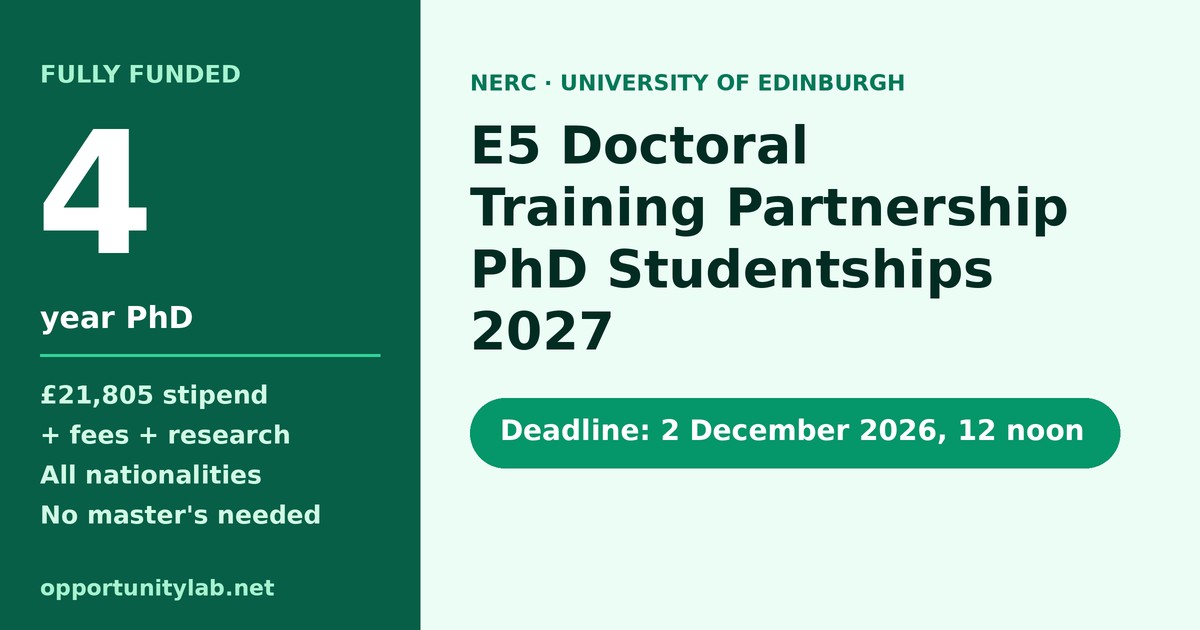
Want to do a fully funded PhD on climate, oceans, ecology, geology or another environmental science? The E5 Doctoral Training Partnership (E5 DTP), led by the University of Edinburgh’s School of Geosciences and funded by the UK’s Natural Environment Research Council (NERC), is recruiting PhD students for 2027. Studentships cover four years of stipend, tuition fees and research costs. International students are welcome, and the university covers the higher international fee. Applications close on 2 December 2026 at 12 noon GMT.
Studentship at a Glance
- Funder: Natural Environment Research Council (NERC), part of UK Research and Innovation (UKRI)
- Led by: School of Geosciences, University of Edinburgh
- Field: Environmental sciences, through supervisor-led PhD projects
- Length: 4 years (48 months), full-time
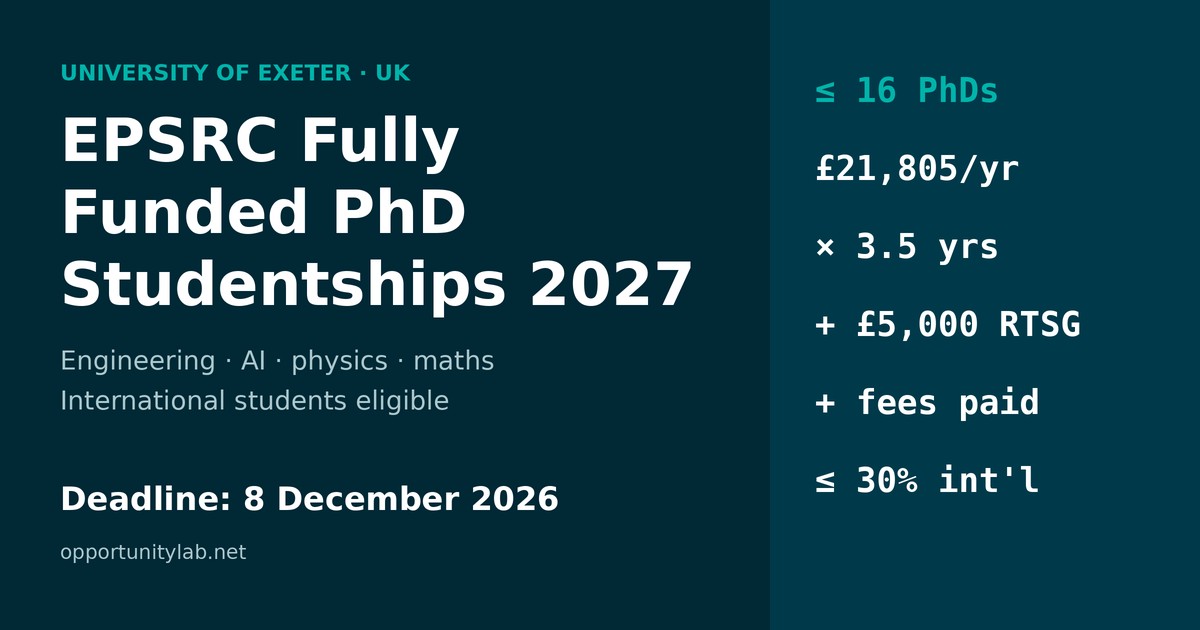
- Funding: UKRI stipend (£21,805 for 2026/27), tuition fees and research costs
- International students: Eligible. The university pays the difference between home and international fees. International places are capped at 30%.
- Master’s degree: Not required
- Deadline: 2 December 2026, 12 noon GMT
About the E5 DTP
E5 builds on the earlier E3 and E4 doctoral training partnerships and trains the next generation of environmental scientists to tackle problems such as climate change, biodiversity loss, natural hazards and pollution. Students choose from advertised PhD projects with supervisors across the partnership and receive training throughout their PhD.
Benefits
- A 4-year UKRI stipend for living costs (£21,805 a year in 2026/27, usually tax-free)
- Full tuition fees, with the university covering the international fee difference
- Research costs for equipment, consumables, fieldwork, conferences and software
- Training and a cohort of environmental science PhD students
- A PhD from the University of Edinburgh
Not covered: visa fees, the Immigration Health Surcharge, flights and relocation costs. International applicants should budget for these.
Eligibility
- Open to all nationalities
- A good honours degree (2:1 or above) or equivalent. Relevant professional experience or postgraduate study can also count.
- No master’s degree required
- Meet the University of Edinburgh’s English language requirements. Evidence is only needed if you receive an offer.
- Be able to live within commuting distance of Edinburgh during the PhD
UKRI limits international students to 30% of the intake, so competition for these places is strong.
Key Dates
| Stage | Date |
|---|---|
| Projects advertised | 16 October – 2 December 2026 |
| Application deadline (all candidates) | 2 December 2026, 12 noon GMT |
| Screening and shortlisting | 3 December 2026 – 31 January 2027 |
| Interview invitations | From the week of 1 February 2027 |
| Interviews for overseas applicants (online) | 24 February 2027 |
| First offers | From 5 March 2027 |
Tips for a Strong Application
- Browse the advertised projects early and pick the ones that best match your skills.
- Contact the project supervisors before applying to discuss the project and your fit.
- Show relevant experience, such as fieldwork, lab work, data analysis, GIS or modelling.
- Explain your motivation, and how the PhD links to environmental challenges you care about, including in Africa.
- Plan for the extra costs of visa, health surcharge and flights.
How to Apply
- Read the entry criteria and funding details on the E5 DTP website.
- Choose advertised projects and contact the supervisors.
- Complete the E5 DTP application.
- Submit by 12 noon GMT on 2 December 2026.
For questions, email [email protected].
Read the official E5 DTP entry and eligibility criteria
Visit the E5 DTP website and browse projects