

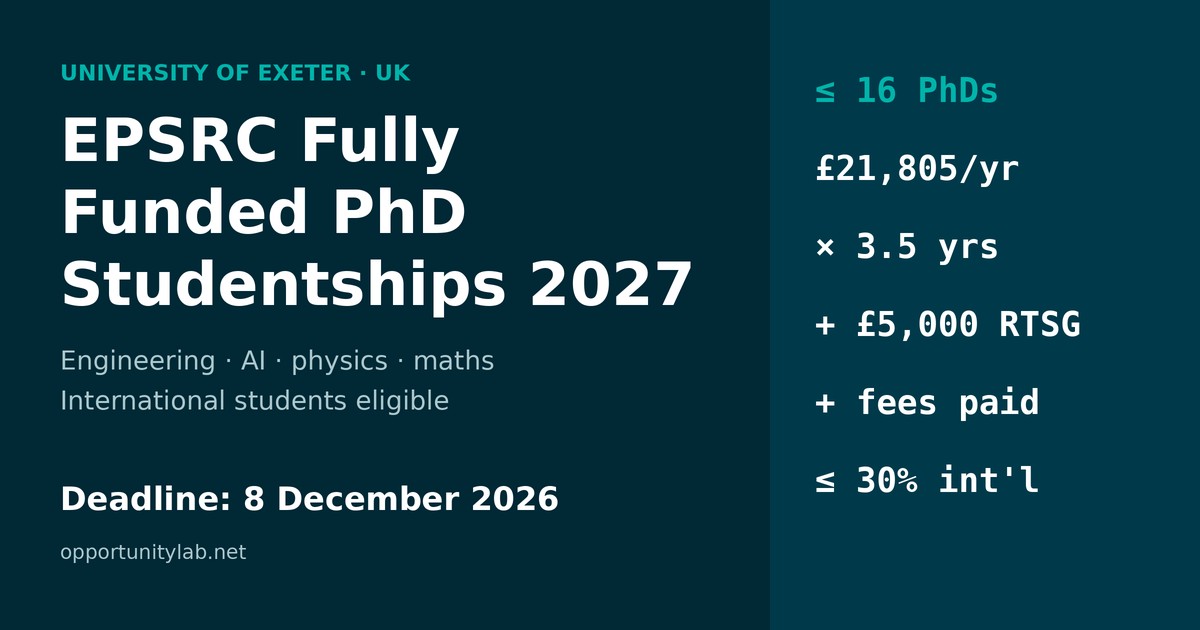
The University of Exeter, a Russell Group university in the UK, is offering up to 16 fully funded PhD studentships for September 2027 through its EPSRC Doctoral Landscape Award, funded by the Engineering and Physical Sciences Research Council. Projects cover engineering, computer science and AI, physics, mathematics, climate and earth sciences, and more. International students, including Africans, can apply for up to 30% of the places.
Applications opened on 26 October 2026 and close at midday (UK time) on Tuesday 8 December 2026.
At a Glance
| University | University of Exeter (Devon and Cornwall campuses) |
| Funder | EPSRC Doctoral Landscape Award (UKRI) |
| Places | Up to 16 studentships, with up to 30% for international students |
| Duration | Up to 3.5 years, full-time (part-time possible) |
| Funding | Tuition fees, a stipend of about £21,805 a year, and a £5,000 research grant |
| Start | September 2027 |
| Deadline | 8 December 2026, 12:00 noon UK time |
Benefits
- Tuition fees covered. International students offered a full studentship are charged only the home fee rate, which the studentship pays.
- A tax-free stipend of about £21,805 a year (the 2026/27 rate, index-linked) for up to 3.5 years
- A Research Training Support Grant of £5,000 over 3.5 years
- Training and development through Exeter’s Doctoral College, with access to leading facilities and industry partners
Not covered for international students: the student visa, the Immigration Health Surcharge, flights and other relocation costs. Budget for these in advance.
Sample Research Projects
You apply to a specific project. Projects for 2027 include:
Engineering
- Engineering Ceramic Powder Feedstocks for Additive Manufacturing of Components for Extreme Environments
- Engineering Catalyst-Layer Microenvironments for Selective and Durable Acidic CO₂ Electrolysis
- Multiscale Scientific Machine Learning Digital Twins for High-Torque Electric Propulsion
- Physics-Aware Graph Neural Networks for Robust Short-Term Visibility Forecasting
- 3D Printing Mechanically Adaptive Regenerative Interfaces for Improved Bone Screw Fixation
- Electrochemical Lithium Extraction
Computer Science
- Explainable AI for Early Dementia Detection and Deployment
- Sovereign Agentic AI: Distilling Small Language Model Agents for Local Deployment
- R2T2-Med: Resource-Aware AI for Scalable Medical Image Analysis
- End-to-End Verification of Security Protocols in Isabelle
Physics, Maths, Geography and Earth Sciences
- Quantum Information with Mechanical Systems: Modelling Nonlinear Quantum Optomechanical Devices
- Uncertainty Quantification for Healthcare Models: A Route to Precision Medicine
- Quantifying Compounding and Cascading Physical Climate Risk to UK Infrastructure
- Forest Microclimate Dynamics under Fire, Degradation and Climate Change in Amazonia
- Digital Twinning for Post-Mining Environmental Transitions
There are also projects in Ecology, Biosciences, Clinical and Biomedical Sciences, Psychology, Public Health and Sport Sciences, and the Business School. See the official project list for all of them.
Eligibility
- Academic: a First or Upper Second Class (2:1) UK honours degree, or the equivalent from outside the UK, in a relevant science, engineering or technology subject. Applicants with a Lower Second (2:2) may be considered if they also have a master’s degree or significant relevant experience.
- Nationality: open to home (UK) and international applicants. International students can take up to 30% of the studentships.
- English: if you’re not from a majority English-speaking country, you’ll need to show English proficiency, through IELTS or one of the accepted alternatives.
- Some projects have extra requirements, which are listed in each project’s details.
Note for African applicants: UK universities often accept degrees taught in English from countries such as Nigeria, Ghana, Kenya, Uganda and South Africa in place of an English test. Check Exeter’s English language page for your country.
Key Dates
| Stage | Date |
|---|---|
| Applications open | 26 October 2026 |
| Application deadline | 8 December 2026, 12:00 noon UK time |
| General interviews | Around 15–24 February 2027 |
| Offers | Early March 2027 |
| PhD start | September 2027 |
Noon UK time on 8 December is 1pm in Lagos, 2pm in Johannesburg and 3pm in Nairobi.
Documents You’ll Need
- A CV
- A personal statement covering your research interests, experience and motivation for the specific project
- Transcripts showing subjects and grades (an interim transcript is fine if you’re still studying)
- Two references, on headed paper and signed
- Proof of English proficiency, if required
- Certified English translations of any qualifications not in English
Applications with missing documents won’t be reviewed.
How to Apply
- Browse the project list and choose up to three projects.
- Contact the lead supervisor of each project to discuss it. Their names are in each project’s PDF.
- Use the application link at the bottom of each project PDF. Submit a separate application for each project, and state your preferred project in your personal statement.
- Upload all the required documents and submit before midday on 8 December 2026.
Official Exeter EPSRC studentships page · Full list of 2027 projects · Eligibility and how to apply
Questions: [email protected]
Tips for a Strong Application
- Email the supervisor early. A short, specific email showing you’ve read the project can make a real difference.
- Match your experience to the project. Mention relevant final-year projects, lab work, coding (Python, MATLAB, C++), modelling or publications.
- Know the project in depth before the interview, as shortlisted applicants are expected to understand it in detail.
- Brief your referees early so their letters arrive on time and on headed paper.
- Plan your visa budget, since visa and health surcharge costs aren’t covered.