
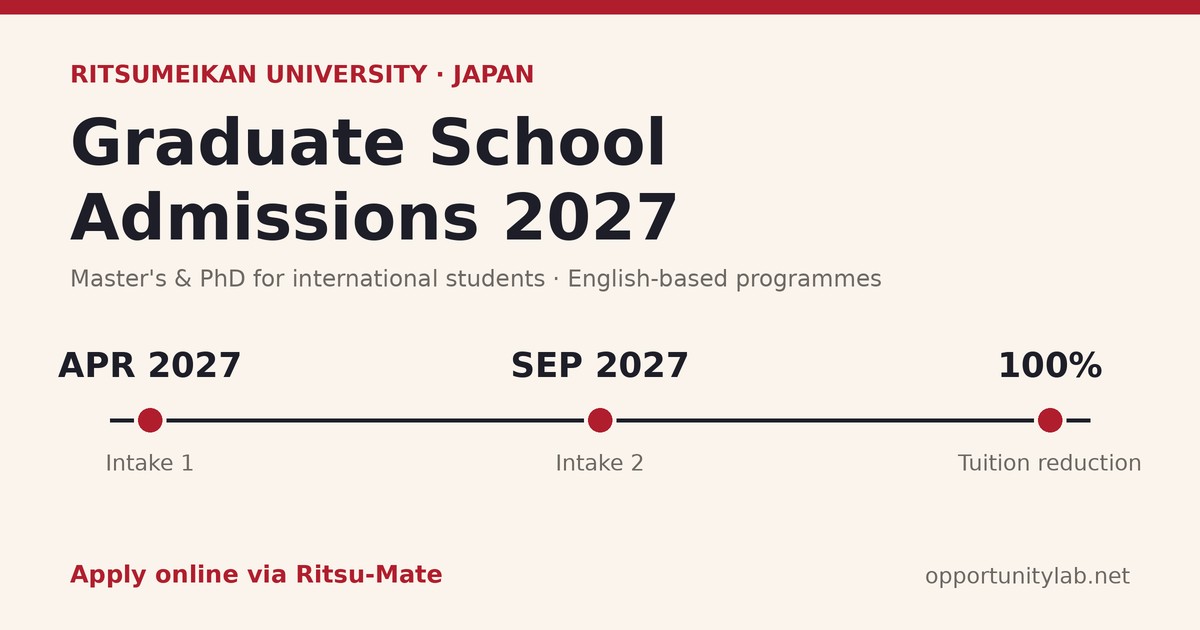
Ritsumeikan University, one of Japan’s best-known private universities, has published its graduate school application guidelines for 2027 entry. International students, including applicants from Africa, can apply for master’s and doctoral programmes starting in April 2027 or September 2027. Seven graduate schools offer English-based programmes, so you can earn a degree without speaking Japanese.
Ritsumeikan has campuses in Kyoto, Shiga (Biwako-Kusatsu) and Osaka (Ibaraki). Self-financed international students who score highly in the entrance exam can also win a 100% tuition reduction. Note that Ritsumeikan says this scheme may change from the 2027 academic year.
At a Glance
| University | Ritsumeikan University, Japan |
| Level | Master’s and doctoral programmes |
| Intakes | April 2027 and September 2027 |
| Language | English-based programmes in 7 graduate schools; other programmes are taught in Japanese |
| Open to | International applicants of any nationality, including Africans |
| Funding | Possible 100% tuition reduction, MEXT University Recommendation and JICA ABE Initiative routes, and other scholarships after enrolment |
| Application system | Online, through Ritsu-Mate |
Graduate Schools with English-Based Programmes
The following graduate schools let you earn a degree by taking credits in English. All of them accept September 2027 entry:
- Graduate School of International Relations (Kyoto, Kinugasa Campus)
- Graduate School of Economics (Shiga, Biwako-Kusatsu Campus)
- Graduate School of Science and Engineering (Shiga, Biwako-Kusatsu Campus)
- Graduate School of Life Sciences (Shiga, Biwako-Kusatsu Campus)
- Graduate School of Policy Science (Osaka, Ibaraki Campus)
- Graduate School of Information Science and Engineering (Osaka, Ibaraki Campus)
- Graduate School of Technology Management (Osaka, Ibaraki Campus)
April 2027 guidelines have also been released for International Relations, Policy Science, Information Science and Engineering, Technology Management and Pharmacy. Not every major takes September entrants, so check the guideline for your chosen programme.
Key Dates: An Example Timeline
Each graduate school sets its own dates. As an example, here is the 2027 timeline for the Graduate School of Information Science and Engineering:
| Admission round | Entry | Application period | Exam |
|---|---|---|---|
| International Student Admissions | April 2027 | 8–22 October 2026 (closed) | 15 November 2026 |
| Overseas Partner Institution Admissions (master’s only) | September 2027 | 19 November – 3 December 2026 | Document screening |
| Regular Admissions (February) | April 2027 | 7–21 January 2027 | 9 February 2027 |
| International Student Admissions | September 2027 | 1–15 April 2027 | 22 May 2027 |
The International Student Admissions round is for applicants living outside Japan who can’t travel to the university for the exam. For most Africans, this is the route to use. For other graduate schools, check the dates in that school’s 2027 guideline. All times are Japan Standard Time (JST), which is 6–8 hours ahead of most African countries.
Benefits
- Study in English at a leading Japanese university, without needing to know Japanese.
- Tuition Reduction (Graduate Students Category I): a 100% tuition reduction for the standard length of your programme. It’s awarded to self-financed international students with excellent entrance exam results. You don’t apply separately; winners are told when they receive their exam results. You must be self-financed and hold a Student visa. Ritsumeikan says the scheme for 2027 and beyond has not yet been decided and may be revised or partly discontinued.
- MEXT University Recommendation Scholarship (English-based programmes only): a Japanese government scholarship route for some schools, including Information Science and Engineering.
- JICA ABE Initiative (English-based programmes only): a JICA scholarship route for selected schools. ABE Initiative participants come mainly from African countries, so it’s worth asking JICA’s office in your country about it.
- Other scholarships after you enrol, including the Monbukagakusho Honors Scholarship and awards from private foundations that the university recommends students for.
- Graduate Student Career Path Support Center: skills programmes, research grants and career support.
Eligibility
- Master’s programmes: you must have a bachelor’s degree, or have completed 16 years of schooling at an overseas institution, by the time you enrol. Some other routes exist, such as 3-year degrees in certain cases; see Section 3 of the general guidelines.
- Doctoral programmes: you need a master’s degree or equivalent.
- English-based programmes: you need proof of English proficiency. For example, Information Science and Engineering uses a “Confirmation Letter of English Proficiency” form.
- A supervisor’s approval: some schools, including Information Science and Engineering, require a prospective supervisor to approve your research plan before you apply. Find faculty on Ritsumeikan’s researchers database and contact them early.
- International Student Admissions: you must live outside Japan when you apply.
Note for many African applicants: Nigeria, Ghana and several other countries have a 12-year school system followed by a 4-year degree, giving 16 years. If your country uses a 3-year degree, read the guidelines carefully, as you may need individual preliminary screening.
Documents You Will Typically Need
- Online registration on Ritsu-Mate
- A research plan or proposal (for some schools, signed by your prospective supervisor)
- Degree certificate(s) and academic transcript(s) in English or Japanese, with official translations if they’re in another language
- An application sheet for non-Japanese applicants
- Proof of English proficiency (for English-based programmes)
- A declaration of financial resources
- Proof of paying the application fee
The exact list varies by graduate school and admission round. Some schools want documents uploaded to Ritsu-Mate, while others want them posted.
Costs
- Application fee: paid through Ritsu-Mate by credit card, PayPal or Alipay. If you can’t use these, you can pay by overseas bank transfer in Japanese yen, adding ¥2,500 for the Japanese bank’s handling fee. The fee amount is listed in each school’s guideline.
- Admission fee: ¥200,000, paid only if you are admitted and enrol.
- Tuition: set each year (around June) and listed on Ritsumeikan’s graduate tuition page.
How to Apply
- Choose your graduate school and programme from the English-based list above.
- Download the 2027 guidelines: the general guidelines for all graduate schools, plus the guideline for your school and admission round.
- Contact a prospective supervisor and get your research plan approved if your school requires it. Start at least 4–6 weeks before the application period.
- Register on Ritsu-Mate and read the Ritsu-Mate manual. Note that Ritsu-Mate is down for maintenance every Wednesday from 7:30pm to 5:30am JST.
- Pay the application fee before the deadline.
- Upload or post your documents within the application period.
- Sit the exam or interview on the scheduled date. International Student Admissions applicants are usually screened without travelling to Japan.
Official Ritsumeikan University Graduate School Application Guidelines (2027)
Ritsumeikan Graduate School Entrance Examination Information (English)
Tips for African Applicants
- Target September 2027. The April 2027 international rounds for some schools have already closed, but most September windows open around April 2027.
- Write a focused research plan. Link your topic to a professor’s work and to a real problem in your country.
- Ask about MEXT and JICA ABE early. These routes have their own timelines, often through the Japanese embassy or JICA office in your country.
- Get translations certified now. Certified translations of documents in French, Portuguese or Arabic can take weeks.
- Plan for funding. Tuition reduction is merit-based and not guaranteed, so you’ll need to show you can cover living costs for a Student visa.