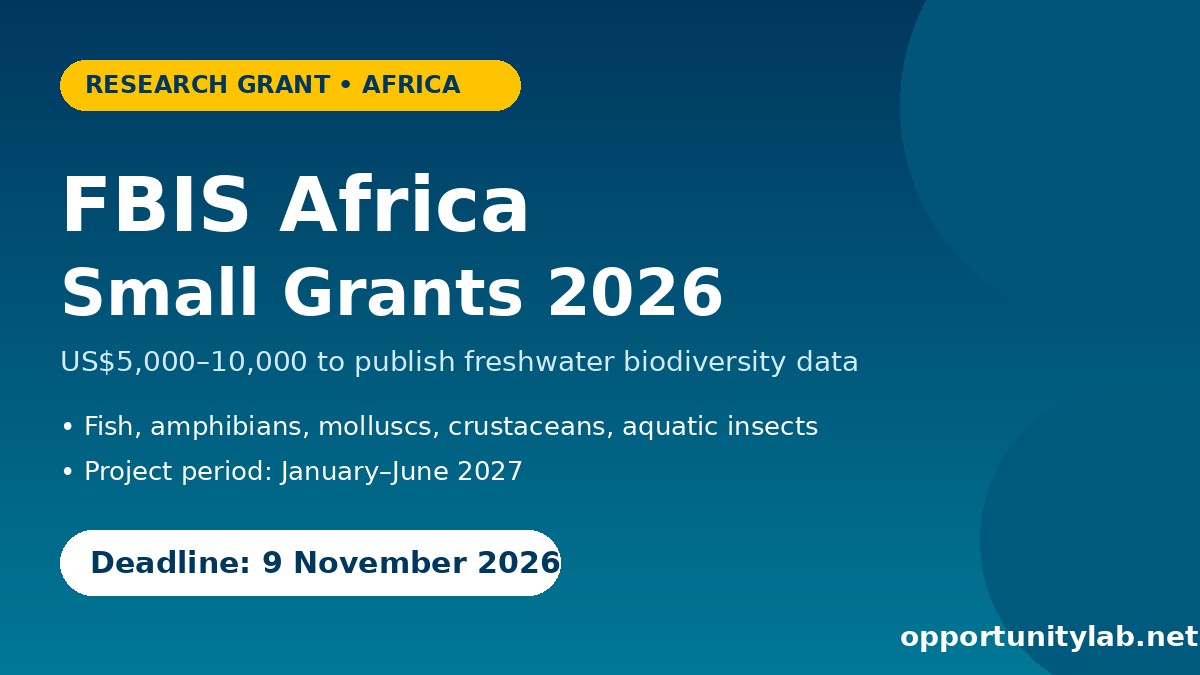
Do you or your institution hold freshwater biodiversity records from Africa sitting in notebooks, spreadsheets or museum drawers? The Freshwater Biodiversity Information System for Africa (FBIS Africa) is offering small grants of US$5,000–10,000 to clean, digitise and publish that data so researchers and conservationists can use it. Applications close on 9 November 2026.
The grants are run by the Freshwater Research Centre (South Africa) with support from the JRS Biodiversity Foundation and the Global Biodiversity Information Facility (GBIF) Biodiversity Information for Development (BID) programme. Funded projects run for six months, January to June 2027.
Quick Facts
- Grant: US$5,000–10,000
- Project period: January–June 2027
- Who: African freshwater biodiversity data holders
- Purpose: publishing existing data, not new fieldwork
- Apply: application form + project leader’s CV by email
- Deadline: 9 November 2026
Benefits: What the Grant Pays For
- collating records and digitising paper data
- cleaning and quality control
- georeferencing — adding or checking coordinates
- writing metadata
- formatting data to FBIS Africa and GBIF standards
- other reasonable costs directly linked to preparing data for publication
The FBIS Africa team also offers technical help with formatting. Published data gets your institution visibility on FBIS Africa and GBIF, the world’s largest open biodiversity database.
Not covered: new surveys or general research unrelated to publishing existing records.
Eligibility
Who can apply: universities and research institutes, museums and natural history collections, government agencies, NGOs, freshwater biodiversity programmes, and individual researchers or data custodians working through an eligible host institution.
Eligible animal groups: freshwater fishes, amphibians, molluscs, crustaceans, Odonata (dragonflies and damselflies), Ephemeroptera (mayflies), Plecoptera (stoneflies), Trichoptera (caddisflies) and Megaloptera (dobsonflies and alderflies).
Your records must:
- be freshwater biodiversity occurrence records from Africa
- not already be published on GBIF
- include at least the taxon name, sampling date and latitude/longitude for every record
- have clear ownership or custodianship and permission to publish
- be ready to mobilise between January and June 2027
Extra fields such as abundance, sampling method, photos, habitat or water-quality measurements are welcome but not required.
How Applications Are Scored
- Data quality — 30%: reliability, correct species identification, metadata, completeness and georeferencing
- Data quantity — 30%: number of unique occurrence records
- Geographic coverage and priority — 25%: filling gaps in under-represented countries, river basins and freshwater ecosystems
- Capacity to deliver — 15%: experience and ability to finish within six months
Bonus consideration goes to historical or irreplaceable datasets, threatened or endemic species, conservation-priority areas, regional collaboration, capacity building and value for money.
What Grantees Must Do
- state how many unpublished records they will mobilise
- sign the FBIS Africa Data Sharing Agreement
- use the official FBIS Africa Data Upload Template
- submit the dataset and metadata, and agree to publication on FBIS Africa and GBIF
- complete technical and financial reports
How to Apply
- Read the call on the official FBIS Africa small grants page.
- Download the small grant application form (Word).
- Fill in your project motivation, dataset details, number and location of records, confirmation they are not on GBIF, and your planned activities.
- Attach the project leader’s CV.
- Email both to [email protected] with the subject line “FBIS-Africa small grant application submission” before 9 November 2026.
Tips
- Count your records carefully — quantity is 30% of the score.
- Highlight data from under-studied countries or river basins; that is 25% of the score.
- Check GBIF first to make sure your records are not already published.
- Old field notebooks and museum collections can be strong candidates — historical data gets extra consideration.
- Students: apply through your supervisor or department as the host institution.
Related Opportunities
- IBCI Blue Carbon Fellowship 2026: US$60,000 for Blue Carbon Scientists
- TWAS Research Professors in LDCs 2026/2027
- SEWA Climate Grants Africa 2026
Deadline: 9 November 2026.