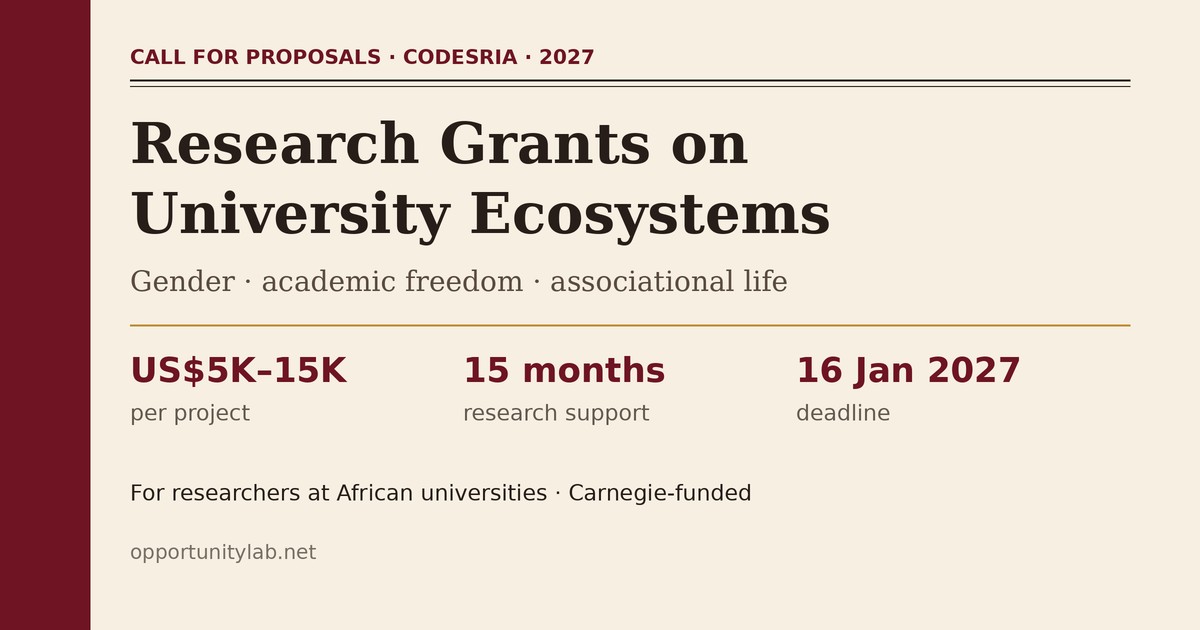
The Council for the Development of Social Science Research in Africa (CODESRIA) is inviting proposals for Research Grants on University Ecosystems, with funding from the Carnegie Foundation. Researchers at African universities and research institutions can get USD 5,000–15,000 for a 15-month study on higher education, gender, academic freedom and campus associational life in Africa.
Applications close on 16 January 2027. Individual and team proposals are both welcome, and women scholars and early-career academics are especially encouraged to apply.
At a Glance
| Organiser | CODESRIA (Dakar, Senegal) |
| Funder | Carnegie Foundation |
| Grant | USD 5,000–15,000 (based on your budget) |
| Duration | 15 months |
| Who can apply | Researchers affiliated with an African university or research institution, individually or in teams of 3–5 |
| Deadline | 16 January 2027 |
Research Themes
Proposals should address one or both of two linked themes:
1. Gender and associational life in African universities
- The gendered experiences of students, academics and staff
- Institutional culture, governance and student or staff associations, seen through a gender lens
- Barriers to women’s participation, leadership and career progression
- Gender-based violence, safety and wellbeing on campus
- Practical insights for policy reform and institutional change
2. Academic and intellectual freedom
- How threats to academic freedom happen, and at which levels of university life they’re felt most
- The links between academic freedom, gender and the civic role of universities
- How strong, independent associations protect academic freedom
Priority sub-themes
- University governance, autonomy and accountability
- Funding models and their effects on equity and quality
- Digital transitions, AI and new ways of teaching
- Research ecosystems, knowledge production and epistemic justice
- Gender, minority inclusion and social justice on campus
- Neoliberalism, globalisation and university autonomy
- Private universities and TVET institutions in Africa
- University missions, the SDGs and Agenda 2063
- Graduate outcomes in a changing labour market
- Partnerships between universities and communities, the state, industry and civil society
Benefits
- Research funding of USD 5,000–15,000
- 15 months of support for original research
- Places in knowledge-exchange workshops and peer-learning forums
- Support to publish in reputable journals and to take part in policy dialogue across Africa
- Membership of CODESRIA’s pan-African research network
What Grantees Must Deliver
- Original research on the programme’s themes
- At least one publishable manuscript, such as a journal article and a policy brief, or equivalent
- Contributions to public dialogue and policy engagement
- Regular progress reports and a final consolidated output
Eligibility
- You must be affiliated with a recognised African higher education or research institution.
- African scholars in the diaspora are encouraged to apply together with colleagues at an Africa-based institution.
- Women scholars, early-career academics, and staff at less well-resourced universities are especially encouraged.
- You can apply individually or as a team of 3–5. Interdisciplinary, inter-institutional and multi-country teams are strongly encouraged.
- Applicants with outstanding deliverables from earlier CODESRIA grants are discouraged from applying.
Documents Required
- CV of the principal investigator, plus CVs of all team members
- Proposal synopsis (max 4,000 words) including:
- a clear research question or problem statement
- a review of recent literature
- a conceptual or theoretical framework
- methodology and a work plan with timelines
- a list of planned outputs, both scholarly and non-scholarly
- Draft budget between USD 5,000 and USD 15,000
- A letter of affiliation or endorsement from your institution
How to Apply
- Choose a theme and sub-theme, and form your team if you’re applying together.
- Write your proposal (max 4,000 words) and draft budget.
- Get a signed affiliation or endorsement letter from your institution.
- Submit everything online through the CODESRIA application portal before 16 January 2027. Late applications won’t be considered.
Official CODESRIA call for proposals · CODESRIA application portal
Questions: [email protected]
Tips for a Strong Proposal
- Make gender central. CODESRIA especially favours work linking gender with academic freedom and associational life.
- Use real case studies, such as student union elections, staff union strikes, campus safety policies or women in university leadership at specific institutions.
- Show policy relevance. Explain who will use your findings, such as university councils, regulators or ministries.
- Build a cross-country team, for example Nigeria, Kenya and Senegal, to strengthen a collaborative bid.
- Keep the budget realistic and match it to your 15-month work plan.
Related Opportunities
- APDD Individual Research Fellowships 2027: Up to US$12,000 for Peacebuilding Research in Africa
- UNESCO Science for Crisis Response Research Continuity Grants for Africa 2026
- CODESRIA-ZASB Summer School in African Studies
- 26 Global Trainings, Awards and Funded Travel Opportunities Open to Africans Now