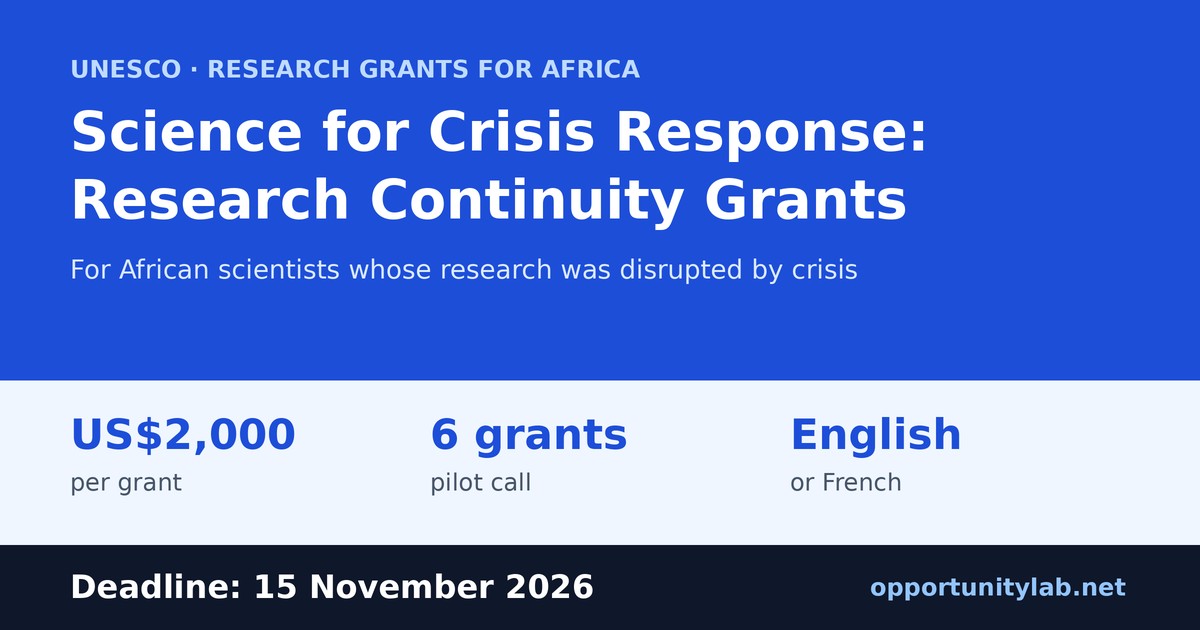
Has your scientific research in Africa been disrupted by conflict, floods, drought, disease outbreaks or another crisis? UNESCO has launched the first pilot call of its Science for Crisis Response and Solutions (SCRS) Research Continuity Grants for Africa. It offers six grants of up to US$2,000 to help African researchers restart or finish interrupted natural-science research. Applications are accepted in English or French until 15 November 2026 at 23:59 Paris time.
Grant at a Glance
- Organiser: UNESCO
- Grants: 6 institutional grants of up to US$2,000 each
- For: African researchers at African universities or research institutes
- Field: Natural sciences, or interdisciplinary work with a strong natural-science component
- Situation: Research interrupted by armed conflict or a natural or biological hazard in the past three years
- Project length: Activities completed within six months
- Languages: English or French
- Deadline: 15 November 2026, 23:59 Paris time (22:59 GMT)
What the Grant Is For
Crises often stop research halfway through. Samples are lost, fieldwork is cancelled, equipment breaks and data goes missing. These small, flexible grants help African scientists get interrupted work back on track, so valuable research isn’t abandoned.
Benefits: What You Can Spend It On
- Consumables and small research supplies
- Local fieldwork and research travel
- Data collection, processing or secure storage
- Minor equipment repair, or short-term access to equipment or facilities
- Laboratory, publication or open-access costs linked to the interrupted research
Not covered:
- salaries or personal allowances
- international relocation
- long-term living costs
- major equipment or construction
- institutional overheads
Eligibility
- You’re an African national based at a recognised university or research institute in an African country.
- You hold at least a master’s degree or equivalent research qualification in a relevant field.
- Your research is in the natural sciences, or is interdisciplinary with a substantial natural-science part.
- Your research was interrupted by armed conflict or a natural or biological hazard in the last three years, or is still affected.
- You can complete the proposed activities within six months and within US$2,000.
- Your host institution supports your application with a signed letter.
- The same costs aren’t funded elsewhere.
Especially encouraged: women scientists, researchers under 40, and researchers from least developed countries and African small island states.
Required Documents
- The completed and signed application form (English or French)
- Your CV
- Proof of your highest qualification
- A signed support letter from an authorised representative of your institution
- Any required ethics, research or fieldwork permits
- A budget, and confirmation that costs aren’t funded elsewhere
Tips for a Strong Application
- Explain the disruption clearly. Say what happened (conflict, flood, outbreak), when, and exactly how it stopped your research.
- Keep the plan small and realistic. US$2,000 over six months suits a focused step, such as replacing reagents, repeating fieldwork or recovering data.
- Itemise the budget and stick to eligible costs.
- Get your institution’s support letter early.
- Apply soon. With only six grants, competition will be strong.
How to Apply
- Read the call on UNESCO’s website.
- Prepare your documents and host-institution letter.
- Complete the online form in English or French.
- Submit by 23:59 Paris time on 15 November 2026.
Apply in English · Postuler en français