Important: this call is only for nationals of Uganda and other sub-Saharan African countries.
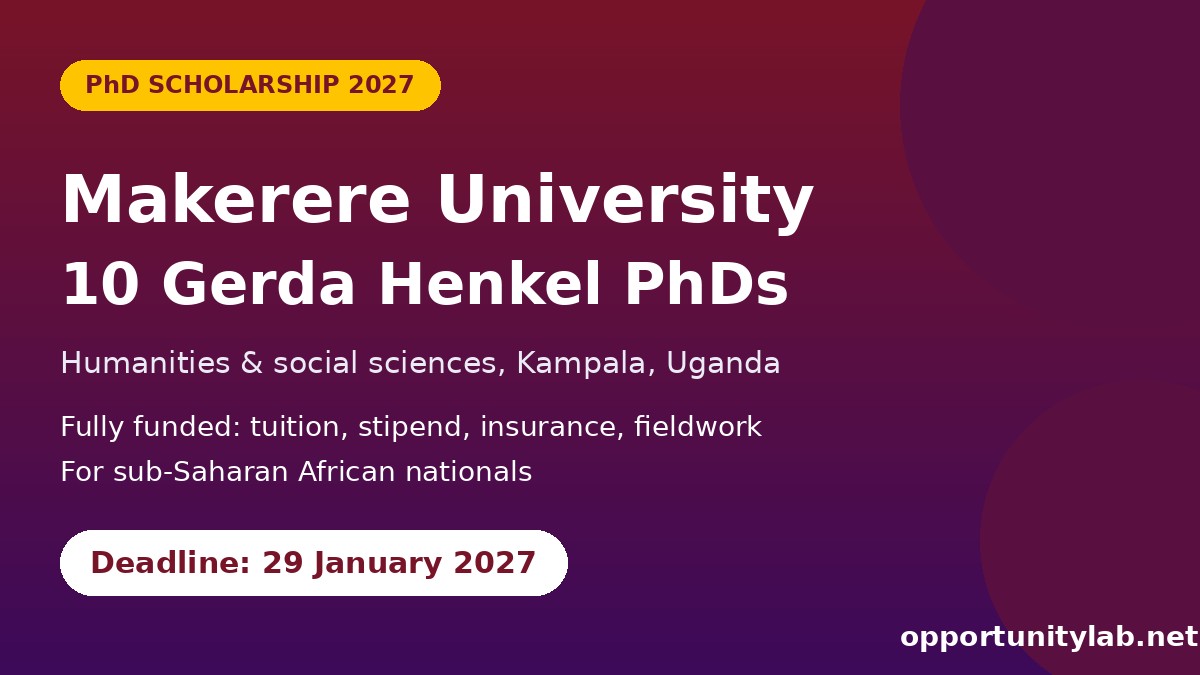
Makerere University’s College of Humanities and Social Sciences (CHUSS) in Kampala, Uganda, has opened its 2027 call for the Gerda Henkel Foundation Inter-disciplinary PhD Programme by Research. The college plans to admit 10 doctoral students whose three-year PhDs in the historical humanities and humanistic social sciences will be fully funded by the Gerda Henkel Foundation of Düsseldorf, Germany.
The funding covers tuition, a stipend, medical insurance, research and fieldwork costs and, for non-Ugandans, travel to Kampala. Candidates from Francophone and Lusophone Africa are specifically encouraged to apply, as are qualified women.
Deadline: Friday, 29 January 2027 (the call gives no time, so submit well before the end of the day in Kampala, East Africa Time).
Key Details
- Host: College of Humanities and Social Sciences, Makerere University, Kampala, Uganda
- Funder: Gerda Henkel Foundation, Germany
- Places: 10 PhD scholarships (2027 cohort)
- Level: Full-time PhD by research, three years (July 2027 to August 2030)
- Open to: Nationals of Uganda and other sub-Saharan African countries
- Age limit: under 40 (men) or under 45 (women) on 31 July 2027
- Deadline: 29 January 2027
Benefits of the Gerda Henkel PhD Scholarship
According to the official call, the scholarship pays for all costs of the PhD training, including:
- Tuition fees
- A stipend
- Medical insurance
- An ICT equipment and materials allowance paid on registration
- A books allowance
- Travel to take up the fellowship (for non-Ugandan fellows)
- A conference attendance allowance
- A fieldwork allowance
Research Fields
Preference goes to projects that study human society with attention to historical change, in fields such as:
- The Classics (literature, philosophy, epic and drama)
- Prehistory and early history of Africa
- Archaeology
- Modern African history
- Sociology and anthropology
- Language and linguistics
- Creative arts in Africa
- Religion in Africa
- Political theory
- Gender studies
Programme Timeline
- July 2027 to March 2028: proposal development
- April 2028 to April 2029: fieldwork
- May 2029 to August 2030: dissertation writing
Eligibility
- Be a national of Uganda or another sub-Saharan African country (attach your passport bio-data page or national ID)
- Hold a master’s degree in a humanities or social science discipline related to your proposed PhD (for example, an MA in Sociology for a PhD in Sociology)
- Hold an honours bachelor’s degree in a related humanities or social science field
- Be fluent in English (those with limited English will take extra intensive language lessons)
- Provide two academic reference letters from the referees named on your form
- Be available for three years of full-time study at Makerere from 31 July 2027, and show proof of study leave from your employer on admission
- Be under 40 (men) or under 45 (women) by 31 July 2027
- Attach MA and undergraduate transcripts and certificates certified by the awarding institution or national accreditation body
Research experience at a university or research institute, strong writing and research-methods skills, and the ability to work independently are desirable.
How to Apply
- Read the official 2027 call for applications (PDF) and the CHUSS announcement page.
- Download the 2027 application form (Word) and complete it.
- Save the form in MS Word as your surname underscore Application, for example Kamara_Application.
- Combine all supporting documents (passport or ID page, certified transcripts and certificates, reference letters) into one PDF.
- Email the form and the PDF to [email protected], copying [email protected], by 29 January 2027.
- For questions, contact the programme coordinator, Dr Edgar Nabutanyi ([email protected]), or the programme administrator, Dr Levis Mugumya ([email protected]).
Tips for a Strong Application
- Make sure your master’s degree matches your proposed PhD field. The call says this directly, so say clearly how your MA prepares you for the PhD.
- Get your transcripts certified early. Nigerian, Ghanaian and other West African universities can take weeks to issue certified copies.
- Pick a topic that fits the listed fields and uses historical evidence. Archives, oral histories, material culture and language data all fit well.
- Brief your two referees now so their letters arrive before the deadline, and make sure they are the same people named on your form.
- If you are employed, start the study-leave conversation with your employer early, because you will need proof of it on admission.
- Francophone and Lusophone applicants: the call encourages you to apply. Show your English ability, but know that intensive English lessons are offered if needed.