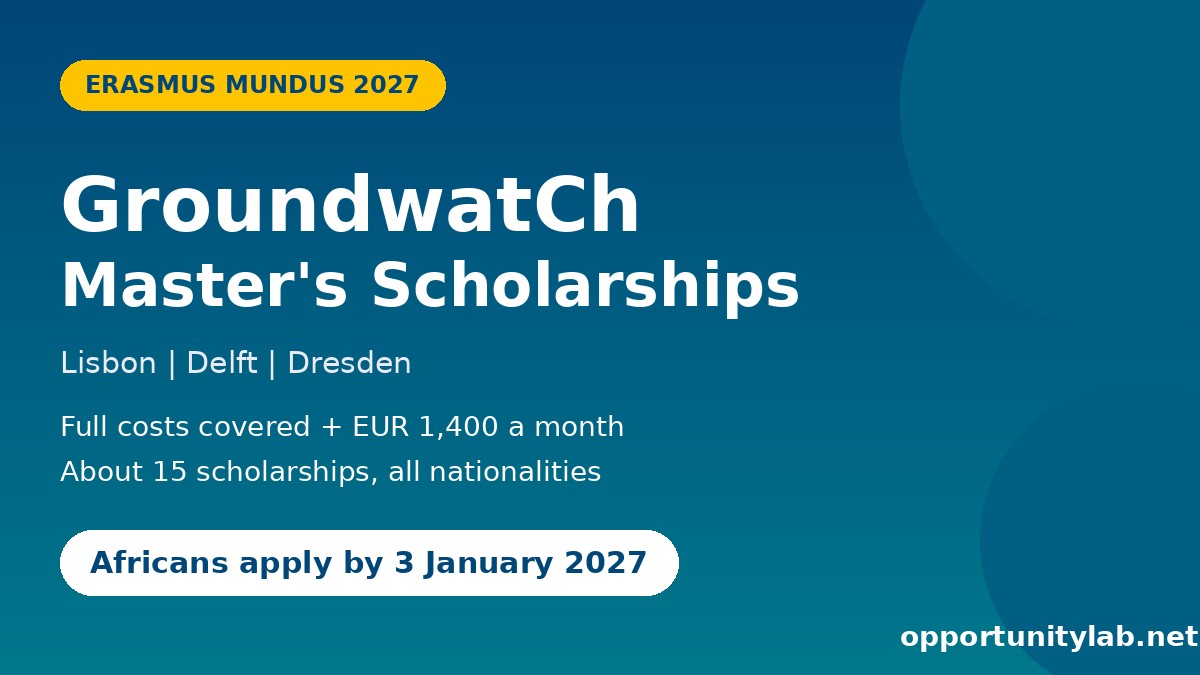
The GroundwatCh Erasmus Mundus Joint Master’s in Groundwater and Global Change – Impacts and Adaptation is accepting applications for its 2027–2029 intake. Around 15 Erasmus Mundus scholarships are on offer. Each covers all participation costs (tuition, library and laboratory costs, full insurance and other mandatory costs) plus €1,400 a month for the full two years.
Students study at Instituto Superior Técnico in Lisbon (Portugal), IHE Delft (the Netherlands) and TU Dresden (Germany), then write a research thesis. Graduates receive a joint MSc degree.
Deadline for Nigerians and other African applicants (Partner Countries): 3 January 2027, 23:59 CET (11:59pm WAT on 3 January; 12:59am CAT/SAST and 1:59am EAT on 4 January). Programme Country applicants have until 7 February 2027.
Key Details
- Programme: Erasmus Mundus Joint Master in Groundwater and Global Change – Impacts and Adaptation (GroundwatCh)
- Coordinator: IHE Delft Institute for Water Education
- Study route: Lisbon (semester 1), Delft (semester 2), Dresden (semester 3), research thesis (semester 4)
- Scholarships: about 15 for the 2027–2029 intake
- Open to: all nationalities (Africans apply under Partner Countries)
- Deadline (Partner Countries): 3 January 2027, 23:59 CET
- Results: April 2027
Benefits
- Full participation costs: tuition, library and laboratory costs, full insurance and other mandatory costs
- A monthly allowance of €1,400 for subsistence, travel and installation for the full 24 months
- Extra support for students with disabilities, within EU limits
- A joint MSc degree recognised across Europe
- Free English support at IHE, and the chance to learn Portuguese, Dutch and German
Eligibility
- A relevant bachelor’s degree. Final-year students can apply if they will graduate before 15 August 2027 (attach a university statement and current transcript)
- Proof of English that meets IHE Delft’s English requirements (citizens of some countries are exempt; graduates of English-medium universities in non-exempt countries still need a test)
- People who have already held an Erasmus Mundus Joint Master scholarship cannot apply for another
- Minimum GPA depends on your country of study, as set by IHE Delft
How to Apply
- Read the official scholarships page and how-to-apply page.
- Prepare certified copies of your degree certificate and transcripts (with a sworn English translation if needed), a CV, two recommendation letters (no older than six months) and English test results. All files must be PDFs of no more than 2 MB each.
- Draft answers to the five motivation questions (600–1,000 characters each). The programme asks applicants not to use AI tools and says it deducts points for obvious AI writing.
- Apply through the IHE Delft Erasmus application portal. When asked how you will fund your studies, select “Erasmus Mundus scholarship”. There is no separate scholarship form.
- Submit before 23:59 CET on 3 January 2027. If your English test result is not ready, you may upload it until 1 February 2027, as long as the application itself was in by 3 January.
Tips for African Applicants
- Your motivation answers are worth up to 25 of 100 points. Write them yourself and link them to real groundwater problems at home, such as borehole failure, saltwater intrusion in coastal cities, or drought in the Sahel.
- Your bachelor’s grade and your university’s national ranking together count for up to 25 points, so include your class of degree and a grading-scale explanation with your transcript.
- Get certified copies early. Notaries, your university or local government offices can certify them.
- Ask referees who know your academic or field work well. Letters must show contact details and be less than six months old.
- Apply well before 3 January, since holiday-season internet and power problems can derail last-minute uploads.