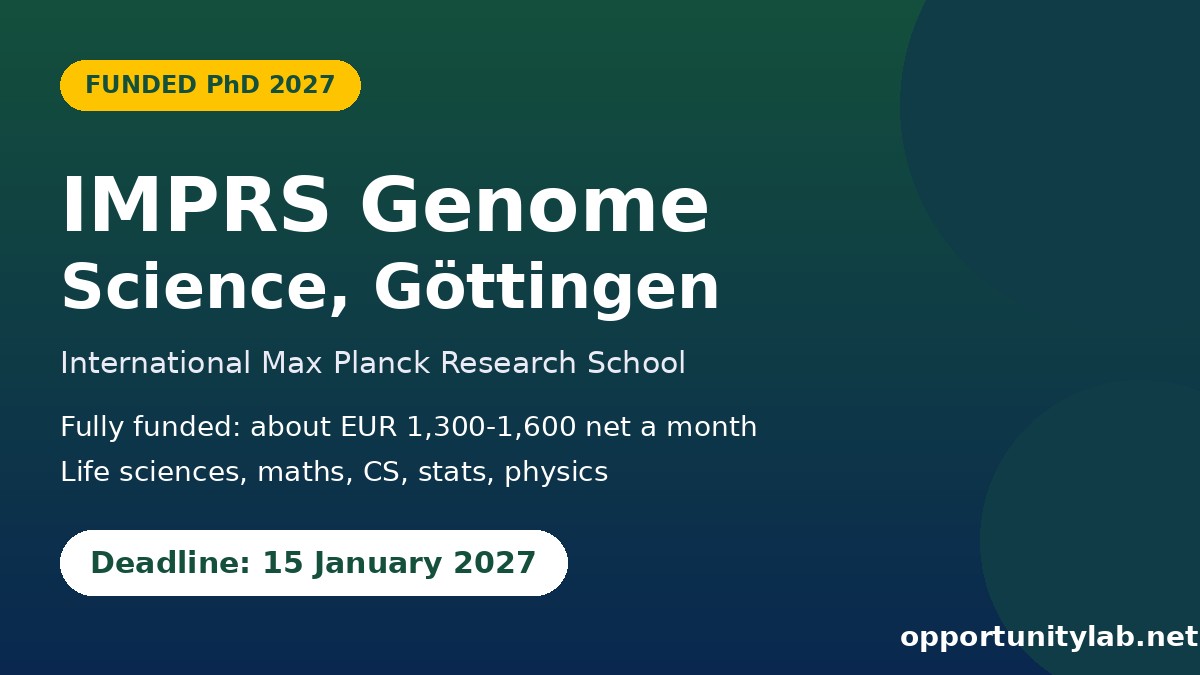
The International Max Planck Research School for Genome Science (IMPRS-GS) in Göttingen, Germany, is recruiting PhD students for 2027. The programme is run with the University of Göttingen and its partners, and all positions are fully funded, typically through an employment contract paying a net salary of about €1,300–1,600 a month. No nationality restriction is stated, and English is the official language.
Projects sit where molecular genetics, development, evolution and bioinformatics meet, so the school welcomes applicants from experimental life sciences as well as mathematics, computer science, statistics and physics.
Deadline: 15 January 2027 (no time stated; submit by the evening of 14 January to be safe). Your two referees must complete their online recommendations by 18 January 2027.
Key Details
- Programme: International Max Planck Research School for Genome Science (IMPRS-GS)
- Location: Göttingen, Germany
- Level: PhD
- Funding: all positions fully funded; net salary of about €1,300–1,600 a month
- Fields: experimental life sciences, mathematics, computer science, statistics, physics or related
- Language: English
- Deadline: 15 January 2027 (referees by 18 January)
- Start: autumn 2027 (earlier starts may be possible)
Benefits
- A fully funded PhD position, usually as an employment contract with the host research group
- A net monthly salary of about €1,300–1,600
- Interdisciplinary research in genetics, development, evolution and bioinformatics within the Max Planck and Göttingen research community
- Training in an English-speaking international doctoral school
Selection Timeline
- Late January to mid-February 2027: online interviews with potential supervisors
- End of February 2027: shortlisted candidates invited to Göttingen (apply for a visa straight away)
- 6–8 April 2027: final selection at recruitment days in Göttingen
- Autumn 2027: PhD projects begin
The official page does not say whether travel to the recruitment days is reimbursed. Ask the IMPRS office ([email protected]) if you are shortlisted.
Eligibility
- A master’s degree or equivalent in experimental life sciences, mathematics, computer science, statistics, physics or a closely related field
- Students expected to finish their master’s before October 2027 can apply
- Proof of English proficiency (for example language of instruction, native speaker status or a test certificate, if available)
- Selection is based on academic excellence, research experience, motivation, communication skills, English, and creative, cross-disciplinary thinking
How to Apply
- Read the official IMPRS-GS admission page and browse the list of supervisors and projects.
- Register on the IMPRS-GS online application tool and enter your addresses, education, language skills, honours and scientific motivation.
- Choose up to five IMPRS-GS faculty members as potential supervisors.
- Upload your documents, including transcripts, degree certificates and English proof, as PDF files.
- Give the contact details of two referees. They will receive an online questionnaire and must answer by 18 January 2027 (ask them to check their spam folders).
- Submit by 15 January 2027. Only applications through the online tool are accepted.
Tips for African Applicants
- Choose your five supervisors carefully and explain in your motivation why each lab’s research fits your background.
- Highlight hands-on research: your master’s thesis, lab techniques (PCR, sequencing, CRISPR) or computational skills (Python, R, genome analysis).
- Warn your referees early. They have only three days after the deadline, and late references can weaken your application.
- Start your German visa preparations as soon as you are invited for interview. Appointments in Lagos, Abuja, Accra and Nairobi can take weeks.
- Bioinformatics, statistics and computer science graduates are welcome, which is a good route for strong quantitative students from African universities.