Important: only PhD holders at an Austrian Africa-UniNet member institution can submit and lead a project. African researchers take part as partners, and their university or research institute must be an active Africa-UniNet member that has paid its 2026 membership fee. Master’s students cannot take part.
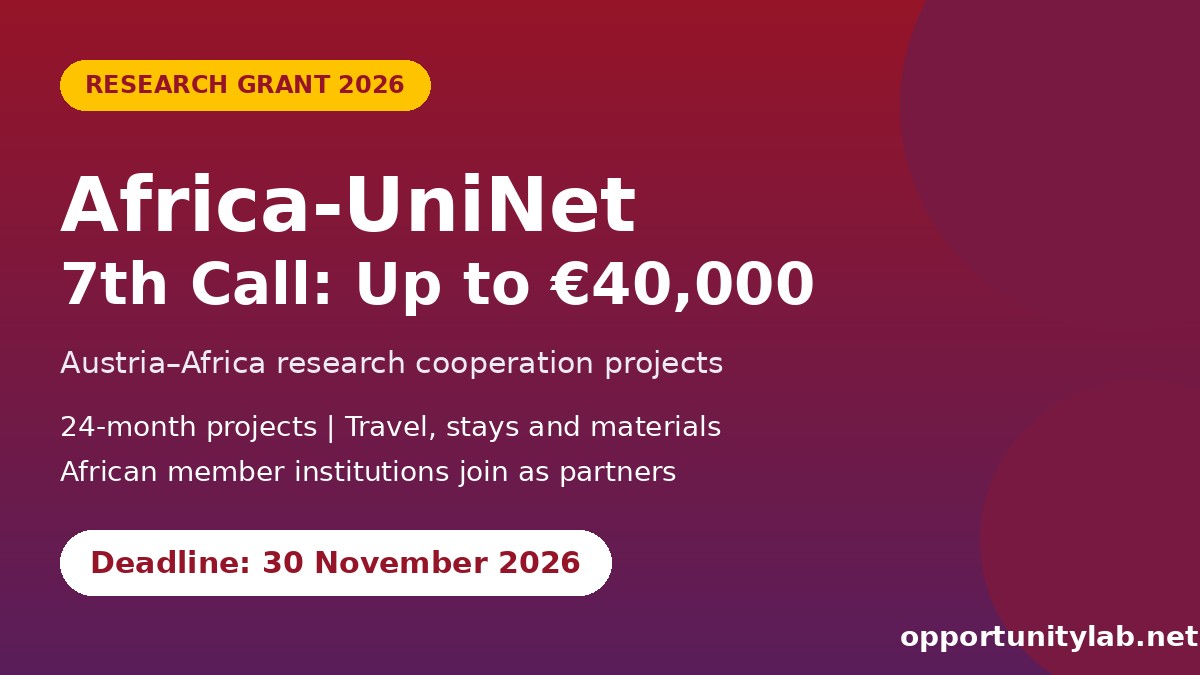
Africa-UniNet, the Austria–Africa research network run by Austria’s Agency for Education and Internationalisation (OeAD) with funding from the Austrian science ministry, has opened its 7th Call for Research Cooperation Projects. Each joint Austrian–African project can receive up to €40,000 over 24 months, mainly for research visits between Africa and Austria and for research materials.
Deadline: 30 November 2026, 13:00 CET (13:00 WAT, 14:00 CAT/SAST, 15:00 EAT). Researchers still looking for a partner can post an idea on the matchmaking page until 20 November 2026.
Key Details
- Programme: Africa-UniNet 7th Call (2026)
- Implemented by: OeAD, for Austria’s Federal Ministry of Women, Science and Research (BMFWF)
- Grant: up to €40,000 per project
- Duration: fixed at 24 months
- Themes: open; projects must contribute to the Sustainable Development Goals
- Consortium: at least one Austrian and one African member institution
- Call period: 1 September – 30 November 2026, 13:00 CET
- Review and selection: December 2026 – May 2027
- Portal: StipOnline
Funding Benefits
- Travel from Africa to Austria: up to €2,000 per person per return trip (economy flights and airport transfers).
- Stay allowance: up to €180 a day, capped at €2,160 a month, for up to three months per person per stay (maximum €6,480 per stay).
- The same travel and allowance rules apply for Austrian researchers visiting the African partner.
- Materials: up to €5,000 for the whole project for consumables such as test kits, chemicals, research permits, data, field vehicle hire and publication costs.
- Joint publications and long-term Austria–Africa research partnerships.
The grant does not pay for staff, honoraria, laptops, internet, overheads, visas, travel insurance or vaccinations, and it does not cover travel within or between African countries. Institutions must also show their own contribution in the financing plan.
Eligibility
- The project coordinator must hold a PhD and work at an Austrian Africa-UniNet member institution.
- At least one African member institution must be a partner; all participating institutions must have paid the 2026 membership fee.
- All participating researchers must be PhD students or PhD holders.
- Only one application per project coordinator.
- Research must be new; it can build on earlier Africa-UniNet projects only with fundamentally new questions or methods. Revised versions of previously rejected proposals are allowed.
- Applications must be in English.
How to Apply
- Check that your African institution is an active Africa-UniNet member (ask your international office or the official call page).
- Find an Austrian partner. Browse the matchmaking page or send your idea (working title, contacts and short abstract) to [email protected] by 20 November 2026.
- Read the 7th Call guidelines (PDF) and use the official templates for the proposal (maximum 12,000 words), financing plan, coordinator CV and letters of endorsement.
- The Austrian coordinator enters the project data and uploads all documents on the StipOnline application portal.
- Submit before 13:00 CET on 30 November 2026.
Tips
- Move quickly: the matchmaking deadline is 20 November, and letters of endorsement from every institution take time to sign.
- Do not forget the own-funds line in the financing plan; applications without it are rejected as incomplete.
- Show clear SDG links and plans for joint publications, as these are key results the network tracks.
- Use the African partner’s strengths, such as field sites, local data or community access, to make the partnership equal.
- Nigerian, Kenyan, Ethiopian and Tanzanian researchers have already posted ideas on the matchmaking page; reading them shows the kind of projects that attract Austrian partners.