Important: this is a joint grant for pairs of researchers. You must apply together with a partner employed at the University of Cambridge, and both of you should be at postdoctoral level or above and formally employed by your institutions. Students cannot apply on their own.
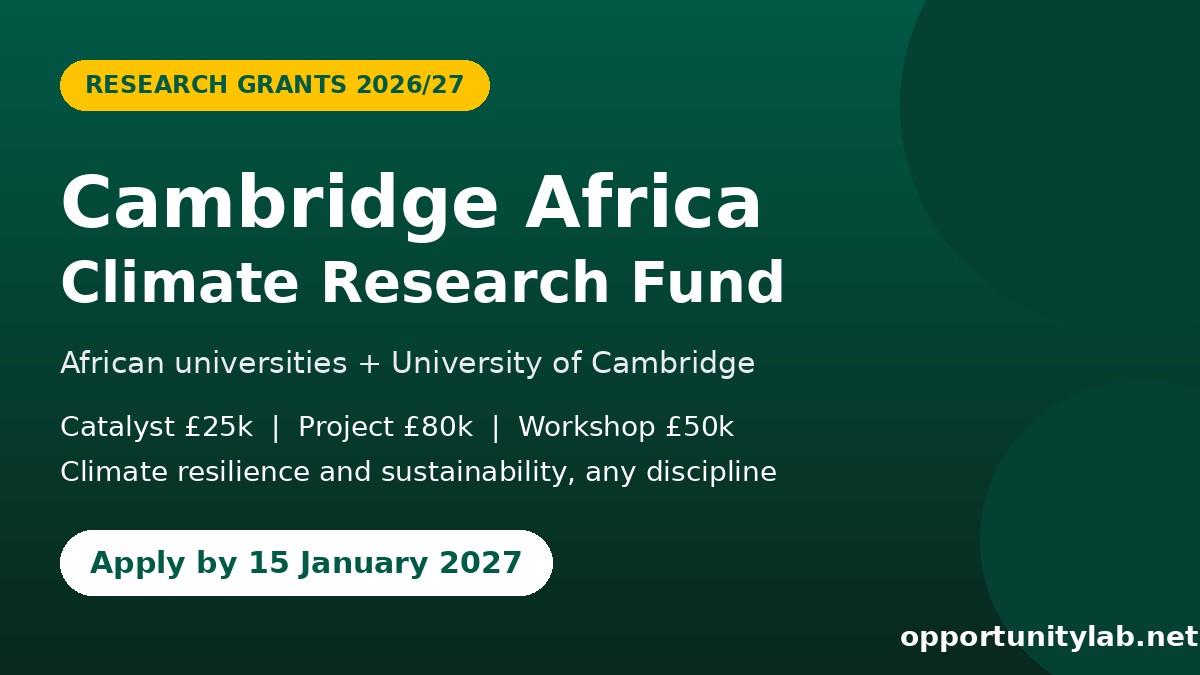
The Cambridge Africa Climate Collaborative Research Fund, backed by a £7.7 million investment from the Mastercard Foundation, has opened its third round (2026/27). It funds partnerships between researchers at African universities and the University of Cambridge working on climate resilience and sustainability, in any discipline. Awards are worth up to £25,000 (Research Catalyst), £80,000 (Research Project) or £50,000 (Workshop).
Deadline: 15 January 2027 (no time stated; applications can be submitted at any time before then).
Key Details
- Funder: Mastercard Foundation, through Cambridge-Africa at the University of Cambridge
- Part of: the Africa Climate Collaborative (Cambridge, University of Cape Town, University of Ghana, Makerere University, the Association of African Universities and the Mastercard Foundation)
- Theme: climate resilience and sustainability, broadly interpreted
- Disciplines: all, including sciences, social sciences, humanities and arts
- Track record: 52 awards in two rounds, involving partners in 19 African countries
- Applications opened: 15 October 2026
- Deadline: 15 January 2027; outcomes in March 2027
Benefits: Grant Types and Amounts
- Research Catalyst Grant – up to £25,000 for about 12 months: seed funding to start or expand a partnership. Equipment can be bought, but it must stay with the African institution.
- Research Project Grant – up to £80,000 for up to 18 months: for larger projects by teams with a proven prior collaboration; must include an internship for a young graduate, ideally a Mastercard Foundation Scholar.
- Workshop Grant – up to £50,000 for about 12 months: skills workshops held in Africa, with a focus on early-career researchers.
The fund does not pay investigators’ salaries, overheads, indirect costs or grant administration costs. Proposals that involve or benefit young Africans under 35 get priority.
Eligibility
- One applicant from a university (or research institution of similar standing) in Africa and one from the University of Cambridge
- Both at postdoctoral level or above (contact the fund in advance if one partner does not have a PhD)
- Both formally employed by their institutions and expected to remain employed after the grant ends
- Support from both Heads of Department, shown by letters or institutional emails
- Genuine collaboration: the grant cannot be used to buy services from one partner
- Research Project Grants need evidence of a successful earlier collaboration (for example, a past Catalyst or ALBORADA grant)
How to Apply
- Find a Cambridge partner. If you don’t have one yet, add your profile to the Cambridge-Africa researchers’ database and contact Cambridge academics in your field.
- Read the 2026/27 Guidance for Applicants (PDF) and the fund page.
- The Cambridge applicant registers first on the 2026 call page and invites the African partner to complete the shared online form.
- Prepare a case for support, an itemised budget (template provided), a lay summary, two-page CVs for both applicants, letters of support from both departments, and two independent referees.
- Submit before 15 January 2027. Questions go to [email protected].
Tips for African Researchers
- Start contacting Cambridge academics now; partners need weeks to agree a project and get departmental sign-off before the holidays.
- Show a fair, two-way partnership: explain what each side brings and how decisions and budget will be shared.
- Include early-career researchers or students under 35 from your institution in the team, since this is a priority.
- Ask your bursary or research office early about due diligence; successful African institutions must pass financial checks before funds arrive.
- Plan a start date no earlier than 1 June 2027, as the fund recommends.