
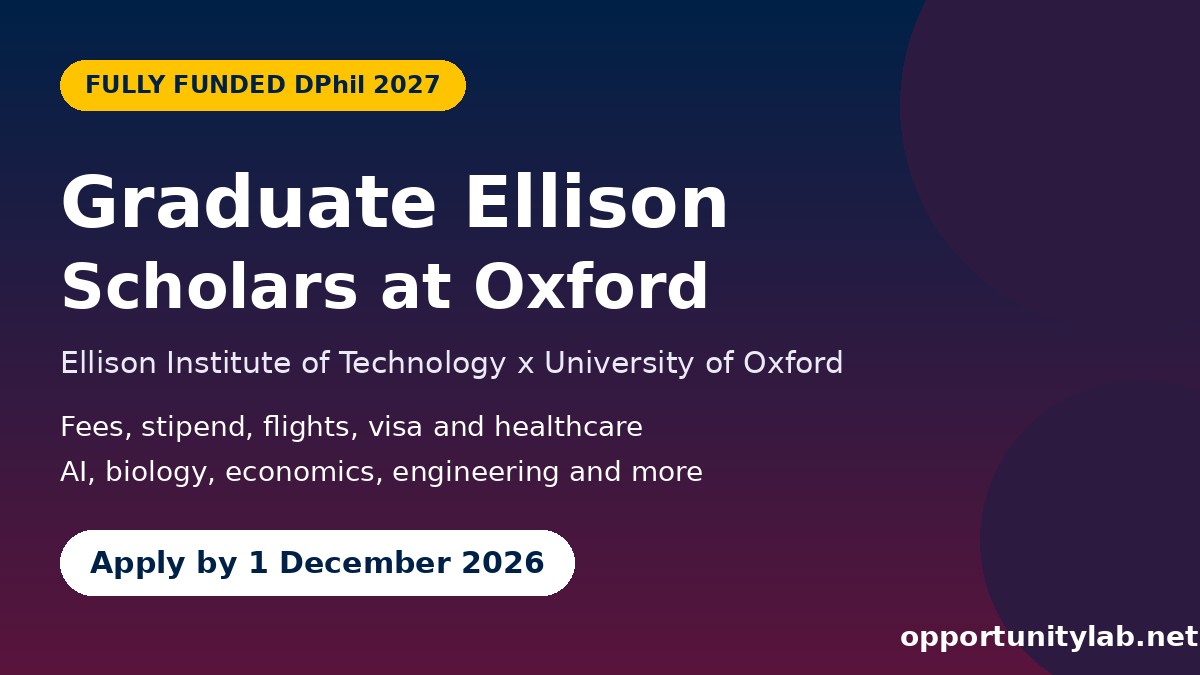




The Ellison Institute of Technology (EIT) in Oxford is accepting applications for the Graduate Ellison Scholars programme for October 2027 entry. Scholars complete a fully funded DPhil (PhD) at the University of Oxford while working on a real EIT research project. Funding covers course fees, a living stipend, flights, visa and healthcare costs on arrival, travel and conferences, and a personal technology setup.
EIT does not publish a nationality restriction; applicants must meet Oxford’s entry requirements, so strong candidates from Nigeria and the rest of Africa can apply.
Deadline: Tuesday, 1 December 2026. EIT does not state a cut-off time on its news page, so submit by the morning of 1 December (UK time in December is GMT: 1 hour behind WAT, 2 hours behind CAT/SAST and 3 hours behind EAT).
Key Details
- Funder: Ellison Institute of Technology, founded by Larry Ellison
- Host university: University of Oxford, UK
- Level: DPhil (PhD), October 2027 entry
- Fields: computer science, AI, economics, mathematics, robotics, plant sciences, machine learning, chemistry, biology, engineering, medicine, microbiology and related areas
- Projects: apply for a published EIT project or, in some research areas, propose your own aligned project
- Applications opened: 16 September 2026
- Deadline: 1 December 2026
Benefits of the Graduate Ellison Scholarship
- Full tuition fees for the length of the DPhil
- A living stipend for Oxford
- Arrival costs, including flights, visa charges and access to healthcare (the UK immigration health surcharge)
- Travel and conference funding
- A personal technology setup
- Mentoring from leading researchers and access to EIT facilities and its scholar community
Which Route Applies to You
The application route depends on the research area. For DPhil projects in EIT’s Pathogen Program, Materials & Devices for Life Sciences, Plant Biology and Economics, you apply through EIT’s own process. For other areas, such as Generative Biology, AI and Robotics (through the CDT in Fundamentals of AI) and Correlates of Immunity, you apply through the relevant Oxford doctoral programme, which has its own requirements. Read your area’s page carefully first.
Eligibility
- Meet the University of Oxford’s graduate entry requirements for your course, including English language requirements
- Outstanding academic record. EIT gives examples such as a first-class degree, a distinction at master’s level or a GPA of at least 3.7/4
- Research or innovation experience that lets you contribute to the project quickly (publications, patents, major lab or field projects help)
- Clear fit with your chosen EIT project and a well-matched research proposal
- Evidence of collaboration and resilience
How to Apply
- Read the programme overview and selection criteria on the Graduate Ellison Scholars page.
- Go to the EIT graduate research areas page and choose a published DPhil project, or check whether your area accepts your own proposal.
- Follow the route for that area: either EIT’s application or the linked Oxford doctoral programme.
- Prepare your CV, transcripts, references and a research proposal tied to the project’s goals.
- Submit before 1 December 2026. Shortlisted candidates then apply to Oxford separately; admission to Oxford is an independent process. Questions can go to [email protected].
Tips
- Pick a project that matches skills you can already prove. EIT wants scholars who contribute from day one.
- Convert your grades clearly: explain your class of degree and your rank in class, since a Nigerian or Kenyan transcript may not show a GPA out of 4.
- Ask referees early; December holidays slow responses.
- Mention any publications, competitions or hackathon wins, as EIT lists these as evidence of excellence and innovation.
- Also apply to other Oxford funding routes, since the Ellison programme is highly competitive.