

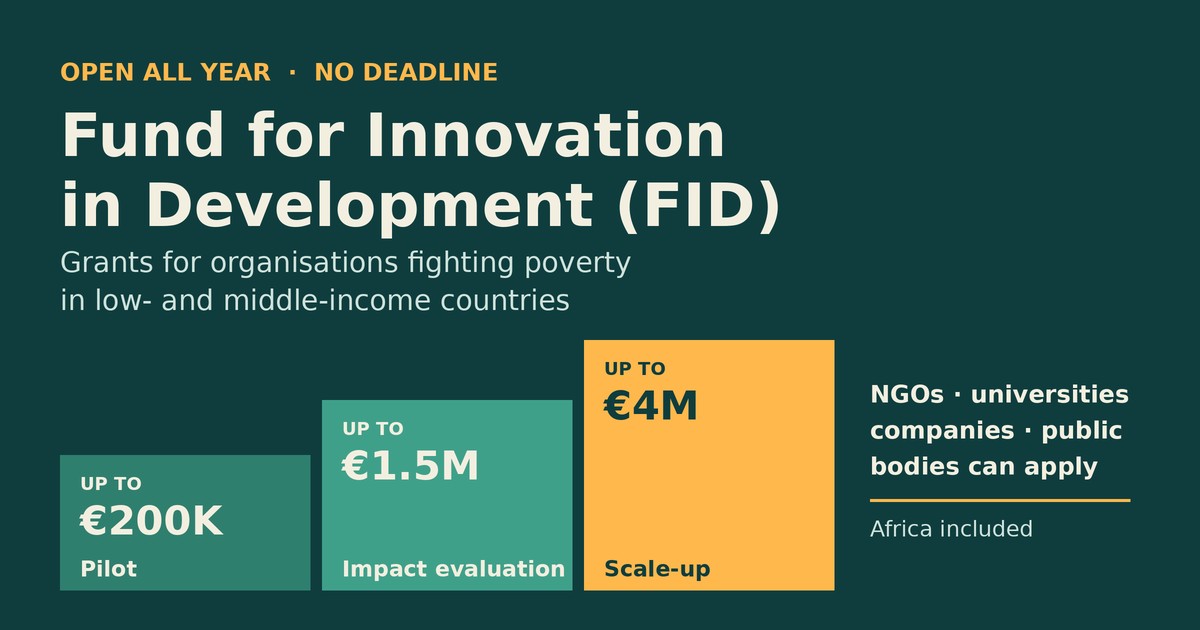
The Fund for Innovation in Development (FID) funds organisations testing new ideas to fight poverty and inequality in low- and middle-income countries, including across Africa. Grants range from up to €50,000 to prepare a pilot to up to €4 million to scale up a proven solution. FID’s call for proposals is open all year, so there’s no deadline: you can apply whenever your project is ready.
FID is based in Paris and has committed €48.5 million to 121 projects since 2021, including projects in Uganda, Ethiopia, Togo, Benin and Egypt.
Note: some listings describe this call as limited to 12 Middle Eastern and North African countries with a 24 November 2026 deadline. FID’s own website says the call is open year-round to projects in any low- or middle-income country on the OECD aid list, except Burkina Faso, Mali and Niger.
At a Glance
| Funder | Fund for Innovation in Development (FID) |
| Type | Grants for innovative development projects |
| Who can apply | Legally registered organisations: NGOs, universities, research institutes, companies, public bodies |
| Where | Projects in low- and middle-income countries (OECD DAC list), except Burkina Faso, Mali and Niger |
| Grant size | Up to €50,000 to €4 million, depending on the stage |
| Sectors | All sectors, including health, education, governance, gender equality and climate |
| Deadline | None. Applications are open all year. |
FID’s Funding Stages
| Stage | Up to | What it’s for |
|---|---|---|
| Preparation for a pilot | €50,000 | Developing a proposal for a pilot |
| Preparation for an impact evaluation | €50,000 | Developing a proposal for an impact evaluation |
| Pilot | €200,000 | Testing a prototyped solution in real-life conditions |
| Impact evaluation | €1.5 million | Rigorously measuring the impact of a piloted solution |
| Scale-up | €4 million | Expanding a solution with proven impact |
| Innovation and public policy | €500,000 | Helping a public body adopt and scale an innovation |
| Evidence and public policy | €500,000 | Helping public bodies use impact evidence in decisions |
Important: FID says the two preparation grants are currently being redesigned, with the next window planned for 2027. The other stages are open now.
Benefits
- Grant funding sized to your project’s stage, from early piloting to national scale-up
- Support to rigorously evaluate your impact, often in partnership with researchers
- A path to larger grants as your solution proves itself. Each stage is assessed separately, so later funding isn’t guaranteed.
- Reasonable indirect costs can be covered
- Visibility in FID’s global portfolio of evidence-based innovations
Eligibility
- You must be a legally constituted organisation, such as an NGO, social enterprise, company, university, research institute or government body. You can apply alone or as a consortium.
- Individuals can’t apply, and nor can international or multilateral bodies such as UN agencies.
- Your project must be implemented in a country eligible for official development assistance (OECD DAC list). Burkina Faso, Mali and Niger are excluded.
- Your organisation can be registered anywhere, but preparation grants are only for organisations registered in aid-eligible countries.
- FID doesn’t fund emergency humanitarian aid or infrastructure projects on their own.
How FID Judges Applications
- Potential impact on people living in poverty, backed by a clear theory of change and evidence
- Cost-effectiveness compared with existing alternatives
- Potential to scale and be financially sustainable
How to Apply
- Read FID’s Call for Projects Guide and use its decision tree to choose the right funding stage.
- Download the application form (Word) to see what’s required, and fill in the budget template (Excel). Scale-up applicants also need the research protocol template.
- Submit your proposal on FID’s online platform. You can save your work and come back to it.
- Join one of FID’s regular online Q&A sessions if you have questions. FID doesn’t review projects before they’re submitted.
Official FID call for proposals: guide, forms and submission · FID FAQ
Tips for African Organisations
- Lead with evidence. FID funds what can be proven to work, so explain how you’ll measure impact. Partnering with a local university can strengthen your proposal.
- Apply at the right stage. An early idea should go for a pilot grant, not an impact evaluation or scale-up.
- Show cost-effectiveness. Compare your cost per person reached with existing approaches.
- AI tools are allowed for drafting, according to FID, but every figure and reference must be accurate and verifiable.