



Who this is for: This programme is open only to South African citizens with a bachelor’s degree in Electrical, Electronic or Information Engineering. If you’re from another country, see the related opportunities at the end.
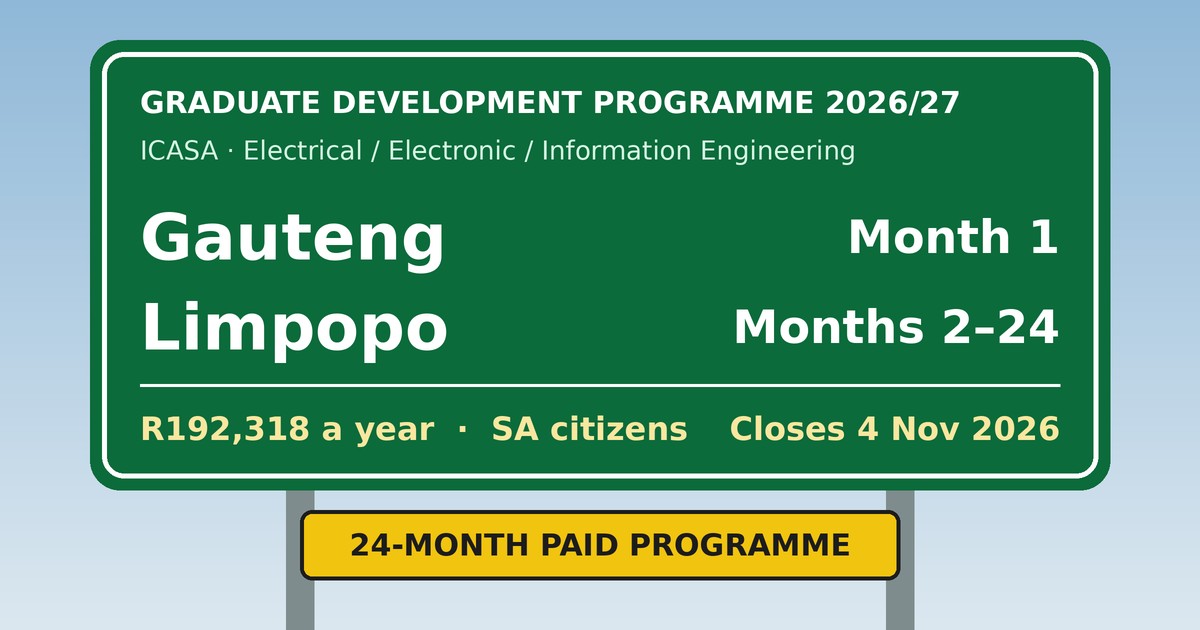
The Independent Communications Authority of South Africa (ICASA) is recruiting for its Graduate Development Programme 2026/27 in the Regions and Consumer Affairs division. It’s a 24-month, salaried programme with a total package of R192,318 a year. Graduates spend the first month in Gauteng and the remaining 23 months at ICASA’s Limpopo regional office.
Closing date: 4 November 2026. Applications must be submitted online. ICASA doesn’t accept applications by email.
At a Glance
| Employer | Independent Communications Authority of South Africa (ICASA) |
| Programme | Graduate Development Programme 2026/27, Regions and Consumer Affairs |
| Duration | 24 months, fixed term |
| Salary | R192,318 a year (total cost to company) |
| Location | Gauteng for month 1, then the Limpopo regional office for 23 months |
| Who can apply | South African citizens with an Electrical, Electronic or Information Engineering degree |
| Deadline | 4 November 2026 |
About ICASA and the Programme
ICASA is the public body that regulates South Africa’s electronic communications, broadcasting and postal sectors under the ICASA Act and the Electronic Communications Act. Its Graduate Development Programme is a two-year, intensive programme that combines practical work experience with theoretical training while you earn a salary, to build a career in the information and communications technology (ICT) industry.
Graduates are supported by coaches, their performance is reviewed throughout, and they get career guidance for their next steps.
Benefits
- A salary of R192,318 a year (total cost to company)
- Two years of structured, practical work experience at the national communications regulator
- Theoretical training alongside your work
- Guidance from coaches and ongoing performance support
- Career guidance for after the programme
Note: ICASA doesn’t pay for accommodation. You’ll need to arrange and pay for housing in Gauteng and then in Limpopo.
Eligibility
- South African citizen.
- A completed bachelor’s degree in Engineering (Electrical, Electronic or Information) from a recognised institution.
- A valid driver’s licence is an advantage.
- Foreign qualifications must be evaluated by SAQA. This is the applicant’s responsibility.
- ICASA gives preference to candidates from designated groups under its Employment Equity Plan.
Skills ICASA Is Looking For
- Organisation, administration and time management
- Computer literacy and technical expertise
- Good communication and interpersonal skills
- Attention to detail and the ability to meet deadlines under pressure
- Teamwork, self-drive and a results focus
How to Apply
- Prepare these documents. Applications without them won’t be considered:
- Curriculum vitae (CV)
- Motivational letter
- Academic records
- Evidence of significant extracurricular activities that show drive and interpersonal skills
- Go to ICASA’s careers page and select “Graduate Development Programme: Regions and Consumer Affairs – Limpopo Office”.
- Complete the online application, ideally on a laptop or desktop using Chrome or Microsoft Edge, as ICASA advises.
- Submit before 4 November 2026.
Official ICASA vacancy and application page
Enquiries only: [email protected]. Applications sent by email won’t be considered.
If you don’t hear from ICASA within three months of the closing date, treat your application as unsuccessful.
Tips
- Don’t forget the extracurricular evidence. It’s a required document. Certificates from student societies, volunteering, leadership roles or competitions all count.
- Use your motivational letter to show interest in regulation, such as spectrum, broadband access, consumer protection or broadcasting, not just engineering in general.
- Be ready to relocate to Limpopo and budget for accommodation, because ICASA doesn’t cover it.
- Get your driver’s licence documents ready if you have them. They’re an advantage for regional work.