

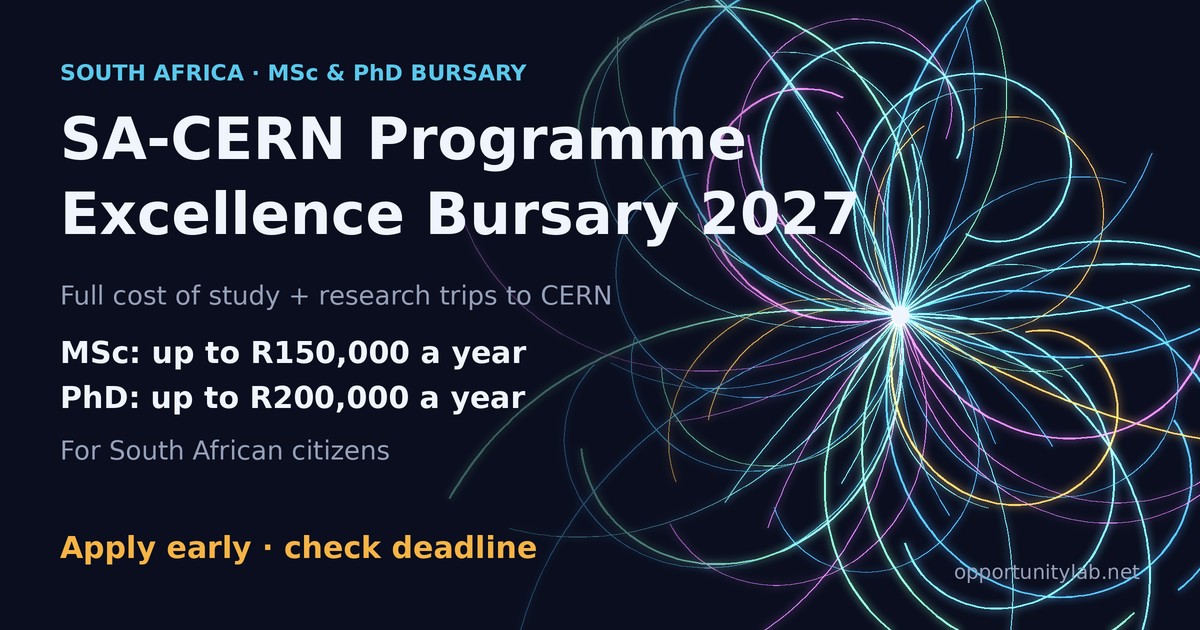
The South Africa–CERN (SA-CERN) Programme is inviting applications for its Excellence Bursary for MSc and PhD students starting in 2027. The bursary covers the full cost of study for the length of your degree, including research trips to CERN in Geneva, home of the Large Hadron Collider. It’s worth up to R150,000 a year for MSc and up to R200,000 a year for PhD students.
The bursary is funded by South Africa’s Department of Science and Innovation (DSI) and the National Research Foundation (NRF), and administered by NRF-iThemba LABS. It’s open to South African citizens only.
Deadline note: we couldn’t confirm the 2027 closing date on the official SA-CERN website. Earlier rounds closed in late December (31 December 2022 and 22 December 2023), so apply as early as possible and check the official page. The official SA-CERN website was unavailable when we checked, so the bursary amounts and requirements below come from published listings. Confirm them on the official page or with iThemba LABS before applying.
At a Glance
| Programme | SA-CERN Programme Excellence Bursary |
| Funders | DSI and NRF, administered by NRF-iThemba LABS |
| Level | MSc or PhD, full-time, starting in 2027 |
| Value | MSc: up to R150,000 a year · PhD: up to R200,000 a year |
| Who can apply | South African citizens at South African universities |
| Deadline | Not yet confirmed (past rounds closed in late December) |
Research Areas
Your project must fit one of the SA-CERN programme’s pillars:
- ALICE: heavy-ion physics and the quark–gluon plasma
- ATLAS: particle physics at the Large Hadron Collider
- ISOLDE: nuclear physics with radioactive ion beams
- THEORY: theoretical physics linked to CERN research
- Technology Transfer: applying CERN technology in industry and society
Benefits
- The full cost of study for the duration of your MSc or PhD
- Up to R150,000 a year (MSc) or R200,000 a year (PhD)
- Funded research trips to CERN in Switzerland
- Work in large international collaborations with physicists and engineers from around the world
Eligibility
- You must be a South African citizen.
- You need an aggregate of at least 65% in your previous degree.
- You must be registered full-time at a South African university from 2027.
- Your research project must fall under an SA-CERN pillar (ALICE, ATLAS, ISOLDE, THEORY or Technology Transfer).
- Your supervisor must be a member of the SA-CERN programme.
Documents Required
- A CV
- Your academic record
- A statement of purpose naming your research topic and supervisor
- A copy of your South African ID
- Three letters of recommendation
- Any publications you have
- The dissertation or research report from your previous degree
How to Apply
- Find an SA-CERN member supervisor at your university and agree on a project in one of the pillars.
- Prepare your documents, and ask your three referees early.
- Check the application instructions and deadline on the official SA-CERN bursary page (link below).
- Submit your application as early as possible.
Official SA-CERN Programme bursary page
Tips
- Talk to your supervisor first. A supervisor from the SA-CERN network is required, so ask your physics department which staff belong to SA-CERN before you choose a project.
- Make your statement specific. Name the experiment, the research question and the skills you bring, such as programming in C++ or Python, or data analysis.
- Include your honours project, even if it’s unpublished, to show your research ability.