
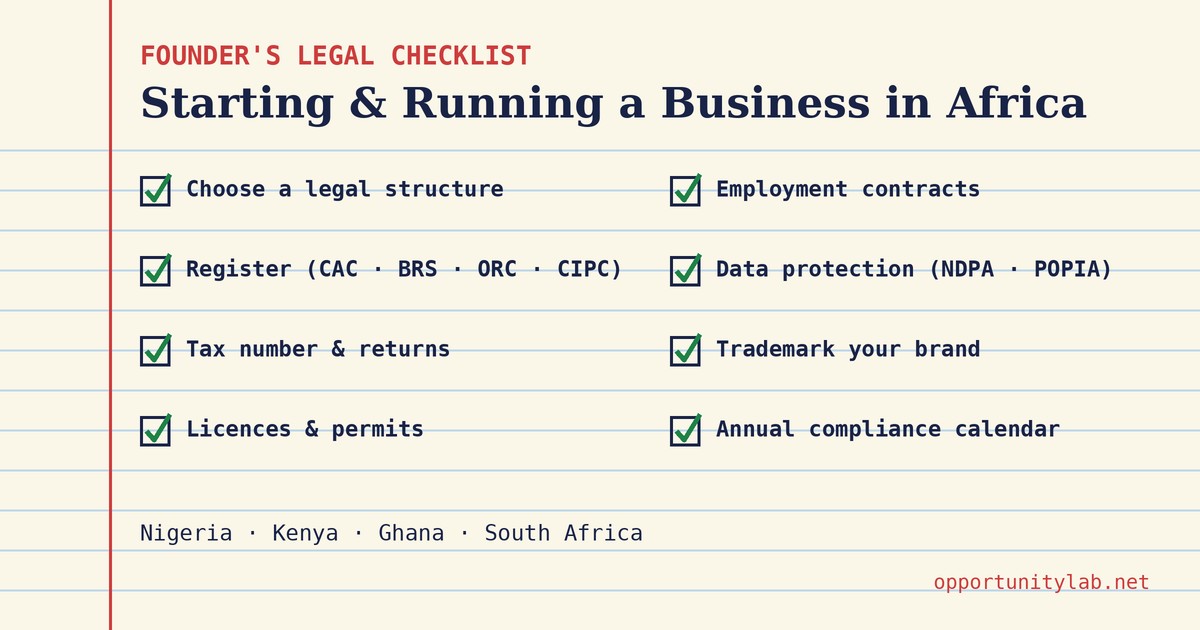





Many African founders put their energy into the product and the pitch, then discover too late that their startup isn’t properly registered, isn’t tax-compliant, or doesn’t own its own brand name. Those gaps can cost you a grant, an accelerator place or an investment, because most funders ask for registration documents and a tax number before they pay out.
This guide explains the main legal requirements for starting and running a business in Africa, with practical examples from Nigeria, Kenya, Ghana and South Africa. It’s general information, not legal advice. Rules and fees change often, so always confirm the details with the official agency or a qualified lawyer in your country.
Who This Guide Is For
- First-time founders turning an idea or side hustle into a formal business
- Startups preparing to apply for grants, accelerators, pitch competitions or investment
- Small businesses that registered years ago and aren’t sure they’re still compliant
- Founders planning to hire staff or collect customer data for the first time
Benefits of Getting the Legal Basics Right
- Access to funding: grant-makers, accelerators, banks and investors usually ask for a certificate of incorporation, a tax number and sometimes proof of good standing.
- Protection for your personal assets: a limited company keeps business debts separate from your house, car and savings.
- Ownership of your brand: a registered trademark stops others from using your name or logo.
- Fewer penalties: late annual returns, unpaid taxes and unregistered data processing can all lead to fines.
- Credibility with customers, partners and large companies that only contract with registered suppliers.
Step 1: Choose the Right Legal Structure
Most African countries offer a similar menu of options. The names differ, but the trade-offs are the same.
| Structure | Best for | Key point |
|---|---|---|
| Sole proprietorship / business name | Freelancers, small traders, testing an idea | Cheap and simple, but no separation between you and the business. You’re personally liable for its debts. |
| Partnership | Two or more people running a small business together | Partners usually share liability. Always sign a written partnership agreement. |
| Private limited company | Startups planning to grow, hire or raise investment | Separate legal entity with limited liability. This is the structure most investors and accelerators expect. |
| Non-profit (e.g. company limited by guarantee, incorporated trustees, NGO) | Social enterprises and charities funded mainly by grants | Can’t distribute profits to members. Some grants are only open to non-profits. |
Example: In Nigeria, the Companies and Allied Matters Act (CAMA) 2020 covers both business names and companies. It allows a small company to have a single shareholder and a single director, so solo founders no longer need a nominal co-founder to incorporate. The minimum issued share capital for a private company is ₦100,000.
Step 2: Register Your Business
Registration is now largely online across the continent. Start with a name search, then file the incorporation documents and pay the fees.
| Country | Registry | Where to start |
|---|---|---|
| Nigeria | Corporate Affairs Commission (CAC) | CAC Company Registration Portal at cac.gov.ng |
| Kenya | Business Registration Service (BRS) | eCitizen at brs.ecitizen.go.ke |
| Ghana | Office of the Registrar of Companies (ORC), set up under the Companies Act, 2019 (Act 992) | orc.gov.gh |
| South Africa | Companies and Intellectual Property Commission (CIPC) | cipc.co.za or the government BizPortal (bizportal.gov.za) |
In other countries, search for your national “registrar of companies” or “business registration” agency, and only use the official government website. Be wary of agents who charge far above the official fee.
Step 3: Register for Tax
- Nigeria: the federal tax authority is now the Nigeria Revenue Service (NRS), which replaced the Federal Inland Revenue Service (FIRS) on 1 January 2026. The CAC says a tax identification number is generated and printed on certificates when you register through its portal.
- Kenya: directors need a KRA PIN from the Kenya Revenue Authority (on iTax) to register a company, and the company itself needs its own PIN.
- South Africa: a company registered with CIPC is automatically registered for income tax with SARS, and the tax number appears on the registration documents. Sole proprietors and partnerships register with SARS directly. VAT registration becomes compulsory once taxable sales pass R1 million in any 12-month period.
- Ghana: for individuals, the Ghana Card PIN serves as the tax identification number. Companies still get a TIN issued by the Ghana Revenue Authority (GRA).
Registering isn’t the end. You must also file returns on time, even if you made no profit. Many founders get penalties simply for filing late.
Step 4: Get the Licences and Permits You Need
Registration lets you exist. Licences let you operate in your sector. Common examples:
- Local business permits from your city or county government (for example, Kenyan county single business permits)
- Sector licences: financial services and fintech (central banks and securities regulators), food and drugs (e.g. NAFDAC in Nigeria), telecoms, transport, health, education and energy
- Product standards certification from your national standards body
- Import and export registrations if you trade across borders
Fintech and health startups should check licensing before launch. Operating without the right licence can force you to shut down.
Step 5: Follow Employment Law When You Hire
- Give every employee a written contract covering pay, hours, leave, duties and notice periods.
- Pay at least the national minimum wage and deduct payroll taxes (PAYE) correctly.
- Register for and pay statutory contributions. Examples: pension contributions in Nigeria, NSSF and the Social Health Insurance Fund in Kenya, SSNIT in Ghana, and UIF and COIDA in South Africa.
- Know the difference between an employee and a contractor. Labelling a full-time worker a “consultant” doesn’t remove your obligations.
- Keep records of payslips, leave and contracts in case of a dispute or inspection.
Step 6: Protect Customer Data
If your business collects names, phone numbers, emails, IDs or payment details, data protection law almost certainly applies to you.
| Country | Law | Regulator | What founders should know |
|---|---|---|---|
| Nigeria | Nigeria Data Protection Act 2023 (NDPA) | Nigeria Data Protection Commission (NDPC) | “Data controllers and processors of major importance” must register. NDPC guidance includes organisations processing data of more than 200 people within six months. |
| Kenya | Data Protection Act 2019 | Office of the Data Protection Commissioner (ODPC) | Controllers and processors must register with the ODPC, with limited exemptions for very small businesses. Certificates last 24 months. |
| Ghana | Data Protection Act, 2012 (Act 843) | Data Protection Commission (DPC) | Data controllers must register. Processing personal data without registering is an offence. |
| South Africa | Protection of Personal Information Act (POPIA) | Information Regulator | Every organisation has an information officer (by default, its head), who must be registered with the Information Regulator. |
At minimum: publish a clear privacy policy, collect only the data you need, get consent where required, keep data secure, and know what to do if there’s a breach.
Step 7: Protect Your Intellectual Property
- Trademarks protect your business name, logo and slogan. Registering a company name does not automatically give you a trademark.
- Copyright protects software code, designs, content and music. It usually arises automatically, but keep proof of when you created your work.
- Patents protect new inventions. Don’t publicly disclose an invention before you seek advice on filing.
- Make sure the company owns the IP, not individual founders, freelancers or developers. Use written IP assignment clauses.
- Regional options include ARIPO (mainly English-speaking countries) and OAPI (mainly French-speaking countries), which can cover several countries through one application.
Step 8: Put Key Contracts in Writing
- Founders’ or shareholders’ agreement: equity split, vesting, roles, decision-making and what happens if a co-founder leaves
- Customer terms and conditions and a refund policy
- Supplier and service agreements
- Non-disclosure agreements (NDAs) for sensitive discussions
- Investment documents such as SAFEs, convertible notes or share subscription agreements, which should always be reviewed by a lawyer
Step 9: Stay Compliant Every Year
- File annual returns with your company registry, even if the business was quiet.
- File tax returns and remit payroll taxes and statutory contributions on time.
- Renew licences, permits and data protection registrations before they expire.
- Keep accounting records and, where required, get your accounts audited.
- Update the registry when directors, shareholders or your address change. Many countries also require beneficial ownership information.
Use a simple compliance calendar with every deadline for the year. It takes an hour to set up and can save you large penalties.
How to Get Started
- Decide on your legal structure. If you plan to raise money, a private limited company is usually the right choice.
- Do a name search and register on your country’s official registry portal.
- Get your tax number and open a business bank account in the company’s name.
- Check which licences and permits your sector needs.
- Write a privacy policy and check whether you must register with your data protection regulator.
- Sign a founders’ agreement and secure your trademark.
- Set up a compliance calendar for returns, renewals and filings.
When to Get a Lawyer
You can do much of the basic registration yourself. Get professional advice when you:
- Raise investment or issue shares
- Bring in or remove a co-founder
- Operate in a regulated sector such as fintech, health or education
- Expand into another country or set up a holding company abroad
- Face a dispute, a tax audit or a regulator’s inquiry
Many university law clinics, startup hubs and accelerators offer free or low-cost legal clinics for early-stage founders, so ask around before paying full rates.