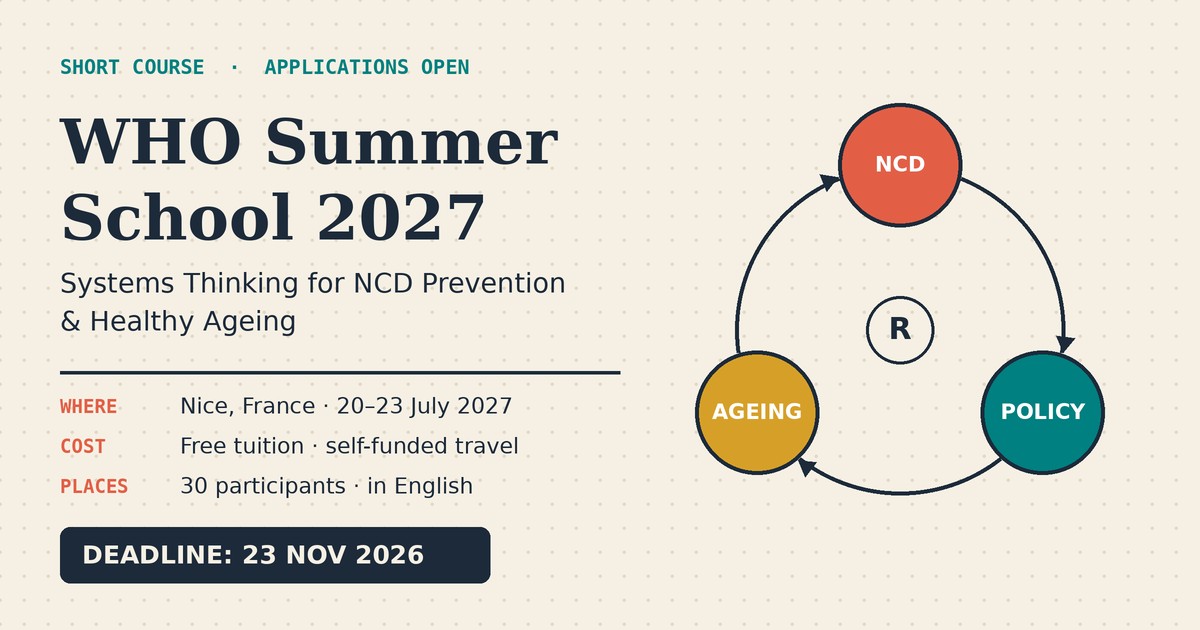
The World Health Organization (WHO) Regional Office for Europe is accepting applications for its 2027 Summer School on Systems Thinking and Innovation for the Prevention of Noncommunicable Diseases (NCDs) and a Healthy Ageing Population. It runs with the WHO Collaborating Centre at Université Côte d’Azur and Ulysseus European University, and takes place in person in Nice, France, from 20 to 23 July 2027.
The course is free of charge, but participants pay their own travel and accommodation. Only 30 places are available. The deadline is 23 November 2026.
Can Africans apply? WHO’s official call doesn’t limit applications by nationality or country of residence, and the application form has no such restriction either. However, the course content focuses on the WHO European Region, and you’ll need to fund your own trip to France, including a Schengen visa. African applicants should show how systems thinking on NCDs and ageing applies to their own work.
At a Glance
| Organisers | WHO Regional Office for Europe, Université Côte d’Azur (WHO Collaborating Centre) and Ulysseus European University |
| Dates | 20 July 2027 (9:00am) to 23 July 2027 (2:00pm) |
| Location | Nice, France (in person) |
| Places | 30 participants |
| Cost | Free tuition. Travel and accommodation are not covered. |
| Language | English |
| Deadline | 23 November 2026 |
| Results | By 18 December 2026 |
What the Summer School Covers
NCDs such as heart disease, cancer, diabetes and chronic respiratory disease cause more than 80% of deaths in the WHO European Region. The summer school teaches systems thinking: ways of understanding how health, the economy, food environments, ageing and policy interact, so that prevention strategies work in practice. The curriculum is still being finalised, but WHO says it will include:
- Systems-thinking concepts and methods for NCD prevention and control
- Identifying systems archetypes and developing policy scenarios
- Systems-thinking tools in practice
- Designing studies informed by systems thinking
- Practical training on decision-making tools
- Policy innovation in public health
- AI opportunities for public health innovation ecosystems
Teaching combines keynotes, lectures, workshops and real-life scenarios. You’ll also apply the methods to your own project. Faculty include WHO experts and international specialists in systems thinking, NCD prevention, healthy ageing and public health innovation.
Benefits
- Free tuition for the four-day course
- Lunch and coffee breaks every day, plus a welcome dinner on 21 July 2027
- Training from WHO experts and leading international faculty
- Hands-on work applying systems thinking to your own project
- A certificate of participation
- A network of researchers, practitioners and policy-makers across countries
Not covered: travel, accommodation, visas and other costs of staying in Nice.
Eligibility
- The course is designed for PhD students and early- and mid-career professionals, including researchers, postgraduate students, health practitioners and policy-makers.
- You should be interested in using systems thinking to improve evidence-based policy, multisectoral collaboration and policy implementation.
- You need good English, as the course is taught in English.
- You must be able to attend in person in Nice from 20 to 23 July 2027 and pay your own way.
Selection criteria: relevant professional experience in public health, innovation, healthy ageing, NCD prevention or NCD risk factors; your education and experience; your personal statement; and your potential for future collaboration.
How to Apply
- Read WHO/Europe’s official call (link below).
- Prepare a short personal statement explaining your work on NCDs, healthy ageing or public health, and the project you’d bring to the course.
- Complete the online application form, which has 19 questions. You can save it and return later.
- Submit by 23 November 2026. A selection panel reviews applications, and successful applicants hear by 18 December 2026.
Official WHO/Europe call for applications · Application form
Tips for African Applicants
- Bring a real project. NCDs are rising fast in Africa, so link your work, such as hypertension, diabetes or tobacco control, to the course’s systems approach.
- Plan funding early. Ask your employer, university or a research grant to cover flights and accommodation, since WHO doesn’t pay these.
- Start your Schengen visa planning as soon as you’re accepted in December. Appointments can take weeks to get.
- Show future collaboration potential. It’s a selection criterion, so mention networks, institutions or policy bodies you work with.