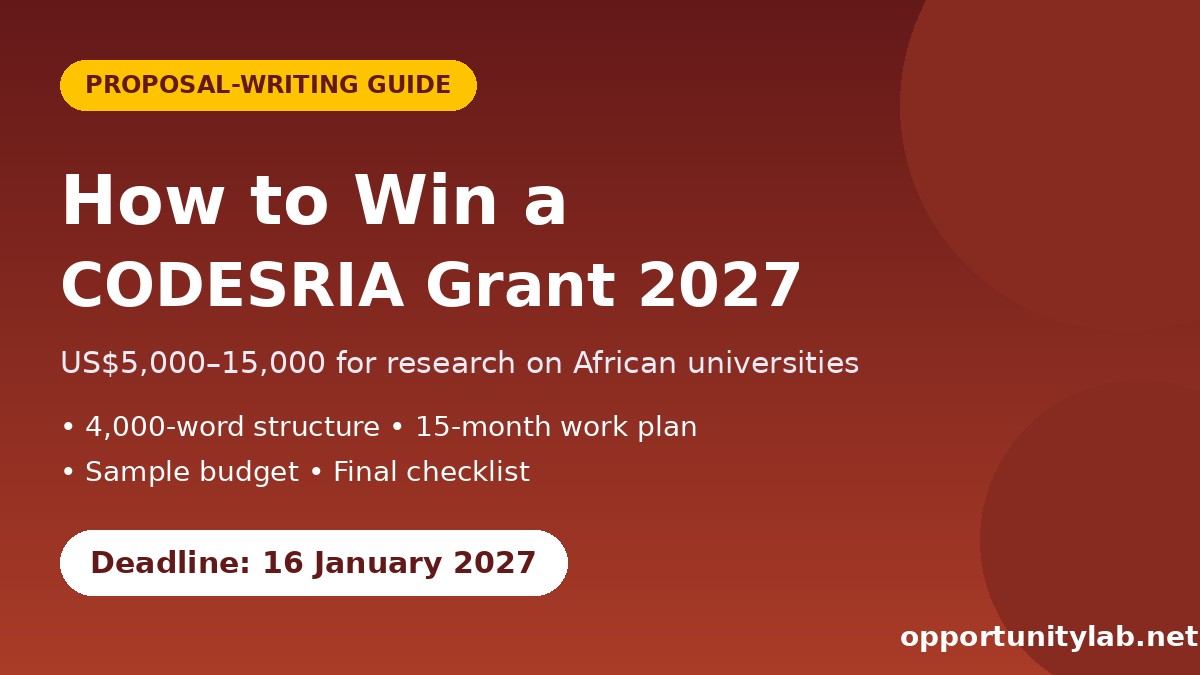
The CODESRIA Research Grants on University Ecosystems 2027 offer US$5,000–15,000 to researchers at African universities and research institutions for a 15-month study on gender, associational life and academic freedom in African higher education. The deadline is 16 January 2027.
Our main CODESRIA 2027 post covers the themes, eligibility and required documents. This guide focuses on the hardest part: writing a 4,000-word proposal and budget that reviewers will fund. The section word counts and budget below are our suggestions, not official CODESRIA rules — always follow the official call.
Step 1: Pick One Theme and One Sharp Question
CODESRIA’s two linked themes are gender and associational life in African universities and academic and intellectual freedom. Strong proposals link the two. Narrow your focus to one question you can answer in 15 months, for example:
- How do student union elections shape women’s access to campus leadership at three Nigerian federal universities?
- How did staff union strikes between 2020 and 2026 affect academic freedom at public universities in Kenya and Uganda?
- What institutional factors explain the under-representation of women professors at selected universities in Senegal and Côte d’Ivoire?
Step 2: Structure Your 4,000 Words
CODESRIA asks for a research question, literature review, theoretical framework, methodology with work plan and timelines, and planned outputs. A balanced split could be:
- Title, summary and research question — about 300 words. State the problem, the question and why it matters now.
- Background and literature review — about 900 words. Show what is known about your topic in Africa, cite recent work (including African scholars and CODESRIA publications) and name the gap.
- Conceptual or theoretical framework — about 500 words. Explain the lens you will use (for example feminist institutionalism or academic freedom frameworks) and how it shapes your analysis.
- Methodology — about 1,200 words. Sites, sample, data sources (interviews, surveys, archives, union records), ethics approval and how you will analyse the data.
- Work plan and timeline — about 400 words. A month-by-month plan over 15 months.
- Expected outputs and policy relevance — about 400 words. At least one journal article and a policy brief, plus who will use your findings (university councils, regulators, ministries, unions).
- Team — about 300 words. Who does what, and why the team is right for the job (for teams of 3–5).
Step 3: Build a Simple 15-Month Work Plan
- Months 1–2: literature update, ethics approval, finalise tools
- Months 3–7: fieldwork and data collection
- Months 8–10: data analysis
- Months 11–13: write the manuscript and policy brief; present at CODESRIA workshops
- Months 14–15: revise, submit to a journal, policy dialogue, final report
Step 4: Draft a Realistic Budget (US$5,000–15,000)
Here is an example for a three-country team requesting US$12,000. Adjust it to your project and CODESRIA’s budget template:
- fieldwork travel and accommodation — US$4,500
- research assistants and transcription — US$2,800
- participant costs and focus-group logistics — US$1,200
- data, software and communication — US$800
- validation and dissemination workshop — US$1,700
- publication, editing and policy brief design — US$1,000
Tips: tie every budget line to an activity in your work plan, avoid large equipment purchases, and don’t pad the budget — reviewers notice.
Eligibility Reminder
- affiliation with a recognised African university or research institution
- individuals or teams of 3–5; multi-country, interdisciplinary teams are encouraged
- diaspora scholars should apply with colleagues at an Africa-based institution
- women scholars, early-career academics and less-resourced universities are especially encouraged
- applicants with outstanding deliverables from earlier CODESRIA grants are discouraged
Benefits
- US$5,000–15,000 research funding
- 15 months of support
- workshops and peer learning
- publication and policy-dialogue support
- membership of CODESRIA’s pan-African network
Final Checklist Before You Submit
- proposal within 4,000 words, covering every section CODESRIA asks for
- CVs for the lead researcher and all team members
- draft budget between US$5,000 and US$15,000
- a signed institutional affiliation or endorsement letter
- proofread by a colleague; references complete
- submitted on the portal before 16 January 2027 — don’t wait for the last day
How to Apply
- Read the official CODESRIA call for proposals.
- Create an account on the CODESRIA application portal.
- Upload your proposal, CVs, budget and affiliation letter.
- Submit before 16 January 2027.
Questions: [email protected].
Related Opportunities
- CODESRIA Research Grants on University Ecosystems 2027: Full Details
- AERC Call for Proposals 2026: Up to US$10,000 for Economists
- HKU Social Sciences Global South Fellowship 2026/27
Deadline: 16 January 2027.