

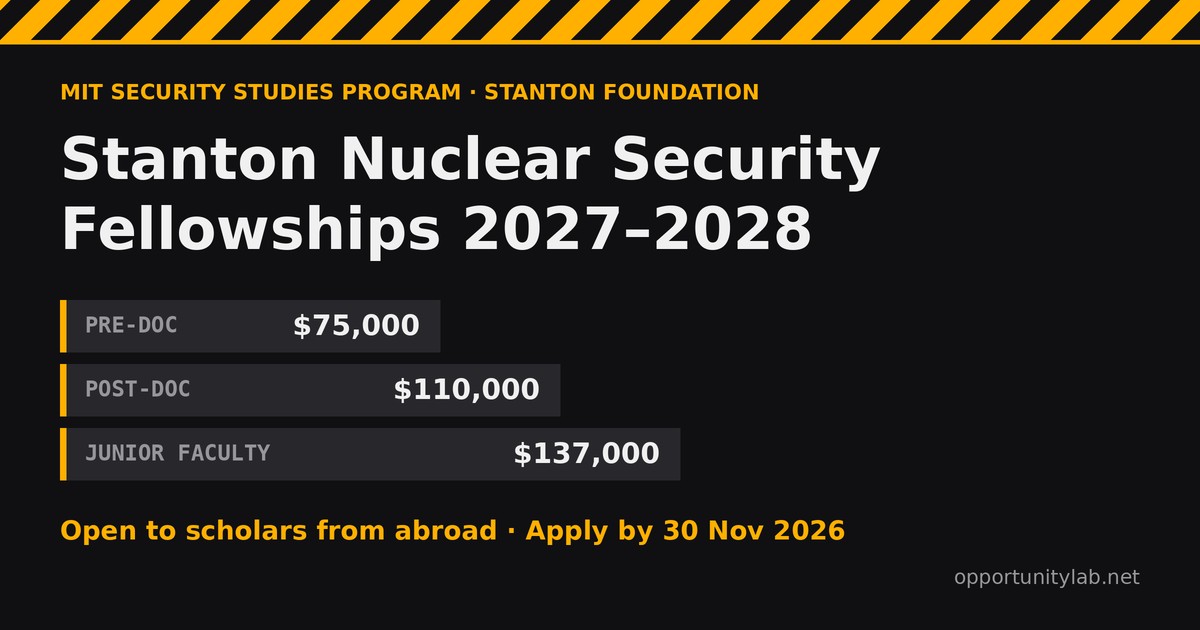
The Stanton Nuclear Security Fellowships, funded by the Stanton Foundation, support the next generation of thought leaders in nuclear security. Several US institutions host them. For the 2027–2028 year, the MIT Security Studies Program fellowship is open to scholars from anywhere in the world, including Africa. It pays stipends of up to $137,000 for ten months in residence at MIT.
Applications close on 30 November 2026.
Which Stanton fellowship can Africans apply for? The MIT fellowship accepts scholars with degrees “from the United States or abroad”. The Council on Foreign Relations (CFR) Stanton fellowship, which also closes on 30 November 2026 and pays $110,000, is only for US citizens. Other hosts set their own rules, so always check eligibility on the host’s page.
At a Glance (MIT Stanton Fellowship)
| Host | MIT Security Studies Program, Cambridge, Massachusetts |
| Funder | Stanton Foundation |
| Levels | Pre-doctoral, post-doctoral and junior faculty |
| Stipend | $75,000 (pre-doc), $110,000 (post-doc), $137,000 (junior faculty) |
| Duration | 10 months, in residence at MIT |
| Who can apply | Scholars with degrees from the US or abroad |
| Deadline | 30 November 2026 (decisions in January 2027) |
About the Fellowship
The fellowship supports policy-relevant research on nuclear security. Here, nuclear security covers nuclear war, nuclear terrorism, nuclear proliferation, nuclear weapons, nuclear force posture and nuclear energy as it relates to security. Fellows are expected to produce work such as book manuscripts, journal articles, dissertation chapters or policy reports.
Africa has a direct stake in these debates. The continent is a nuclear-weapon-free zone under the Pelindaba Treaty, South Africa is the only country ever to give up a nuclear arsenal it built itself, and several African countries are now planning nuclear power. Research from an African perspective is highly relevant.
Benefits
- A ten-month stipend:
- $75,000 for pre-doctoral fellows
- $110,000 for post-doctoral fellows
- $137,000 for junior faculty fellows
- Office space and supplies at MIT
- Access to MIT libraries and facilities
- The option to buy subsidised health and dental insurance
- Membership of one of the world’s leading security studies communities
MIT doesn’t pay other benefits, so plan for travel, visa and relocation costs.
Eligibility
- A PhD or equivalent degree (for example an MD or JD) from the US or abroad, for post-doctoral and junior faculty fellowships.
- PhD candidates must have at least three dissertation chapters completed, and their dissertation must be on nuclear security.
- Your proposed research must fit the programme’s nuclear security mission.
- You must be able to live in Cambridge, Massachusetts, for the fellowship year.
Documents to Submit
- The completed one-page application form, downloadable from MIT’s page
- A research prospectus of up to 1,500 words, explaining how it relates to nuclear security
- Your CV
- Three recommendation letters, sent directly by your referees
- A short writing sample (pre-docs submit at least three completed dissertation chapters)
- A graduate transcript (pre-docs only)
Don’t send books or long manuscripts.
How to Apply
- Download the one-page form from the MIT Security Studies Program website.
- Prepare your prospectus, CV and writing sample.
- Ask three referees to email their letters directly to [email protected].
- Email your complete application to [email protected] by 30 November 2026.
Official MIT Stanton Nuclear Security Fellows Program page
For US citizens: CFR Stanton Nuclear Security Fellowship (US citizens only)
Tips for African Applicants
- Bring an African perspective. Possible topics include the Pelindaba Treaty, South Africa’s denuclearisation, uranium mining and security in Niger or Namibia, or the risks of new civil nuclear programmes.
- Make it policy-relevant. Explain who will use your findings and how.
- Ask referees early. Letters must go directly to MIT before the deadline.
- Plan your US visa, usually a J-1 exchange visa for research scholars, as soon as you receive an offer.
