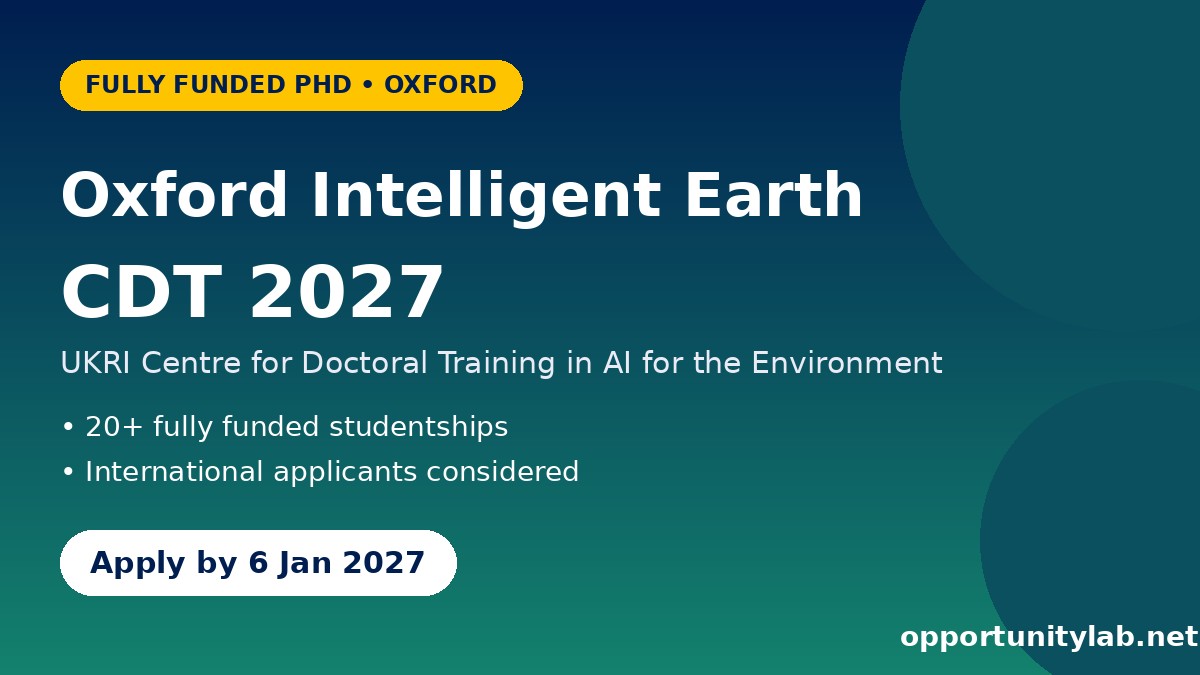


The University of Oxford is accepting applications for 2027 entry to Intelligent Earth, the UKRI Centre for Doctoral Training (CDT) in AI for the Environment. The four-year doctoral programme trains researchers to use artificial intelligence to tackle environmental and sustainability challenges. Oxford expects to offer more than 20 fully funded studentships, and international applicants can be considered.
Deadline: Wednesday 6 January 2027, 12:00 noon UK time (1:00 p.m. WAT, 2:00 p.m. CAT/SAST, 3:00 p.m. EAT).
Key Details
- University: University of Oxford
- Programme: Intelligent Earth (UKRI CDT in AI for the Environment)
- Degree: DPhil (PhD)
- Duration: 4 years full-time (part-time option available)
- Start: September 2027
- Funding: 20+ fully funded studentships (UKRI and co-funding)
- Deadline: 6 January 2027, 12:00 noon UK time
Benefits
- fully funded studentships: course fees and a living stipend for funded students
- individually tailored training in both AI and environmental science
- an interdisciplinary cohort at one of the world’s top universities
- links with UKRI, the University and partner organisations
Check the exact funding terms for international students in the “Funding and costs” section of the Oxford course page.
Eligibility
- open to UK and international applicants (international candidates may be considered for funded places)
- a strong background in a quantitative or scientific field: computer science, mathematics, statistics, physics, engineering, Earth or environmental sciences or similar
- interest in applying AI and advanced computing to environmental problems
- you don’t need to be expert in both AI and environmental science before joining
- Oxford’s English language requirements
How to Apply
- Read the Intelligent Earth How to Apply guide and the official Oxford course page.
- Prepare your CV, transcripts, statement of purpose or research proposal and references as listed by Oxford.
- Apply through Oxford’s graduate application system before 12:00 noon UK time on 6 January 2027.
- Shortlisted candidates are invited to interview.
Tips for African Applicants
- Show quantitative strength: coding, maths, data projects or modelling work.
- Link your interests to real environmental problems in Africa: drought prediction, deforestation monitoring, flood risk, crop forecasting.
- Ask referees early; the deadline falls right after the holiday season.
- Submit before the noon UK cut-off, not at midnight.
