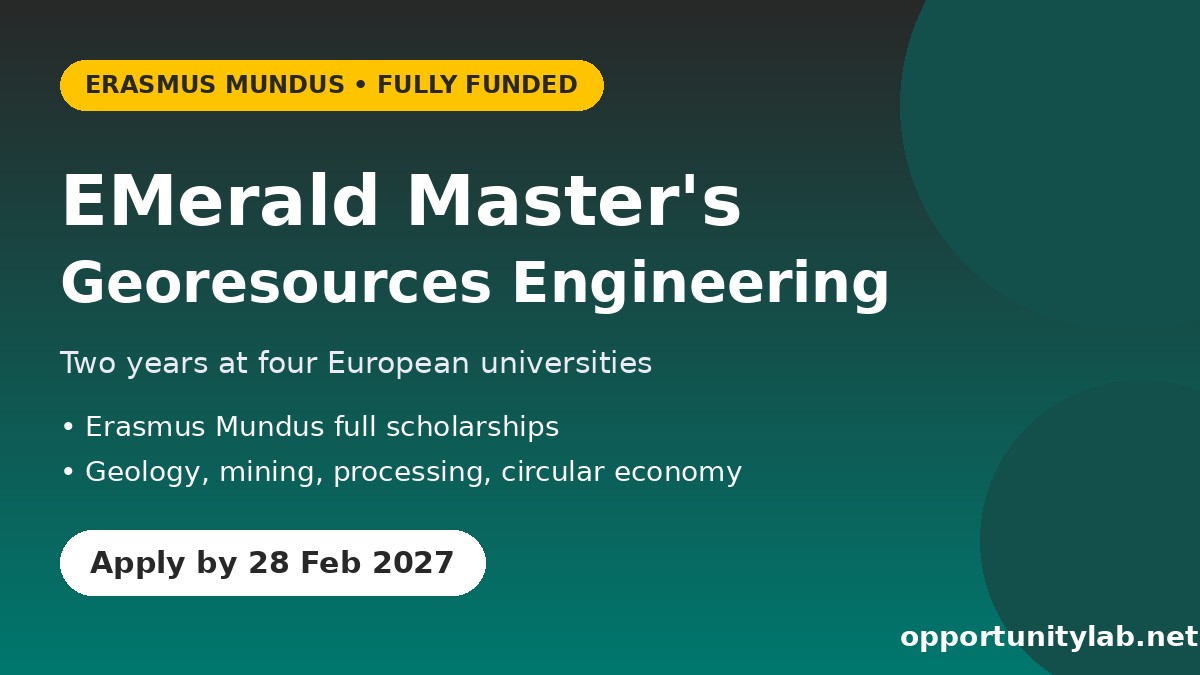
EMerald, a two-year Erasmus Mundus Joint Master’s in Georesources Engineering, is accepting applications for Erasmus Mundus full scholarships for the 2027 intake. The EIT-labelled programme is taught in English by four European universities, coordinated by the University of Liège in Belgium, and covers mineral resources, geology, mining, mineral processing and the circular economy.
Deadline: 28 February 2027. Scholarship applications opened on 3 November 2026.
Key Details
- Programme: EMerald Master in Georesources Engineering (120 ECTS)
- Coordinator: University of Liège, Belgium (with three other European universities)
- Duration: 2 years
- Language: English
- Funding: Erasmus Mundus full scholarships
- Scholarship round: 3 November 2026 – 28 February 2027
Benefits
- an Erasmus Mundus full scholarship, which under the programme’s standard terms includes a monthly allowance (around €1,400) and coverage of participation costs
- study in several European countries with a joint or multiple master’s degree
- training at the interface of Earth sciences and engineering, from geology and urban mining to metallurgy
- the EIT label, with links to industry and the EIT RawMaterials community
Check exact scholarship amounts on EMerald’s Fees and Scholarships page.
Eligibility
- open to students worldwide
- a bachelor’s background in geology and/or applied sciences, such as mining, metallurgy, chemistry or related engineering
- good English
- all required documents and a video submitted with a complete application
How to Apply
- Read the programme details on the EMerald website.
- Register on the EMerald admissions portal and choose the Erasmus Mundus scholarship (Round 1) form.
- Upload your documents: passport or ID, birth certificate (English translation), ID photo, transcripts and other required files, plus the video.
- Submit before 28 February 2027; incomplete applications are not considered.
- The 40 highest-rated applicants are invited to an interview, including discussion of a scientific paper sent a few days before.
A second round for self-funded EU and non-EU students runs separately.
Tips
- Show how your background fits both geology and engineering.
- For the interview, practise summarising and critiquing a short scientific paper.
- Link your goals to Africa’s mining sector and critical minerals, such as cobalt, copper or lithium.
- Submit early; incomplete files are rejected.
