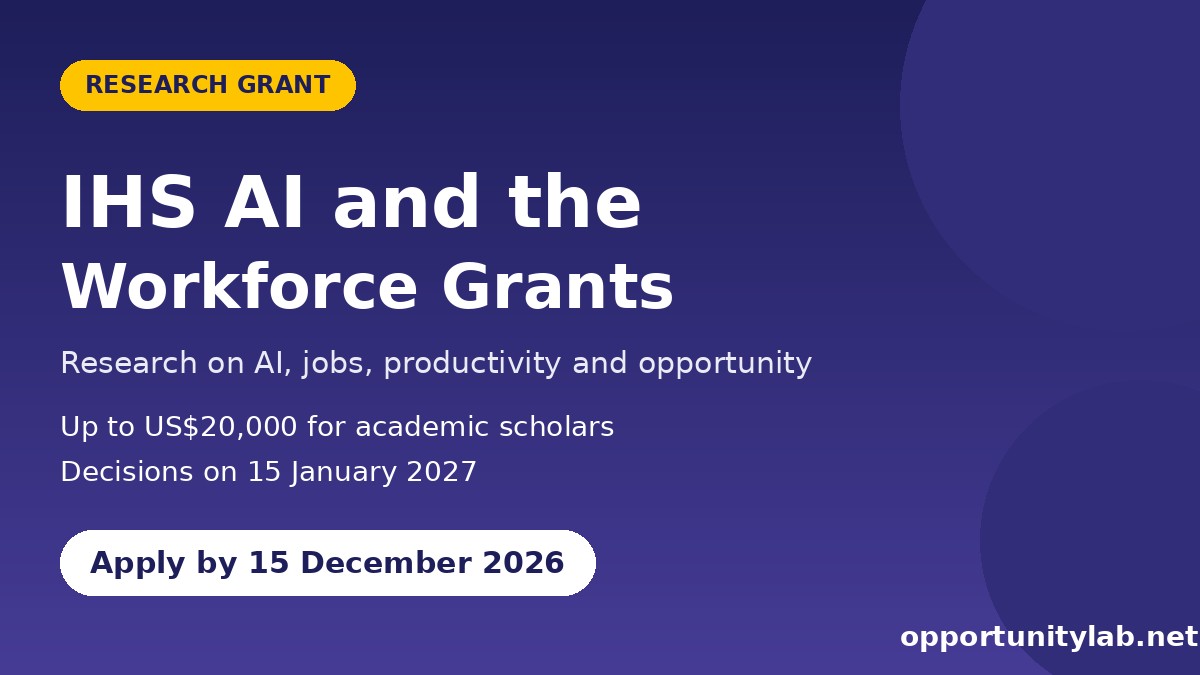
The Institute for Humane Studies (IHS), a US-based academic non-profit, is inviting proposals for its AI and the Workforce research grants. Selected academics can receive up to US$20,000, and larger awards may be considered for exceptional projects.
IHS wants long-term research on how artificial intelligence affects employment, productivity, occupational change, economic opportunity and innovation, and is especially keen on proposals that bridge disciplines. Outputs can be peer-reviewed papers, policy white papers or shareable research databases.
Deadline: 15 December 2026. IHS does not state a closing time; it is a US organisation, so to be safe submit by the end of 15 December in Nigeria (WAT). Decisions will be announced on 15 January 2027.
Key Details
- Funder: Institute for Humane Studies (IHS)
- Grant size: up to US$20,000 (larger awards possible for exceptional projects)
- Who: academic scholars (the call is listed for faculty)
- Focus: how AI affects work, productivity, jobs and economic opportunity over time
- Deadline: 15 December 2026
- Decisions: 15 January 2027
- Project start: the form asks for a start date at least four weeks after you apply
Grant Benefits
IHS lists these as eligible costs:
- Travel and research activities: travel to present at conferences, archival research, and hiring a research assistant
- Data and research materials: buying datasets and subscriptions to specialised AI or LLM research tools
- Publishing and dissemination: journal submission fees, book costs such as copyediting or indexing, and manuscript preparation
Not covered: living expenses, hardware purchases, costs already incurred, conference travel without a scheduled presentation, and institutional overhead or indirect costs.
Eligibility
- Academic scholars, mainly faculty members, whose research addresses how AI influences employment, productivity, occupational change, economic opportunity or innovation
- Any discipline: economics, sociology, labour studies, business, public policy, law, computer science and more; cross-disciplinary projects are preferred
- The call page does not limit applicants by nationality or country. African academics should email [email protected] to confirm before investing time in a full proposal
How to Apply
- Read the official AI and the Workforce call.
- Prepare a specific budget document showing how you will spend the grant, using only eligible costs.
- Complete the IHS online application form. It asks for your affiliation, project dates, amount requested, other funding, a one-sentence purpose, the project’s value to non-academics, what is new about it, intended outputs and your plan to promote the work.
- Submit by 15 December 2026. You will receive a confirmation email. Questions go to [email protected].
Tips for Applicants
- African labour markets are under-studied in AI research. Projects on AI and informal work, call centres, fintech or gig platforms in Nigeria, Kenya or South Africa can stand out.
- Be specific in the budget. A clear plan for data purchases or a research assistant is stronger than a lump sum.
- Do not include salary, overhead or equipment, which IHS will not fund.
- The form asks how your project improves understanding of human freedom. Prepare a short, honest answer that links your topic to opportunity and choice in the labour market.
- Ask a colleague outside your field to review your explanation for non-academics.