




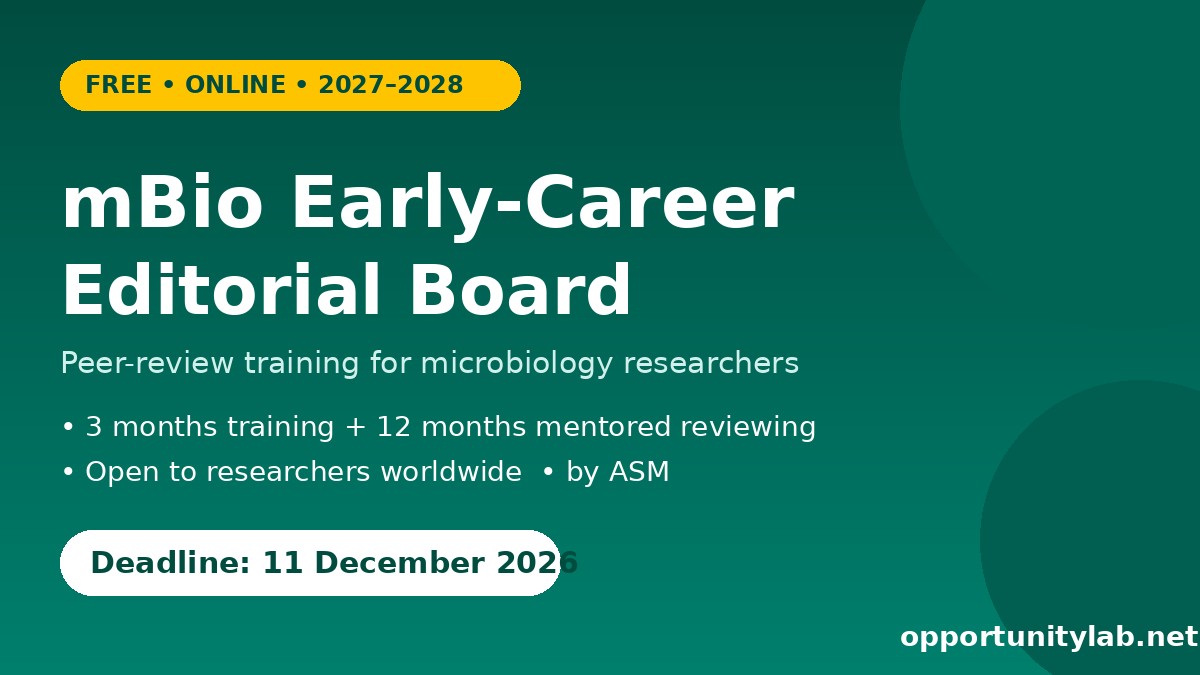
The American Society for Microbiology (ASM) has opened applications for the mBio Early-Career Editorial Board (ECB) 2027–2028. It is a free, online programme that teaches early-career scientists how to peer review research papers properly, then gives them a year of real reviewing for mBio, one of ASM’s flagship open-access journals, with an experienced editor as mentor.
Applications are open from 19 October to 11 December 2026. ASM welcomes applicants from every region of the world and particularly encourages people from groups underrepresented in science, which makes this a good fit for microbiology researchers in Africa and the wider Global South.
Quick Facts
- Organiser: American Society for Microbiology (ASM), publisher of mBio
- Format: online (training sessions live or recorded; reviewing done remotely)
- Term: spring 2027 to summer 2028
- Structure: 3 months of training + 12 months of mentored reviewing
- Cost: no fee mentioned
- Pay: none mentioned — this is a career-development programme, not a paid position
- Deadline: 11 December 2026
Why This Matters for Your Career
Most scientists are expected to review papers but are never taught how. Being on a journal’s early-career board shows hiring committees and grant panels that you understand research quality, ethics and the publishing process. It also puts you in regular contact with senior editors in your field — a network that is hard to build from outside the major research centres.
Phase 1: Training (Three Months)
Board members join biweekly online sessions, which can be attended live or watched later. Topics include:
- what good peer review looks like
- publication ethics and research integrity
- spotting and reducing bias in review
- responsible use of artificial intelligence in scholarly publishing
- writing clear, constructive and useful review reports
Phase 2: Mentored Reviewing (Twelve Months)
Each member is then paired with an mBio editor working in a similar area. The mentor assigns real manuscripts submitted to the journal, gives personal feedback on each review, and meets with the member to discuss progress. Expect to review about one manuscript per month.
Benefits
- structured training in peer review and publication ethics
- hands-on experience assessing real manuscripts
- one-to-one feedback from an experienced journal editor
- stronger critical-reading, writing and communication skills
- a recognised editorial role to list on your CV
- a pathway toward future reviewer and editorial roles
Eligibility
The programme targets early-career researchers in the microbial sciences whose expertise matches the kind of research mBio publishes. Past boards have included PhD students, postdocs and junior faculty. Researchers from all countries can apply.
Please note: the announcement we reviewed does not list exact limits on degree, years since PhD or ASM membership. Check the official page for the full criteria before you apply.
Your Commitments if Selected
- attend all training sessions or watch the recordings
- take part in group discussions and mentoring meetings
- review around one mBio manuscript per month during the reviewing phase
- follow ASM reviewer policies and keep all manuscripts confidential
- submit reviews on time that are fair, unbiased and constructive
Think honestly about your workload before applying — one detailed review a month for a year is a real commitment alongside lab work or teaching.
How to Apply
- Go to the official mBio Early-Career Editorial Board page on the ASM Journals website.
- Read the application guidelines and confirm you meet the requirements.
- Prepare your details: research area, current position and a clear explanation of why you want to join and what you will bring.
- Submit through the official page before 11 December 2026.
Tip: in your statement, name the specific microbiology fields you can review (for example virology, antimicrobial resistance or host–pathogen interactions). It helps ASM match you with the right mentor.
Related Opportunities
- IIASA Young Scientists Summer Program (YSSP) 2027 for PhD Researchers
- ICTP-CCG Academic Writing Residency 2027 for Global South Researchers
- Duke HOPE Center Visiting Scholars Program 2027–2028
Deadline: 11 December 2026. Apply through the official ASM mBio website.