




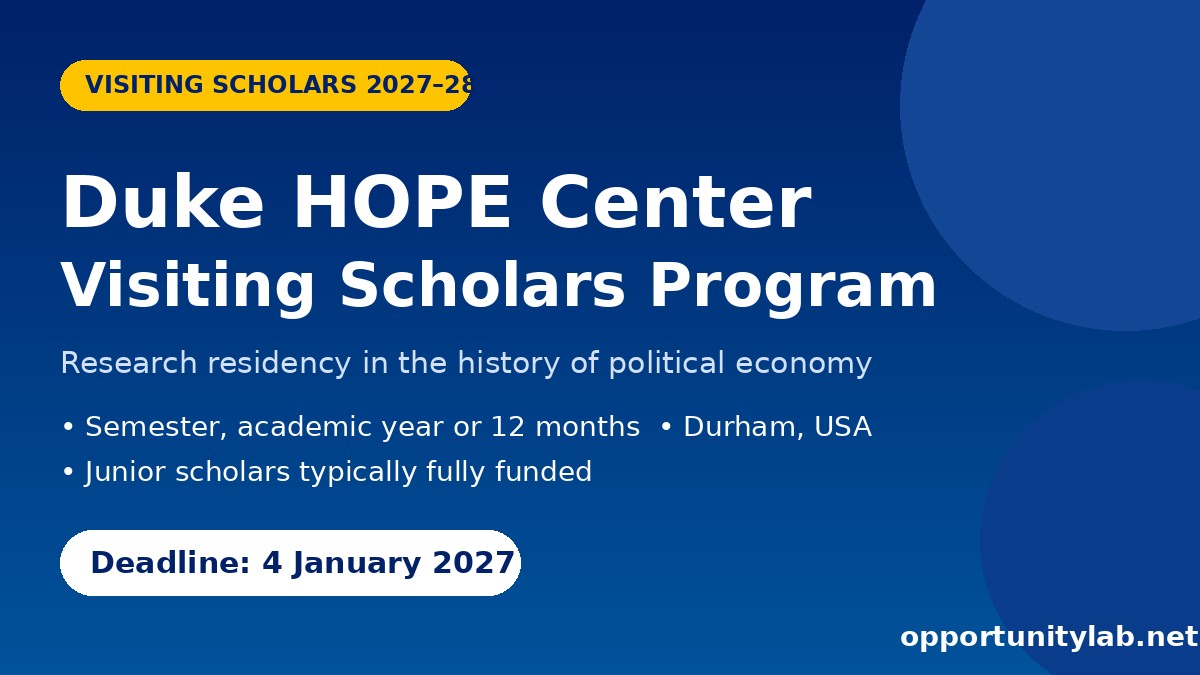
Duke University’s Center for the History of Political Economy (HOPE Center) in Durham, North Carolina, is accepting applications for its Visiting Scholars Program 2027–2028. The Center hosts 8 to 12 researchers each year who want time and space to work on their own projects in the history of economic thought and political economy. Applications close on January 4, 2027.
The HOPE Center is one of the best-known homes for this field in the world. It publishes the journal History of Political Economy, runs the Hayek Lecture series, and keeps a large archive of economists’ papers at Duke. For a PhD candidate or early-career researcher in economics, history or political theory, a stay here can shape a career.
Programme at a Glance
- Host: Center for the History of Political Economy, Department of Economics, Duke University (USA)
- Places: 8–12 Visiting Scholars
- Length: one semester, a full academic year (September–May), or a 12-month appointment
- Focus: independent research in the history of political economy and economic thought
- Funding: available from the Center; junior scholars are typically fully funded (see below)
- Deadline: January 4, 2027
What Visiting Scholars Do
The main purpose is your own research. You arrive with a project and use the residency to move it forward. But the Center says its most successful visitors also take part in the intellectual life around them, including:
- the weekly HOPE Workshop and HOPE Lunch series, where scholars present work in progress
- the Hayek Lectures and HOPE conferences
- sitting in on Duke classes during term (useful for junior scholars)
- the “Summer in the Archives” programme, working with economists’ papers held at Duke
Funding: What to Expect
This is the part most readers will ask about, so here is exactly what the Center says. It does have funding for Visiting Scholars. Senior scholars are asked to bring their own support where they can, for example sabbatical pay, a university fellowship or a foundation grant. The Center recognises that junior scholars often cannot do this, and it typically funds their stays in full.
Two limits are worth knowing. First, Center funding only covers the regular academic year (late August to early May), not summer months. Second, some offers are made on condition that outside money is found by either the applicant or the Center. You must state your funding position honestly in the application.
Eligibility: Who Should Apply
- PhD candidates (pre-doctoral) working on the history of economics or political economy
- postdocs and early-career academics
- established scholars on sabbatical
- researchers from any country — there is no nationality restriction, but you must state your citizenship because international visitors need a US visa (normally the J-1 exchange visitor visa arranged with Duke)
The process is competitive and only a portion of applicants are selected, so a clear, focused research plan matters more than anything else.
Required Documents
Combine items 1–4 into one single PDF, in this order:
- CV — up to date, showing your academic and professional record.
- Statement of Interest (max. 1 page) — your background, why you want to join the Center, and your preferred period (e.g. Fall 2027, Spring 2028, the 2027–2028 academic year, or 12 months from September 1, 2027).
- Research Plan (max. 2 pages) — the project you will pursue during the residency.
- Funding Statement & Citizenship — your country of citizenship; any funding you will bring (source, amount, secured or pending, and decision date if pending); and how much support, if any, you would need from the Center.
You also need one letter of recommendation from a scholar who can speak to your proposed research. PhD candidates should ask their dissertation supervisor. The referee emails the letter (PDF preferred) directly to [email protected].
How to Apply
- Prepare your single PDF packet and name it with your last name and the year, e.g. Smith 2027.
- Upload it through Duke’s secure Strongbox submission portal.
- Email [email protected] to say you have submitted.
- Ask your referee to email their letter to the same address.
- If you get no acknowledgement within one to two days, email the Center to confirm receipt.
Read the full instructions on the official submission page and the Visiting Scholars Program page before applying.
Tips for a Strong Application
- Show why Duke specifically: mention archive collections, faculty or seminars that connect to your project.
- Keep the research plan concrete — what you will write, which sources you will use, and what you will finish by the end of the stay.
- Be precise in the funding statement. Junior scholars should say plainly if they have no outside funding; the Center expects this.
- Contact your referee early; the deadline falls right after the holiday season.
More Opportunities on OpportunityLab
- ICTP-CCG Academic Writing Residency 2027: Funded Three Weeks in Italy
- IIASA Young Scientists Summer Program (YSSP) 2027 for PhD Researchers
- Climate Risk Lab Data Science and Machine Learning Fellowship 2027
Deadline: January 4, 2027. Apply via the official Duke HOPE Center website.