




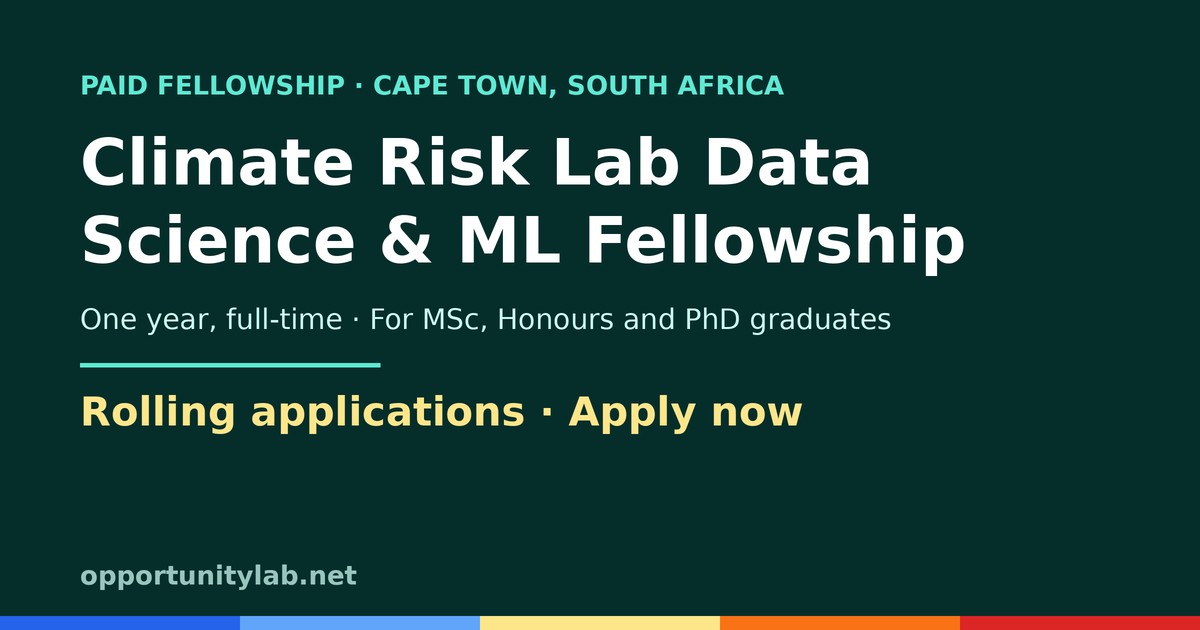
Are you a recent graduate in data science, statistics, computer science or a related field who wants to use your skills on climate change? The Climate Risk Lab in Cape Town, South Africa, is recruiting for its Data Science and Machine Learning Fellowship, a paid, full-time, one-year role working with large climate, environmental, health and socioeconomic datasets. The lab prefers fellows to start in February 2027. Applications are reviewed on a rolling basis, and reviews have already begun, so apply soon.
Fellowship at a Glance
- Host: Climate Risk Lab, Cape Town (enquiries are handled through the University of Cape Town)
- Type: Full-time, paid fellowship, in person in Cape Town
- Length: One year, with a possible one-year renewal
- Preferred start: February 2027
- Pay: Competitive with academic and market rates, based on experience
- For: Recent PhD, MSc or first-class Honours graduates
- Deadline: Rolling. Reviews began in October 2026, and the post stays open until filled.
About the Climate Risk Lab
The Climate Risk Lab aims to create breakthrough science, tools and policies that protect people and nature from climate change. Its current projects include:
- models of how climate change has affected people and nature in the past, and predictions of future impacts
- AI-enhanced reviews of evidence on which climate solutions work for human health and wellbeing
The fellowship has two goals: to boost the lab’s data science capacity, and to build the research and technical skills of the fellows themselves.
What Fellows Do
- Analyse large climate, environmental, health and socioeconomic datasets
- Download, clean, process and optimise big datasets
- Write code for large spatial-temporal data, including parallel computing
- Develop and apply AI tools, and help other analysts use them
- Keep workflows reproducible, including maintaining Git repositories, and document them
- Lead or co-lead a research project that results in a peer-reviewed paper, toolkit or dataset
- Travel internationally when needed
Benefits
- Competitive salary in line with academic and market rates
- One-to-one mentorship from a senior data scientist or postdoctoral researcher
- Your own research project, with the chance to publish
- International exposure through working groups with global collaborators and conferences
- Possible renewal for a second year
- A path to further study: the fellowship may be converted into a PhD scholarship or postdoc funding
Eligibility
Minimum requirements:
- An MSc or first-class Honours degree (completed or in your final year) in data science, machine learning, computer science, mathematics, statistics or a related field. Recent PhD graduates are also welcome, and the lab lists econometrics, engineering and physics among relevant backgrounds.
- Programming skills, preferably in Python or R
- A solid grounding in statistics and/or data science
- Excellent spoken and written communication
Nice to have:
- Experience with packages such as xarray, pandas, numpy, zarr, netCDF4, terra, tidyverse, arrow or duckdb
- Familiarity with bash, Linux and high-performance computing (HPC)
- Experience with agentic AI tools
- Experience using GitHub
- Experience with large spatial-temporal datasets
The lab especially encourages applications from groups historically underrepresented in these fields, such as women of colour.
Note for applicants outside South Africa: the call doesn’t limit nationality, but you must state in your CV whether you hold a valid South African work or study permit. If you don’t, ask the lab how it handles permits before you apply.
Required Documents
Combine everything into a single PDF file:
- Your CV, stating whether you hold a valid South African work or study permit
- Names, positions and email addresses of two professional referees (included in your CV)
- A cover letter explaining why you’re a good fit
- Your academic transcript
- Optional: links to GitHub, Jupyter notebooks or other code samples
- Optional: your personal website and/or LinkedIn profile
Selection Process
- Applications are reviewed on a rolling basis (reviews began in October 2026).
- Shortlisted candidates are invited to a technical interview.
- The position stays open until filled.
Tips for a Strong Application
- Apply early. With rolling reviews already under way, places may fill before the end of the year.
- Show your code. A clean GitHub repository or notebook working with real datasets, ideally climate, satellite or health data, is strong evidence of your skills.
- Connect your skills to climate impact. In your cover letter, explain what kind of climate or health question you’d like to work on.
- Mention large-data experience. If you’ve handled big or spatial-temporal datasets, HPC or parallel processing, say so clearly.
- Keep the PDF tidy. Order it as CV, cover letter, then transcript, and check that the links work.
How to Apply
- Read the official call for applications.
- Prepare your documents as one PDF.
- Submit through the Climate Risk Lab’s Google Form.
For questions, contact Puja Pande at [email protected].
Apply for the Climate Risk Lab Data Science and Machine Learning Fellowship
Read the official call for applications (PDF)