




Important – who can apply: This fellowship is open only to US citizens and to foreign nationals from US-allied countries who live in the Washington, DC area. All in-person sessions are in downtown DC, so you can’t take part from Africa. If you’re an African professional already living and working in DC, check carefully whether you meet the nationality rule before applying. For opportunities open to applicants in Africa, see the related opportunities at the end of this article.
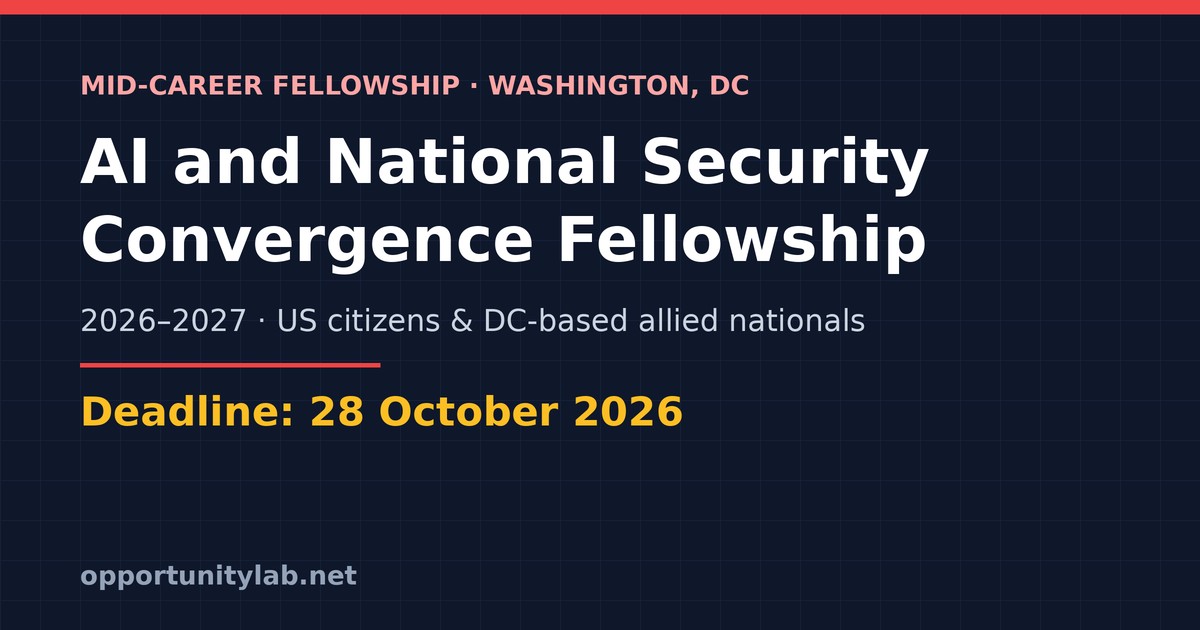
Artificial intelligence is changing how countries think about defence, cyber security and weapons control. The Council on Strategic Risks (CSR), through its Converging Risks Lab and in partnership with the Future of Life Institute, is recruiting its second cohort of the AI and National Security Convergence Fellowship 2026–2027. It’s an eight-month programme for mid-career professionals focused on one question: how humans keep control over increasingly powerful AI. Applications close on 28 October 2026 at 5 pm EDT.
Fellowship at a Glance
- Organisers: Council on Strategic Risks (Converging Risks Lab) with the Future of Life Institute
- Location: Washington, DC (hybrid: half the sessions virtual, half in person at Farragut Square)
- Duration: Eight months, November 2026 to July 2027
- Cohort: 15 fellows
- For: Mid-career professionals with 10–15 years of experience
- Nationality: US citizens and DC-based foreign nationals from allied nations
- Cost: Free. The study trip is fully paid, but there is no stipend.
- Deadline: 28 October 2026, 5 pm Eastern Daylight Time (9 pm GMT)
What the Fellowship Covers
The fellowship has four parts:
- A seven-month bootcamp of 14 two-hour sessions held every two weeks, half online and half in person.
- A staff ride, a short trip within the US to visit frontier AI labs and organisations such as a national laboratory, military unit or research institution.
- Exercises: two scenario exercises and a final “matrix game” where fellows apply what they’ve learned.
- Networking: opening and closing dinners, informal meet-ups, and contact with six senior leaders who serve as Senior Advisors.
Monthly Topics
| Month | Module |
|---|---|
| November 2026 | The rise of autonomous intelligence: control as a key national security priority |
| December 2026 | Autonomous cyber and influence operations |
| January 2027 | Chemical, biological, radiological and nuclear (CBRN) risks and bioweapons |
| February 2027 | AI and military integration, including nuclear command, control and communications |
| March 2027 | AI-driven escalation with China and potential cooperation |
| April 2027 | Testing, evaluation, verification and validation of AI |
| May 2027 | AI literacy, dependency and the national security workforce |
Benefits
- Specialised training on AI safety and control in national security
- A fully funded study trip: airfare, lodging and meals for the staff ride
- Hands-on scenario exercises and a capstone matrix game
- Access to senior leaders serving as advisors to the fellowship
- A professional network of peers across government, defence, law and technology
- Alumni status for fellows who complete the programme
Eligibility
- Nationality: you’re a US citizen, or a foreign national from a US-allied country based in DC.
- Location: you live in the DC area and can attend regular meetings in downtown Washington.
- Experience: you’re mid-career, with 10–15 years of professional and/or advanced academic experience.
- Background: relevant fields include diplomacy, defence, international relations, law, science, technology, work with the US Congress, and local, state or federal government.
- AI knowledge: helpful but not required.
- Availability: you can commit to all bootcamp sessions. You can miss at most five for good reasons. Missing more than six means you lose alumni status.
CSR’s ideal candidate has a graduate degree or professional certification and has worked on issues such as arms control, verification, foreign policy, counterterrorism or homeland security.
Required Documents
- The online application form
- Your resume or CV
- Details of two references
A cover letter is not required.
Tips for a Strong Application
- Show your national security link. Highlight work on defence, arms control, cyber, diplomacy or policy, even if AI wasn’t the main focus.
- Show you understand the AI landscape. Mention the key AI labs and debates you follow, and why AI control matters to your work.
- Confirm your availability. Attendance rules are strict, so only apply if you can make the sessions.
- Brief your referees early. With the deadline only days away, contact your two references now.
How to Apply
- Read the full announcement on the Council on Strategic Risks website.
- Complete the online application form.
- Upload your resume or CV and add two references.
- Submit by 5 pm EDT on 28 October 2026. You can edit your submission until then.
Applicants will be told the outcome by early November. For questions, contact Lily Boland at [email protected].
Read the official announcement and apply