




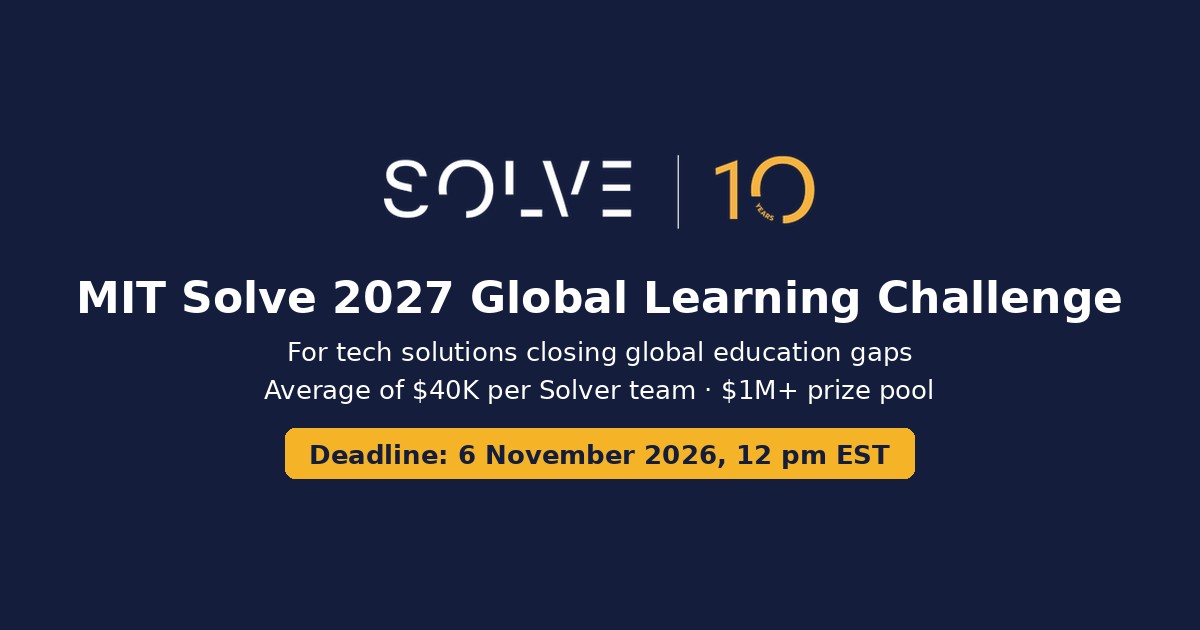
MIT Solve is looking for technology-based solutions that help close global education gaps for its 2027 Global Learning Challenge. Selected Solver teams receive an average of about US$40,000 each, access to a prize pool of more than US$1 million, and a nine-month support programme.
Deadline: 6 November 2026, 12:00 pm EST.
About the Challenge
More than 270 million children are out of school worldwide, and aid to education is falling. MIT Solve wants solutions that show real educational value: gains in what learners can do, not just engagement. Tools should build in privacy, fairness, safety and human oversight. In 2027, Solve is particularly interested in solutions that:
- Strengthen teachers’ instruction with evidence-based tools that support teachers’ judgement rather than replace it
- Work in emergency or low-resource settings, including low-bandwidth, offline or low-cost designs
- Offer assistive technology or multilingual features for learners with disabilities or who speak non-dominant languages
- Improve assessment, including formative assessment, diagnostics and early screening, so teachers can intervene in time
Across all areas, Solve favours solutions that use AI to deepen learning rather than shortcut it, build connection between learners, teachers and communities, are designed with or led by the communities they serve, and strengthen public education systems.
Benefits for Selected Solver Teams
- An average of about US$40,000 per team after selection
- A US$10,000 Solver Award grant for every selected team
- Access to a prize pool of more than US$1 million, including the AI for Humanity Prize of up to US$150,000
- A nine-month support programme with capacity-building workshops, leadership coaching, and in-kind and pro bono resources
- Four-day events at Solver Orientation in Cambridge, Massachusetts (April) and Solve Challenge Finals in New York (September)
- Ongoing funding opportunities and lifelong membership of the Solver community
Who Can Apply?
- Individuals, teams and organisations from any country, both for-profit and non-profit
- Technology-based solutions at prototype, pilot, growth or scale stage. Concept-stage ideas are only reviewed under the Indigenous Communities Fellowship.
- Past Solvers can apply with a new solution
Solve defines technology broadly, from apps, SMS, AI and software to traditional and community knowledge systems.
How to Apply
- Read the brief on the official 2027 Global Learning Challenge page.
- Download the application questions (PDF) to prepare. You must submit online.
- Click “Start Solution” on the challenge page and submit by 6 November 2026, 12:00 pm EST.
More Education and Tech Opportunities
- HP-UCL IOE Fellowship in AI in Education 2027 (closes 7 November 2026)
- 12 Tech and AI Funding Opportunities Open Now (October 2026), including the MIT Solve Global Climate Challenge
- Cities Deliver AI Public Services Grants 2026
Frequently Asked Questions
Can African innovators apply to MIT Solve?
Yes. Solve accepts solutions from any country.
Can I apply with just an idea?
Not for this challenge. Your solution must be at least at prototype stage. Concept-stage ideas are only considered under the Indigenous Communities Fellowship.
When is the deadline?
6 November 2026, 12:00 pm EST.