



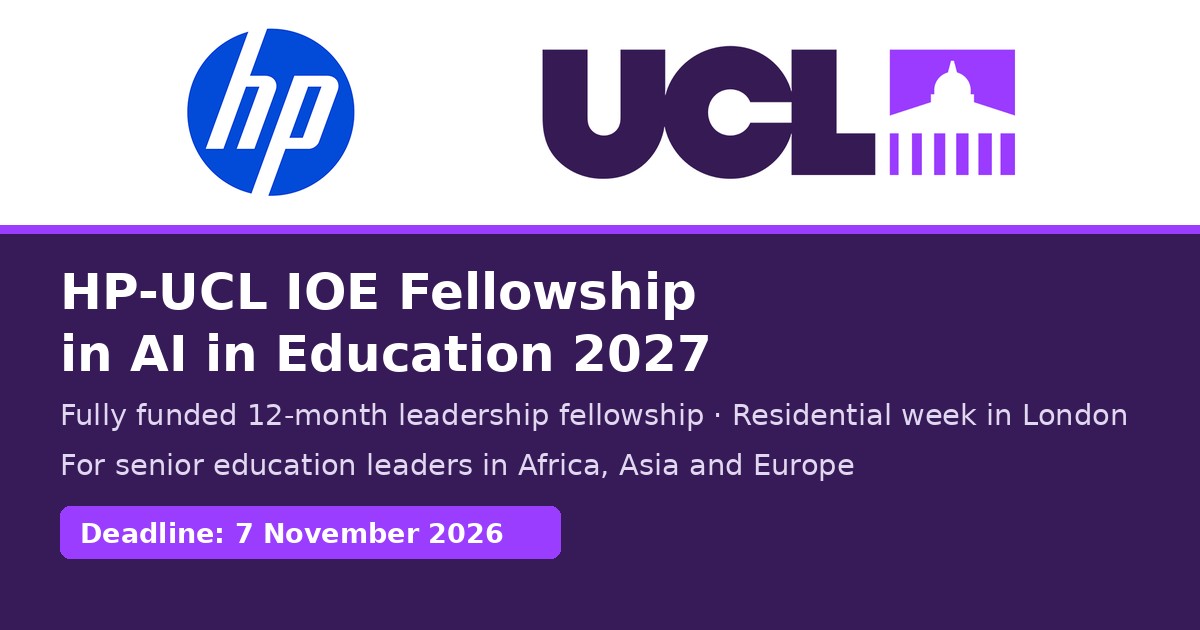
The UCL Institute of Education (IOE) and HP are accepting applications for the HP-UCL IOE Fellowship in AI in Education 2027. It is a fully funded, 12-month hybrid leadership programme for senior education policymakers and organisational leaders in Africa, Asia and Europe. It includes a one-week residential in London and a nine-month mentored capstone project.
Deadline: 7 November 2026.
About the HP-UCL IOE Fellowship
As AI reshapes education, many leaders face high-stakes decisions without enough evidence, governance frameworks or understanding of what AI means for learning, equity and trust. This fellowship prepares senior policymakers and organisational leaders to lead AI transformation responsibly.
The programme draws on expertise in AI, the learning sciences, policy, ethics and human-computer interaction. Fellows learn with global experts, work through applied case studies and learn from their peers, so they can design responsible AI strategies for their own education systems and organisations. The programme is based at the UCL Knowledge Lab. UCL’s Institute of Education has ranked first in the world for Education in the QS World University Rankings for 13 consecutive years.
Benefits
- Fully funded: all programme costs are covered on acceptance. Airfares and visas are not covered.
- Expert faculty: academics whose work informs AI in education policy at UNESCO, the OECD, the Council of Europe and the European Commission
- A nine-month mentored capstone project on a live policy or implementation challenge from your own work and organisation, such as an AI strategy, a procurement framework or a policy design
- A practical curriculum covering ethics, governance, procurement, evidence and scaling, so leaders can question vendor claims and guide effective AI policy
- A global network: a select cohort of international senior leaders and membership of a global network of fellows
Programme Structure
- Months 1–3: weekly live online workshops, supported by independent study and coaching
- Residential: one week in London, starting on 5 April 2027
- Months 4–12: nine months of mentoring on a capstone project in your own work context, guided by a facilitator, with two follow-up calls
The academic team includes Professor Kaśka Porayska-Pomsta (Academic Director), Professor Manolis Mavrikis, Professor Mutlu Cukurova and Professor Alison Clark-Wilson. Lord Knight of Weymouth, a former UK government minister, is Expert in Residence.
Who Can Apply?
The fellowship is open to senior education policymakers, system leaders and organisational leaders who work in Europe, Asia or Africa across education, government, the public sector or related fields. It is particularly suited to:
- Senior education policymakers in ministries, government departments and national agencies
- Regulators and inspectorate leaders responsible for education quality, assessment or data
- C-suite executives and senior leaders at international edtech companies
- Senior officials at international organisations working on education and AI policy
- Regional and local education leaders, including Directors of Education and Children’s Services
- Leaders of school systems, such as school group CEOs and directors
- Leaders of education non-profits, foundations and professional bodies, including teacher and school-leader unions
Fellows must commit fully to every part of the programme, including all live sessions and the London residential week.
Selection Criteria
- Relevance of your role to AI and education transformation
- Demonstrated leadership experience and potential for impact
- Capacity to take part fully in all programme activities
- Commitment to responsible, equitable and human-centred approaches to AI
- Strength and clarity of your proposed project idea
- Potential contribution to peer learning and international collaboration
Key Dates
- Application deadline: 7 November 2026
- Notification of outcomes: 16 November 2026
- Programme starts: 11 January 2027
- Residential week in London: week starting 5 April 2027
Application Requirements
- Your name, email, current role, organisation and country of residence
- A personal statement of up to 4 A4 pages, in three sections:
- Professional background and current role (up to 2 pages): your responsibilities, leadership experience, organisational context, and experience in digital transformation, AI, education, innovation or policy
- Motivation and commitment (up to 1 page): why you want to take part, how it fits your work and goals, what you would contribute, and your capacity to engage throughout
- Outline of a capstone or leadership project (up to 1 page): the idea, why it matters in your context, and how the fellowship would support it
- A letter of support from your employer or sponsoring organisation, confirming support for your participation, attendance and proposed project
- Confirmation that you can attend all required sessions and the residential week in London
How to Apply
- Read the full details on the official HP-UCL IOE Fellowship page.
- Prepare your personal statement and letter of support, each as a PDF or document of up to 10 MB.
- Submit through the official application form before 7 November 2026. You will need to sign in to a Google account to open it.
Questions about eligibility can go to the programme team at [email protected].
More Fellowships for Education and Tech Leaders
- Echidna Global Scholars Program 2027 at Brookings: Fully Funded Fellowship for Education Leaders
- Atlantic Fellows for Social and Economic Equity (AFSEE) 2027–28 at LSE (closes 11 January 2027)
- CMU-Africa Certificate in Artificial Intelligence for Africa 2027: Free Online AI Training
Frequently Asked Questions
Can Africans apply for the HP-UCL IOE Fellowship?
Yes. The fellowship is open to senior leaders working in Africa, Asia or Europe.
Is the fellowship fully funded?
All programme costs are covered on acceptance, but you must pay for your own flights and visa for the London residential week.
Is it online or in person?
Both. It is a hybrid programme: three months of live online workshops, one residential week in London, then nine months of remote mentoring on your capstone project.
When is the deadline?
7 November 2026. Outcomes are announced on 16 November 2026, and the programme starts on 11 January 2027.