



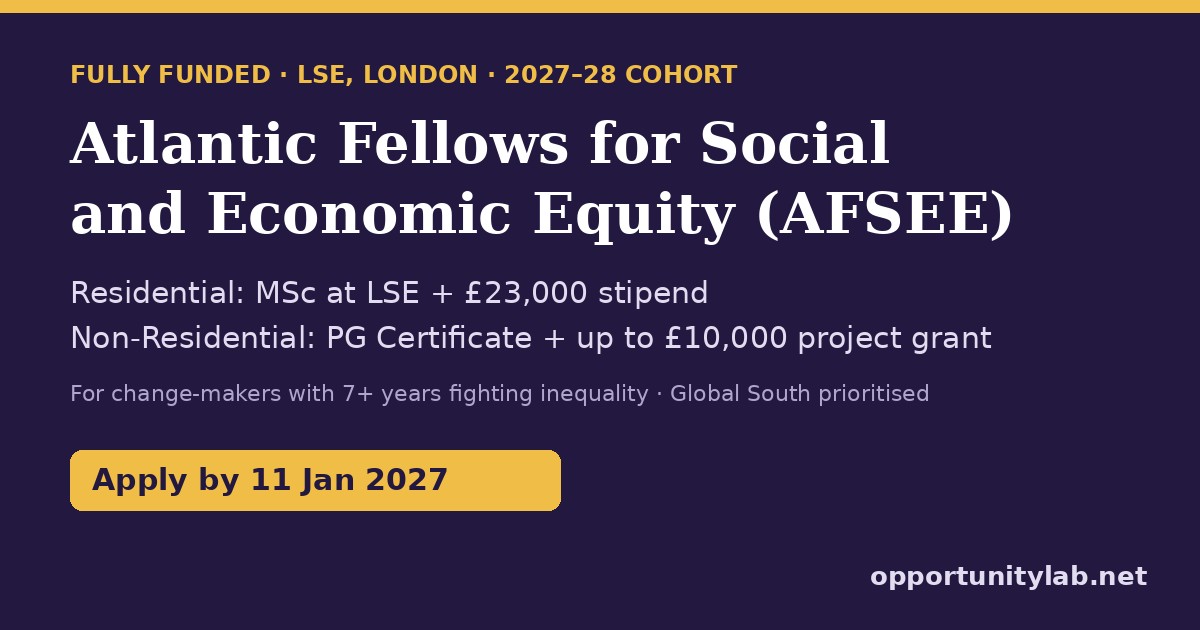
Have you spent years working to tackle inequality as an activist, policymaker, researcher, artist or practitioner? Applications are open for the 2027–28 cohort of the Atlantic Fellows for Social and Economic Equity (AFSEE). It is a fully funded fellowship based at the London School of Economics and Political Science (LSE).
The deadline is 11 January 2027 at 5:00pm UK time (6:00pm in Nigeria). The majority of Fellows come from the Global South, and the programme particularly welcomes applicants from Africa.
About the AFSEE Fellowship
AFSEE is based at the LSE International Inequalities Institute. It brings together mid-career change-makers from around the world who want to challenge social and economic inequalities. Every Fellow starts with an intensive “active fellowship year” of four AFSEE learning modules (lectures, debates, group work and community-building), leadership and skills development, and practical approaches to social change. After that year, Fellows join the Senior Fellowship, a global network with access to more funding, initiatives and collaborative projects.
There are two tracks:
1. Residential Track
- A one-year, full-time MSc in Inequalities and Social Science at LSE, plus the four AFSEE modules
- You relocate to London for the academic year
2. Non-Residential Track
- You stay in your home country and keep working, travelling for the AFSEE modules
- You develop and carry out your own fellowship project
- You are awarded a Postgraduate Certificate in Social and Economic Equity from LSE
Benefits
Residential Fellows (fully funded):
- Full tuition fees for the MSc in Inequalities and Social Science
- A £23,000 stipend for living costs in London
- Travel to and from London at the start and end of the fellowship year
- All visa and immigration-related costs
Non-Residential Fellows (fully funded):
- The full cost of the Postgraduate Certificate
- All travel to and from the modules
- Accommodation and related costs during the modules
- All visa fees
- A grant of up to £10,000 for your fellowship project
AFSEE also offers extra support so that money is not a barrier to taking part once you are accepted.
Who Can Apply?
Both tracks:
- At least 7 years of experience challenging inequality, for example in policy-making, research, movement-building or activism
- Meet LSE’s English language requirements. You do not need to take an English test before you apply.
Residential track only:
- Qualify for admission to LSE’s MSc in Inequalities and Social Science: a 2:1 degree or equivalent in any discipline. A social science background or social policy experience helps.
- Be able to commit to a full academic year of full-time study in London
Non-Residential track only:
- A degree is not required. The track welcomes applicants with an undergraduate degree (2:2 or above) and those without one, as well as people who already have postgraduate degrees.
- If you are currently enrolled in a degree, your course must end before the fellowship starts.
Applicants AFSEE especially wants to support include people who:
- Live in the Global South
- Come from marginalised or historically underrepresented groups
- Do not otherwise have the resources to pay for a fellowship like this, or have had little access to fellowships and scholarships
What selectors look for: experience, clarity of vision and future impact, commitment and readiness, and reflexivity.
Application Timeline
- 7 October 2026: applications open
- 19 October 2026, 2:00–3:30pm GMT: information webinar
- October–November 2026: Q&A sessions with AFSEE Ambassadors
- 16 November 2026, 2:00–3:30pm GMT: application tips webinar
- November–December 2026: weekly Zoom drop-in sessions
- 11 January 2027, 5:00pm UK time: applications close
- Mid-March 2027: interview invitations
- Mid-April 2027: final decisions
- Mid-July 2027: the 2027–28 cohort is announced
How to Apply
- Read the details on the official AFSEE How to Apply page, and take the short eligibility quiz there.
- Join the free webinars on 19 October and 16 November if you can.
- Complete the online application through LSE’s Graduate Application System.
- Nominate two referees, and make sure both references arrive by the reference deadline.
- Upload your transcripts (or a document stating that you do not have an undergraduate degree), your statement of academic purpose and your CV.
- Submit before 11 January 2027, 5:00pm UK time.
More Fully Funded Opportunities
- NOHA Erasmus Mundus Scholarship 2027: Fully Funded Master’s in International Humanitarian Action in Europe (closes 15 December 2026)
- France Excellence Eiffel Scholarship 2027: Fully Funded Master’s and PhD Study in France
Frequently Asked Questions
Is the AFSEE Fellowship fully funded?
Yes. Residential Fellows get full MSc tuition, a £23,000 stipend, travel and visa costs. Non-Residential Fellows get the full Postgraduate Certificate cost, module travel and accommodation, visa fees and up to £10,000 for their project.
Can I apply without a degree?
Yes, for the Non-Residential track. The Residential track needs a 2:1 degree or equivalent.
How much experience do I need?
At least 7 years of experience working to challenge inequality.
Can Nigerians and other Africans apply?
Yes. AFSEE is a global fellowship, most Fellows come from the Global South, and it especially welcomes applicants who live there.
When is the deadline?
11 January 2027 at 5:00pm UK time.