





Eligibility note: This fellowship is only for people who have completed (or will complete) a PhD at The University of Texas at Austin, with research focused on security studies. It is not open to most Africans. If you are an African UT Austin doctoral graduate in security studies, you can apply. For opportunities open to Africans more widely, see the related list at the end of this article.
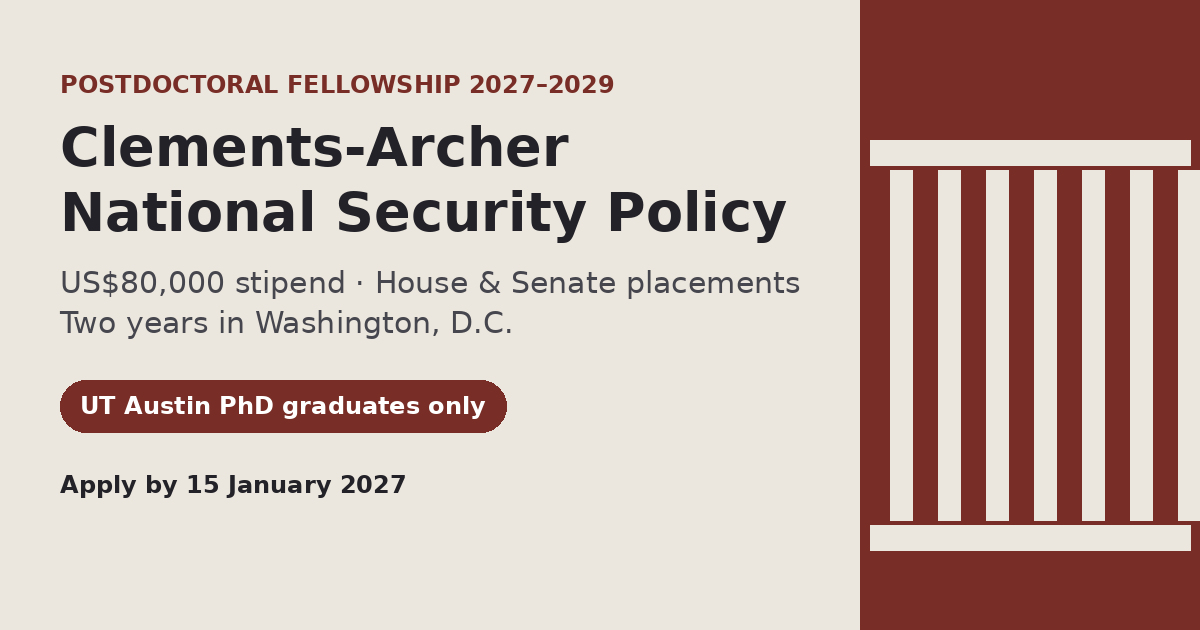
The Clements Center for National Security and the Archer Center (the University of Texas System’s campus in Washington, D.C.) are offering the Clements-Archer National Security Policy Postdoctoral Fellowship 2027–2029. The two-year fellowship places recent UT Austin PhD graduates inside the U.S. Congress to learn how national security policy is made.
Two fellowships will be awarded. Each fellow spends the first year working full-time on a committee or in a member’s office in the U.S. House of Representatives, and the second year in the U.S. Senate. The fellowship starts between May and August 2027.
Quick Facts
- Organisers: Clements Center for National Security (UT Austin) and the Archer Center
- Location: Washington, D.C. (full-time residence required for two years)
- Stipend: US$80,000 plus benefits
- Places: 2
- Deadline: 15 January 2027, 11:59 PM US Eastern Time
Eligibility
- You must have completed your doctorate at UT Austin by August 2027. Those who completed their doctorate in 2026 are also eligible.
- Any discipline is accepted, as long as your doctoral research focuses on security studies.
- All degree requirements must be met and the degree awarded before the fellowship starts (August 2027 at the latest).
- You must be able to live full-time in Washington, D.C. for the two years.
Benefits
- A US$80,000 stipend plus benefits
- A year working in the U.S. House of Representatives and a year in the U.S. Senate
- Orientation for living and working in Washington, D.C.
- Professional development training and coaching from Archer Center staff and faculty
- Mentorship from an established scholar-practitioner
Fellows are expected to mentor undergraduate and graduate Archer Fellows and give a workshop or presentation each semester.
How to Apply
Apply through the official Interfolio listing: Clements-Archer National Security Policy Postdoctoral Fellowship on Interfolio. Your application should include:
- Two letters of recommendation (one must be academic)
- A one-to-two-page cover letter on your qualifications and motivation
- Undergraduate and graduate transcripts
- A scholarly writing sample, such as a dissertation chapter or article
- A policy memo of up to 800 words on an important national security challenge, addressed to a legislator or congressional staff member, with citations
Shortlisted candidates are interviewed in person. Questions go to Derek O’Leary, Academic Director at the Archer Center ([email protected]).
Stay Safe
Applying is free through Interfolio. Never pay anyone who promises a place on this fellowship.
Related Opportunities Open to Africans
- Reagan Institute Society of Fellows 2027: US$80,000–$90,000+ a year, international applicants welcome
- New America Fellows Program, Class of 2028: US$15,000–30,000, non-US citizens eligible
- MECAM Fellowships 2027–2028 in Tunis: open to all nationalities
- Asia House Fellowship 2027/2028: £24,000, remote, all nationalities
How we checked this: all details come from the official Interfolio listing posted by the University of Texas at Austin Clements Center.