Who this is for: African founders deciding where to apply next, whether you have an idea, a first product, paying customers or fast growth.
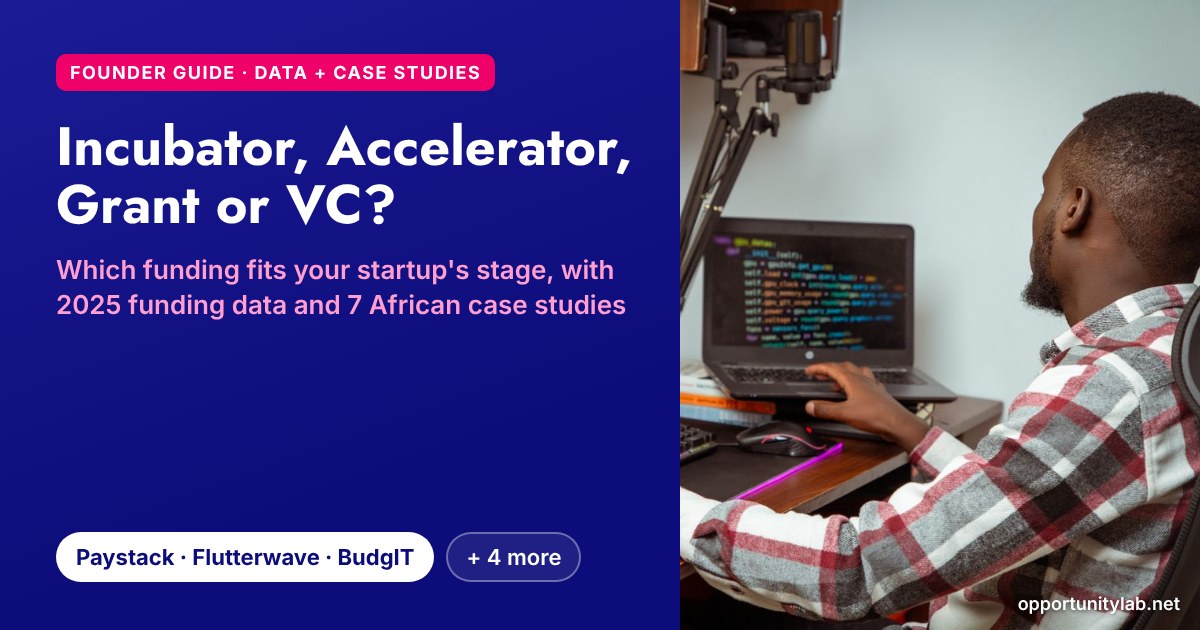
Founders often apply for the wrong kind of money. An idea-stage team pitches venture capital firms that only back proven traction; a growing company spends months on a grant it can’t scale with. The four options are built for different stages, cost very different amounts of ownership, and take very different amounts of time. This guide uses the latest African funding data, the real published terms of the best-known programmes, and seven African case studies to help you choose.
The Short Answer
| Your stage | Best fit | What it costs you |
|---|---|---|
| Idea, no product | Incubator or small grant | Little or no equity; time |
| Product, first users, little revenue | Grant, incubator or early accelerator | 0–10% equity, or paperwork |
| Early traction: paying customers, growth | Accelerator | Typically 5–10% equity, or none at equity-free programmes |
| Proven traction: revenue growing fast, a big market | Venture capital (seed, Series A) | Usually 10–25% per round; a board seat |
| Steady revenue you can repay from | Debt (loans, revenue-based finance) | Interest, no equity |
Equity ranges are typical, not rules; every deal is negotiated.
The Money in Africa: 2025 by the Numbers
African startups raised US$4.1 billion in 2025, up 25% from US$3.25 billion in 2024, according to the Partech Africa 2025 report, which counts equity and debt rounds. Africa: The Big Deal, which counts deals of US$100,000 or more including grants, puts 2025 at US$3.2 billion, up 40%. The trackers count differently, so their totals differ, but both show the same story:
- Debt is rising fast. Partech counted a record US$1.64 billion in debt in 2025, 41% of all funding, up from 31% in 2024 and 17% in 2019. Equity grew only 8%, to US$2.41 billion.
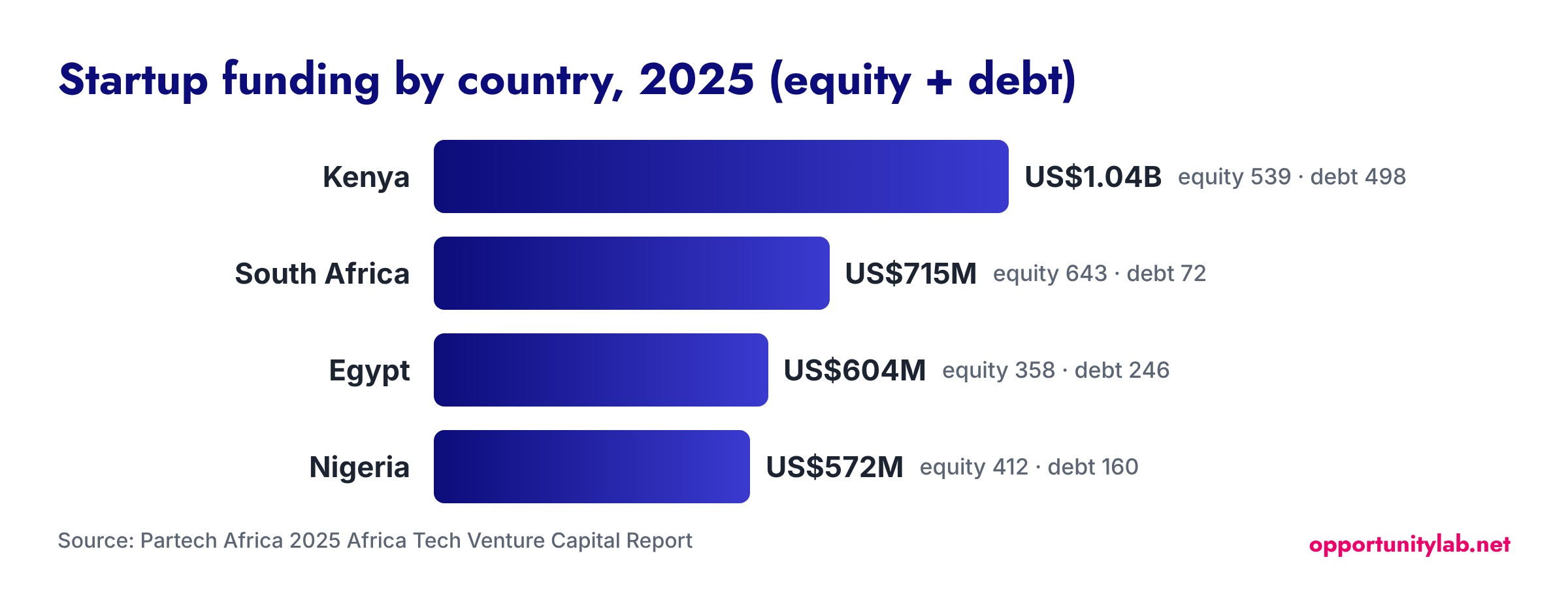
- Four countries take most of the money. Kenya, South Africa, Egypt and Nigeria took 72% of capital (Partech).
- Nigeria fell while the others grew. Partech shows Nigerian equity down 21% in 2025, even as Kenya’s more than doubled.
- Typical round sizes: Partech’s average seed round was US$1.7 million and average Series A US$7.0 million in 2025. AVCA’s 2024 report put the median African seed deal at US$1.5 million.
- 2026 is tougher at the start. Africa: The Big Deal counted about US$1.4 billion in the first half of 2026, down 6%, and only 190 startups raised US$100,000 or more, the fewest since it began tracking in 2021.
What this means for you: equity investors are backing fewer, larger and more proven companies. If you’re early, grants, incubators and accelerators are where most of the realistic money is, and the competition is fierce: the Tony Elumelu Foundation picked 3,200 of over 265,000 applicants in 2026, and Google’s Africa accelerator took 15 of about 2,600.
What You Get From Each Route
1. Incubators: from idea to first product
- What they give: workspace, mentoring, training and sometimes a small cheque, usually over several months to a year or more.
- Example: CcHUB in Lagos, which says it put US$4.18 million into startups in 2025 and supported 3,312 ventures across 49 countries.
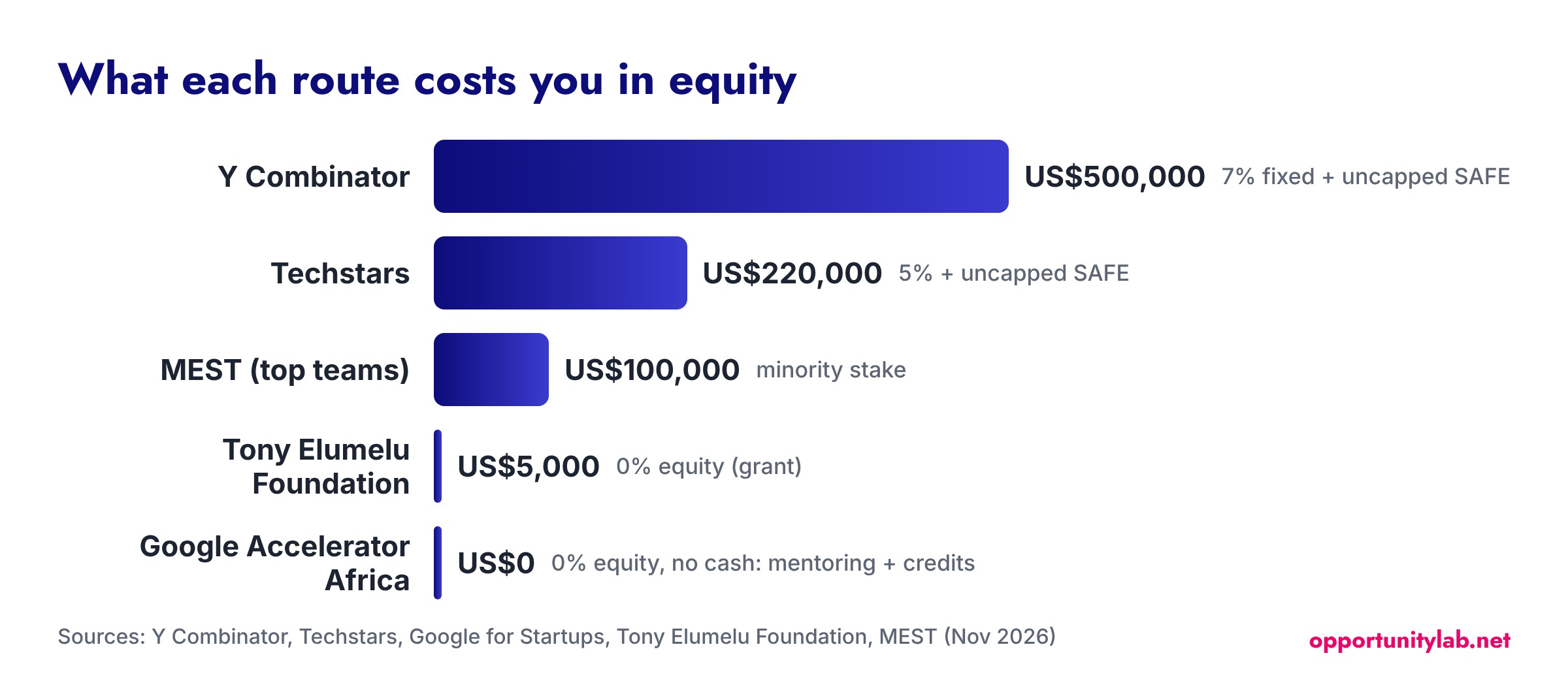
- Example: MEST in Accra runs a free AI Startup Program: seven months of training, four months of incubation, then pre-seed investment of up to US$100,000 for the top startups. MEST takes a minority stake; it doesn’t publish the percentage.
- Best for: first-time founders who need structure, skills and a network more than money.
- Watch out for: fees. A genuine incubator rarely charges you to join; check what you give up before you sign.
2. Accelerators: short, intense, investor-ready
- What they give: a fixed cohort of about three months, intense mentoring, a demo day in front of investors, and often cash for equity.
- Y Combinator: US$500,000: US$125,000 for a fixed 7%, plus US$375,000 on an uncapped SAFE whose final stake depends on your next round (YC’s own example works out to about 9.5% in total).
- Techstars: US$220,000: 5% for US$20,000, plus US$200,000 on an uncapped SAFE.
- Google for Startups Accelerator Africa: equity-free and cash-free, with mentoring, technical support and Google Cloud credits for 10–15 growth-stage startups per cohort. Its 106 alumni have raised over US$263 million, Google says.
- Best for: startups with a working product and early traction, ready to grow fast and raise.
- Benchmark: Carta’s US data puts the median equity sold for a US$500,000 raise at 7%, so YC’s fixed 7% is close to market.
3. Grants: money without giving up ownership
- What they give: non-repayable money, often with training, for a defined purpose.
- Tony Elumelu Foundation: US$5,000 non-refundable seed capital, plus training and mentoring, open to all 54 African countries. The Foundation says it has funded over 24,000 entrepreneurs, that 80% are still in business, and that over 25% have since raised from other investors.
- Best for: idea and early-stage businesses, impact and non-profit models that venture capital won’t fund, and anyone who wants to keep 100% ownership.
- Watch out for: paperwork, reporting and slow timelines. TEF’s 2026 call opened on 1 January, closed on 1 March and announced its cohort on 22 March, about 12 weeks from opening.
4. Venture capital: fuel for proven growth
- What it gives: large cheques (an average US$1.7 million at seed and US$7.0 million at Series A in Africa in 2025, per Partech), plus investors’ networks and help.
- What it costs: a meaningful share of your company each round, a board seat, and an expectation of very fast growth and an eventual exit.
- Best for: businesses with proven demand, growing fast in a large market, that need big money to grow faster.
- Watch out for: raising too much at too high a valuation. If growth stalls, the next round can be a painful down round (see 54gene below).
Seven African Case Studies
Paystack (Nigeria): accelerator → venture capital → exit
Paystack joined Y Combinator’s Winter 2016 batch. Stripe later led its funding and, in October 2020, announced it was buying Paystack, which then served over 60,000 businesses in Nigeria and Ghana and processed more than half of all online transactions in Nigeria, Stripe said. Stripe didn’t disclose the price; TechCrunch reported it was over US$200 million. Lesson: an accelerator opened the door to the right investor, and the investor became the buyer.
Flutterwave (Nigeria/US): accelerator → venture capital at scale
Founded in 2016, Flutterwave went through Y Combinator’s Summer 2016 batch. In February 2022 it raised US$250 million at a valuation of over US$3 billion, after processing more than 200 million transactions worth over US$16 billion for 900,000+ businesses. Lesson: payments infrastructure in a huge market is the kind of business venture capital is built for.
BudgIT (Nigeria): incubator → grants
BudgIT, the civic-tech organisation that makes Nigeria’s budgets readable, was CcHUB’s first incubation graduate (2011–2014). By graduation it had raised over US$500,000 in grants from funders including Indigo Trust, OSIWA and MacArthur, plus US$400,000 from Omidyar Network, and grown from 2 to 14 staff. In 2016 it received US$3 million from Omidyar Network and the Gates Foundation. Lesson: grants are the right fuel for impact models that investors can’t price.
LifeBank (Nigeria): incubator → seed funding
While at CcHUB’s incubator, LifeBank signed up 160+ hospitals, earned over US$90,000 in revenue and delivered 9,000+ pints of blood. It then raised US$200,000 from CcHUB’s Growth Capital fund, EchoVC and Fola Laoye. Lesson: use the incubator to prove demand with real numbers, then raise on them.
meQasa (Ghana): incubator → seed venture capital → merger
meQasa’s founders met at MEST, which backed the company. In 2015 the property site raised US$500,000 from Frontier Digital Ventures, and in 2017 it merged with Jumia House Ghana. Lesson: incubators that invest can bring the first cheque and the credibility for the second.
Smoothie Express (Nigeria): grant → steady growth
Omowunmi Akande was in the Tony Elumelu Foundation’s first cohort in 2015, as her smoothie business was starting. The Foundation reports she has since made over US$1 million in revenue and created more than 30 jobs, and later won €10,000 in further grant funding. Lesson: not every good business needs venture capital; a grant and steady revenue can build a lasting company.
54gene (Nigeria/US): a cautionary tale
The genomics startup 54gene went through Y Combinator in 2019 and raised about US$45 million, reaching a US$170 million valuation in 2021. When its COVID-testing revenue fell, it cut nearly 200 jobs, its CEO stepped down and its valuation was slashed by over US$100 million in a 2022 bridge round, as TechCrunch reported. It closed in 2023. Lesson: big rounds at high valuations raise the bar; when revenue falls, the terms turn against you.
Eligibility
- Incubators: usually an idea or early product and a committed team; many are country- or sector-specific.
- Grants: a clear purpose, a registered business or organisation (often), and the capacity to report on how you spend the money. Many are limited to certain countries, sectors or groups such as women or young founders.
- Accelerators: a working product and early traction (users, pilots or revenue), a team that can work full-time, and usually an incorporated company.
- Venture capital: proven, fast-growing traction in a large market, a strong team and clean company records (cap table, accounts, contracts).
How to Choose: A Five-Question Checklist
- Do you have paying customers? No: incubator or grant. Yes: keep going.
- Is revenue growing every month? Not yet: accelerator or grant. Yes, fast: you may be ready for venture capital.
- Can your business become very large? If not, venture capital is the wrong fit; use grants, revenue and debt.
- What’s missing: money, skills or network? Skills and network point to incubators and accelerators; money alone points to grants or investors.
- How much ownership will you give up, and for what? Compare the cash, the equity and the support, not the brand name.
Apply Now: Open Opportunities by Stage
Incubation and early programmes
- Orange Corners Nigeria Cohort 16: free incubation and up to €30,000
- INSEAD AI Founder Sprint 2027: free 10-week virtual programme
Grants and equity-free funding
- develoPPP Ventures Call 2026: €100,000 non-dilutive funding
- Learnstar Startup Challenge 2027: ₦1.5 million grant
- African Energy Entrepreneurship Awards 2026
- Free startup cloud credits from Cloudflare, Google Cloud, AWS and MongoDB
Accelerators
- Base44 Accelerator Cohort 2: up to US$1 million in perks, 0% equity
- OceanHub Africa Acceleration Programme Cohort 8: equity-free
- BlueInvest Africa 2027 Call for Pitchers
Investment
- Digital Africa Seed Fund: up to €2 million for African tech startups
- Michael & Susan Dell Foundation: how to get on its radar
- 20 Funding Opportunities for Startup Founders Open Now
Tips
- Stack them. Most successful founders use several: a grant to start, an incubator to learn, an accelerator to grow, investors to scale.
- Bring numbers to every application. Users, revenue, retention and growth rate beat adjectives.
- Never pay to apply for funding. Real grants and accelerators don’t charge application fees.
- Read the term sheet. Understand SAFEs, valuation caps and liquidation preferences before you sign; ask a lawyer or an experienced founder.
FAQ
What’s the difference between an incubator and an accelerator?
An incubator helps you go from idea to first product over a longer, flexible period. An accelerator is a short, fixed cohort, usually about three months, for startups that already have a product and traction, ending in a demo day with investors.
Do accelerators always take equity?
No. Y Combinator and Techstars invest for equity, but Google for Startups Accelerator Africa is equity-free and gives support and credits instead of cash.
How much do African startups raise at seed?
Partech Africa’s average seed round was US$1.7 million in 2025; AVCA put the median at US$1.5 million in 2024. Many first rounds are far smaller.
Is venture capital right for every business?
No. It suits businesses that can grow very large very fast. Profitable small businesses, impact organisations and many services companies do better with grants, revenue and debt.
Related Opportunities
- Grants for Small Businesses and Startups in Nigeria: Open Now
- 20 Funding Opportunities for Startup Founders Open Now (November 2026)
Sources
- Partech Africa, 2025 Africa Tech Venture Capital Report
- Africa: The Big Deal, 2025 recap and H1 2026
- AVCA, 2024 Venture Capital in Africa Report
- Y Combinator, the YC deal
- Techstars, investment terms
- Google for Startups Accelerator: Africa
- Tony Elumelu Foundation, 15-Year Impact Report
- CcHUB, 2025 Impact Report
- MEST AI Startup Program
- Carta, YC deal and market rate
Figures checked on each organisation’s own report, website or announcement on 23 November 2026. Run your own numbers before you sign anything.