


Deadline alert: Applications close on 16 November 2026, through the official CaCTüS application portal.
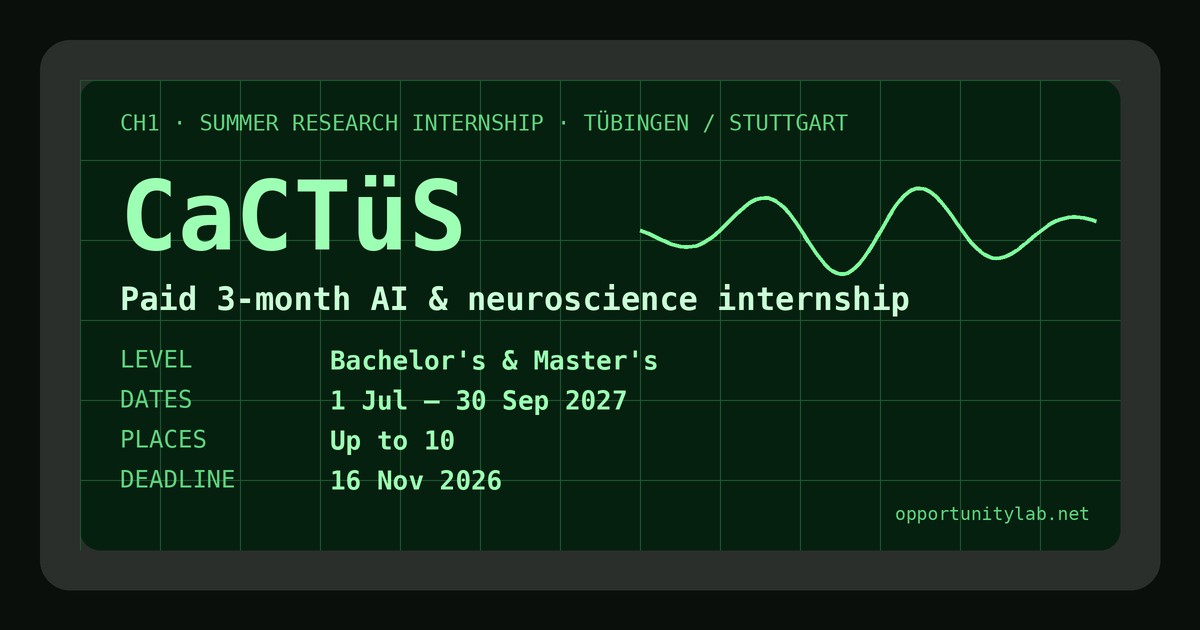
The Computation & Cognition Tübingen Summer (CaCTüS) Internship offers up to ten bachelor’s and master’s students a paid three-month research internship in Germany. It’s run jointly by the Max Planck Institute for Biological Cybernetics, the Max Planck Institute for Intelligent Systems and the Tübingen AI Center.
The programme is aimed at talented students who are held back by personal, financial, regional or societal constraints. The Max Planck Institute for Biological Cybernetics says it especially encourages students living in low- and middle-income countries, which includes most of Africa.
At a Glance
| Organisers | Max Planck Institutes for Biological Cybernetics and Intelligent Systems, and the Tübingen AI Center |
| Places | Up to 10 interns |
| Who can apply | Bachelor’s and master’s students (not yet started a PhD) |
| Dates | 1 July – 30 September 2027 (fixed, no flexibility) |
| Location | Tübingen or Stuttgart, Germany (in person) |
| Pay | Paid internship (about €1,350 a month, as reported) |
| Deadline | 16 November 2026 |
What You’ll Do
Interns work on real research projects with experienced scientists, in areas such as machine learning, electrical engineering, theoretical neuroscience, behavioural experiments and data analysis. Alongside the research, the programme includes soft-skills courses (such as giving scientific presentations and application training), career advice, visits to other research institutes and social events. At the end, interns present their work to scientists on campus.
Benefits
- A paid three-month research internship at world-leading Max Planck institutes
- Return flights booked and paid for by the programme, according to the programme description reported by Opportunity Desk
- Help finding accommodation through the Internship Coordination Office
- Supervision by experienced scientists and a strong research network
- Training, career guidance and the chance to present your research
Not covered: costs before the internship starts, such as visa fees, travel to the embassy and travel health insurance.
The monthly pay of about €1,350 is reported by several listings but isn’t shown on the official pages we could access, so treat it as a guide and confirm it in the portal.
Eligibility
- You’re a bachelor’s or master’s student and haven’t started a PhD by the time of the internship.
- You face personal, financial, regional or societal constraints that affect your education or research career.
- Students from low- and middle-income countries are especially encouraged.
- You can be in Germany for the full fixed period, 1 July – 30 September 2027. The dates can’t be changed or extended.
- Some projects require you to be enrolled at a university for the whole period from January to September 2027. Check the requirements for each project in the portal.
How to Apply
- Read the project list and requirements on the official CaCTüS website.
- Create an account on the official CaCTüS application portal (link below). Applications are only accepted through the portal.
- Complete your application and choose the projects that match your skills and interests.
- Submit before 16 November 2026. Interviews are expected in January 2027.
Apply on the official CaCTüS 2027 portal · Official programme page
Questions: [email protected]
Tips for African Applicants
- Explain your constraints honestly. The programme is designed for students facing barriers, so describe yours clearly and how the internship would help.
- Show your coding and maths skills. Mention projects in Python, machine learning, data analysis or electronics.
- Plan your visa early. German visa appointments can take weeks, and visa costs aren’t covered.
- Apply now. The deadline is only days away.