

Who this is for: Developers, researchers, digital security experts and organisations, from any country except those under US sanctions, working on tools or research that help people get around censorship and surveillance.
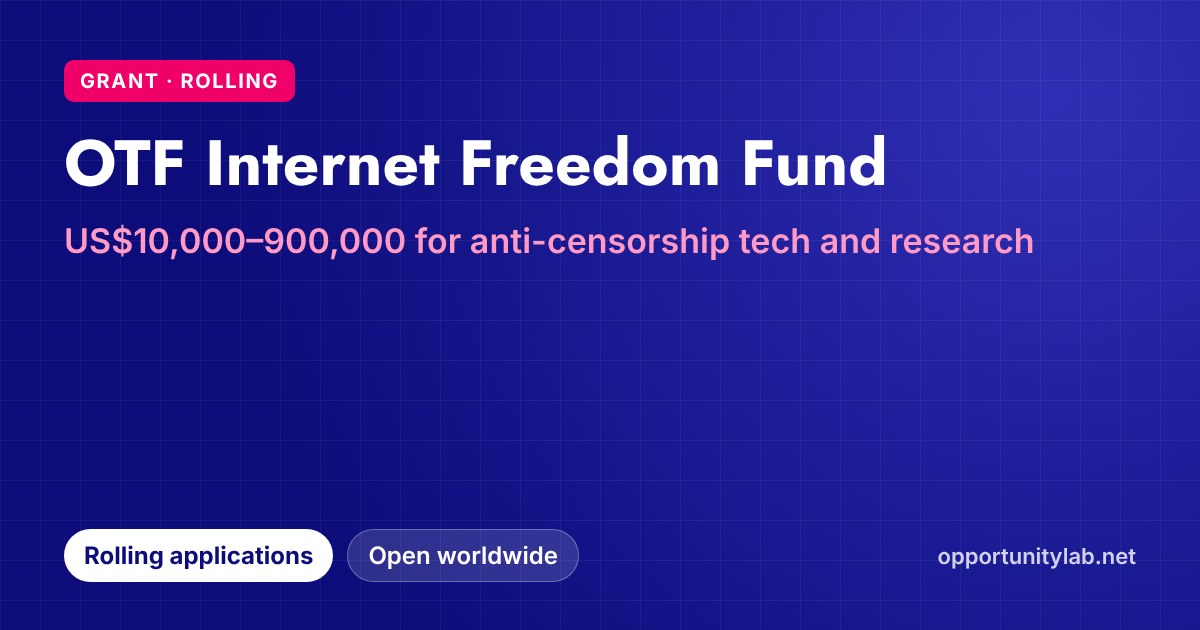
The Open Technology Fund (OTF) runs the Internet Freedom Fund, its main grant programme for internet freedom projects. It funds technology development, applied research, digital security and community events with grants of US$10,000 to US$900,000 for up to 24 months. OTF prioritises first-time applicants, people underrepresented in the field and underfunded areas.
Deadline: rolling. You can submit a concept note at any time.
At a Glance
| Funder | Open Technology Fund (OTF) |
| Grant size | US$10,000–900,000 (ideal requests US$50,000–200,000) |
| Duration | Up to 24 months (ideally 6–12 months) |
| Format | Remote; funding paid in US dollars as milestones are met |
| Who can apply | Individuals aged 18+ and organisations, regardless of nationality |
| Not eligible | Applicants in countries under US trade restrictions or OFAC sanctions |
| Response time | About 6–8 weeks after a concept note |
| Deadline | Rolling |
What the Fund Supports
- Technology development: taking tools from prototype to deployment, including new open-source circumvention tools and better security, usability and accessibility for existing ones. Past examples include OONI, VPNalyzer and the Tor Project.
- Applied research: monitoring censorship and threats, studying circumvention, and user research with people living under surveillance or censorship.
- Digital security ecosystem: systemic improvements that strengthen coordination across the field.
- Events and convenings: gatherings on censorship, surveillance and digital security, such as the Forum on Internet Freedom in Africa.
OTF doesn’t fund basic connectivity (except some politically driven shutdowns), ICT4D development projects, legal analysis or policy advocacy, or one-off trainings and organisational capacity building as the main outcome.
Benefits
- Grants of US$10,000–900,000, paid in US dollars
- Funding for up to 24 months
- A dedicated OTF programme manager for each project
- Priority for first-time applicants and underfunded areas, which favours new voices from Africa
Eligibility
- Individuals aged 18 or over, or for-profit or nonprofit organisations.
- Open regardless of nationality, creed or sex.
- OTF can’t support applicants in countries under US trade restrictions or OFAC sanctions.
- Your project must fit OTF’s internet freedom remit.
How to Apply
- Read OTF’s Applicant Guidebook, especially the concept note guide.
- Submit a short concept note through OTF’s online application system describing the problem and your project.
- Wait about 6–8 weeks for a response.
- Write a full proposal if your concept note is rated highly competitive. An advisory council of experts does the final review.
Official Internet Freedom Fund page
Tips
- Start with the problem, not the tool. OTF scores fit, whether you solve a current problem, cost-effectiveness, sustainability and how your work complements others’.
- Ask for a realistic amount. Most strong first projects sit in the US$50,000–200,000 range.
- Show local knowledge. Documenting shutdowns, censorship or surveillance in African countries is exactly the kind of gap OTF wants filled.
- Keep it open source. Tools OTF funds are expected to be openly available.
