Who this is for: Doctoral candidates at the dissertation stage and recent PhD holders researching AI, cyber, quantum, biosecurity or the geopolitics of technology. The call states no nationality restriction.
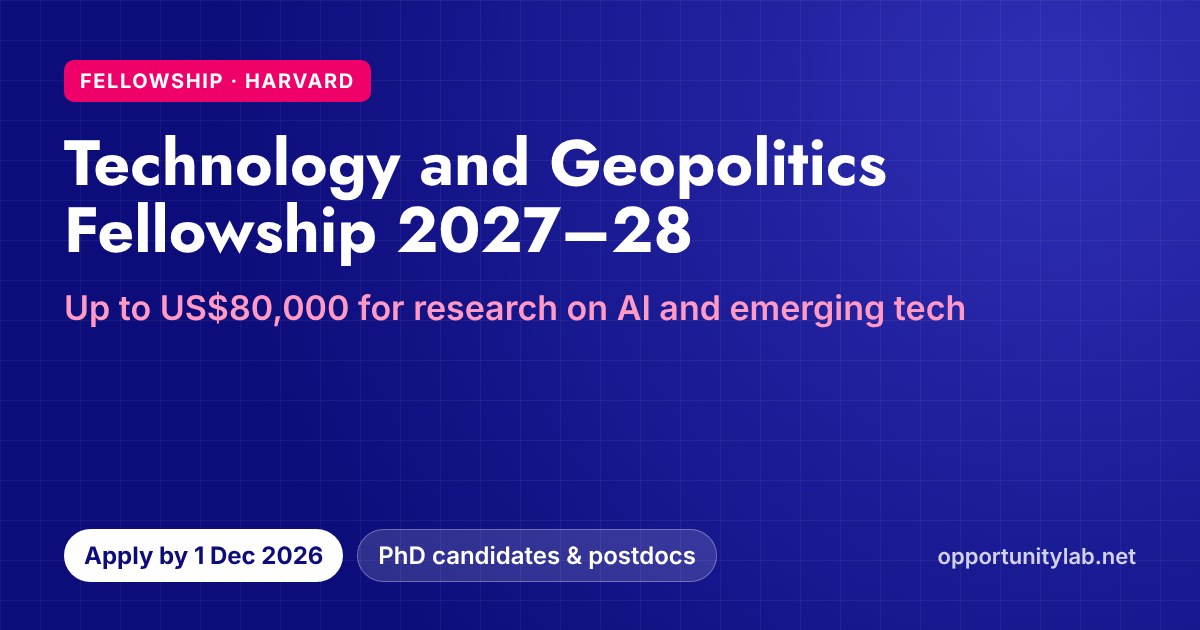
Harvard Kennedy School’s Belfer Center for Science and International Affairs is accepting applications for its Technology and Geopolitics Fellowship 2027–28. It’s hosted by the Program on Emerging Technology, Scientific Advancement, and Global Policy, and runs for one academic year (1 September 2027 – 30 June 2028). Stipends are up to about US$70,000 for pre-doctoral and US$80,000 for post-doctoral fellows.
Deadline: 1 December 2026.
At a Glance
| Host | Belfer Center, Harvard Kennedy School (Program on Emerging Technology, Scientific Advancement, and Global Policy) |
| Duration | Ten months, 1 September 2027 – 30 June 2028 |
| Location | Cambridge, Massachusetts, USA (non-resident appointments possible) |
| Stipend | Up to about US$70,000 (pre-doctoral) or US$80,000 (post-doctoral) |
| Also included | Workspace and small travel and research grants |
| Who can apply | Doctoral candidates past general exams, and PhD holders (usually within five years) |
| Deadline | 1 December 2026 |
About the Fellowship
The programme’s goal is to help society harness the benefits of emerging technologies while managing their risks. Research topics include technology in US–China and wider geopolitical competition, international cooperation versus national competition in tech regulation, the effects of emerging technologies on governance and democracy, biological threats, and artificial intelligence, quantum science and cyber challenges. Applicants from science, technology, social science, history and international affairs are invited.
Pre-doctoral fellows are expected to work on, and ideally finish, their dissertations. Post-doctoral fellows are expected to complete a book, monograph or other significant publication. All fellows spend part of their time on collaborative work with Harvard colleagues from other disciplines.
Benefits
- A stipend of up to about US$70,000 (pre-doctoral) or US$80,000 (post-doctoral)
- Workspace at the Belfer Center
- Small travel and research grants
- A year inside one of the world’s leading centres on technology and international affairs
Pre-doctoral fellows aren’t eligible for benefits. Funding is limited, and some non-stipend, non-resident appointments may also be offered.
Eligibility
- Pre-doctoral: enrolled in a doctoral programme, passed your general exams before the appointment starts, and made significant progress on your dissertation.
- Post-doctoral: a PhD or equivalent, in most cases awarded within the last five years.
- Research that fits the programme’s themes: AI, quantum, cyber, biosecurity, or technology and geopolitics.
- The call states no nationality restriction.
How to Apply
- Prepare your CV and, for pre-doctoral applicants, an unofficial transcript.
- Write a 3–5 page research statement describing what you’ll work on during the fellowship.
- Choose a writing sample of under 50 pages, in English and written by you alone (no co-authored pieces). A journal article, book chapter, dissertation chapter or white paper works.
- Line up three referees. They’re invited to send letters directly to the Belfer Center after you submit.
- Say whether you need full or partial funding, and list any other funding sources.
- Submit through the Belfer fellowships portal by 1 December 2026.
Official fellowship page and application portal
Tips
- Make the geopolitics angle explicit. Strong statements connect the technology to power, security or governance.
- Show what you’ll finish in ten months. A clear chapter plan or publication goal helps.
- Ask referees early. They get their invitation only after you submit, so don’t leave it to the last day.
- Highlight African perspectives. Work on how AI, cyber or tech competition plays out in Africa fills a real gap.
