Who this is for: Journalists, and AI experts who want to become journalists, with experience in journalism or AI. No degree is required. The fellowship is mainly for people who already have the right to work in the US, UK or Hong Kong; visa sponsorship is possible but uncommon. If that rules you out, see the related opportunities at the end.
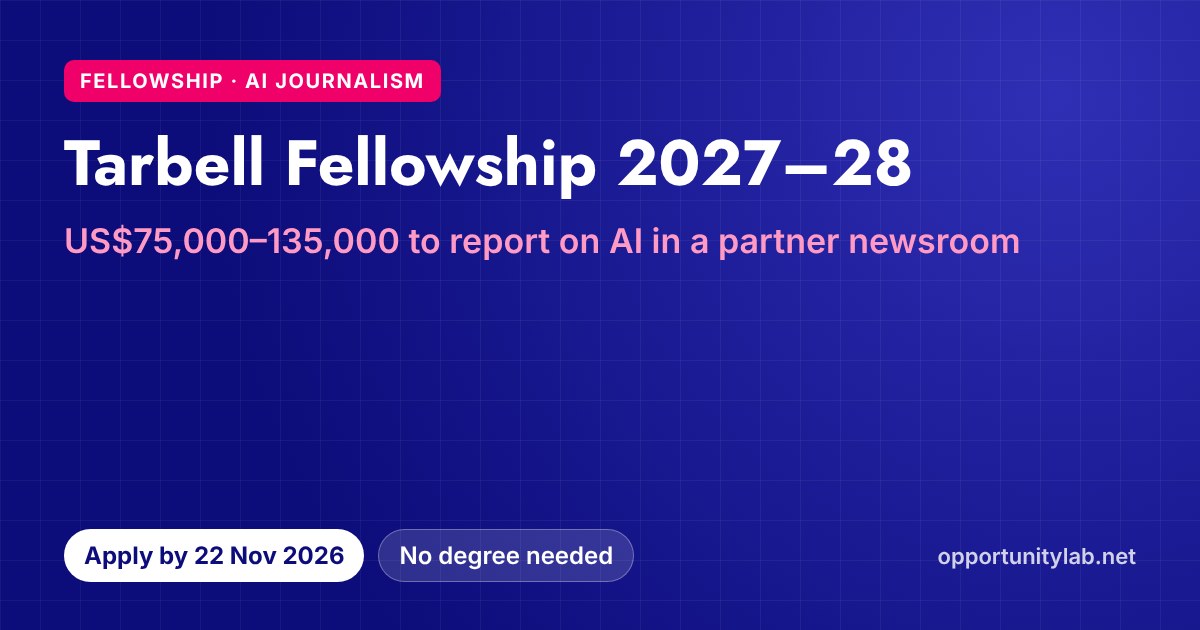
The Tarbell Center for AI Journalism is recruiting for its 2027–28 Tarbell Fellowship: a year of training and paid reporting on artificial intelligence. Fellows complete a remote AI journalism course, attend a summit, then spend nine months as AI reporters at a partner newsroom. The stipend is US$75,000–120,000, or US$115,000–135,000 for senior fellows.
Deadline: 22 November 2026.
At a Glance
| Host | Tarbell Center for AI Journalism |
| Training | AI Journalism Fundamentals, remote and full-time, 7 June – 6 August 2027 |
| Summit | In person, 16–20 August 2027 (to be confirmed), travel and accommodation covered |
| Placement | Nine months at a partner newsroom, September 2027 – May 2028 (may be extended a year) |
| Placement cities | Hong Kong, London, Los Angeles, New York, San Francisco, Seattle, Washington DC and Cambridge |
| Stipend | US$75,000–120,000; senior fellows US$115,000–135,000 |
| Who can apply | 18+ with journalism or AI experience; mainly people with the right to work in the US, UK or Hong Kong |
| Deadline | 22 November 2026 |
About the Fellowship
The Tarbell Fellowship trains journalists to cover AI well and places them in newsrooms that want that coverage. Past host newsrooms include CBS News, The Bureau of Investigative Journalism, MIT Technology Review and TIME, and past speakers include Kevin Roose, Jack Clark and Kelsey Piper. Fellows train and work alongside their cohort several times a week, and Tarbell arranges the placement interviews.
Benefits
- A stipend of US$75,000–120,000, depending on your experience and the cost of living where you’re placed
- Senior fellows (usually 7+ years of experience) receive US$115,000–135,000 and spend about five hours a week mentoring during training
- A full-time AI journalism course with guest lectures and graded assignments
- A week-long summit with travel and accommodation covered
- A nine-month reporting job at a partner newsroom, which may be extended by a year
Eligibility
- You must be at least 18 by 7 June 2027.
- You need experience in journalism or AI, and interest in both. Strong writing, persistence and open-mindedness count.
- No university degree is required.
- The fellowship is mainly for people with the right to work in the US, UK or Hong Kong. Visa sponsorship is possible but uncommon and needs the partner newsroom’s approval.
- It’s full-time, so you can’t combine it with a graduate programme or other training.
How to Apply
- Submit the application (1–3 hours) by 22 November 2026: your CV, short answers and one to three writing samples (up to 4,500 words in total, at least one in prose).
- Complete a work test (3–5 hours) in late December 2026 or early January 2027. You’ll hear by the end of December whether you’ve advanced.
- Interview (2–4 hours) between January and March 2027: one hour with Tarbell, then one to three interviews with possible host newsrooms.
- Hear the result in late March 2027.
Official Tarbell Fellowship page and application form
Tips
- Don’t use AI to write any part of your application. Tarbell disqualifies AI-generated writing samples.
- Choose samples that show reporting, not just opinion. Stories where you found facts others hadn’t are strongest.
- If you’re an AI expert, not a journalist, show you can explain technical ideas clearly to a general reader.
- Be honest about work rights. If you’d need a visa, say so early; it’s uncommon but not impossible.
