



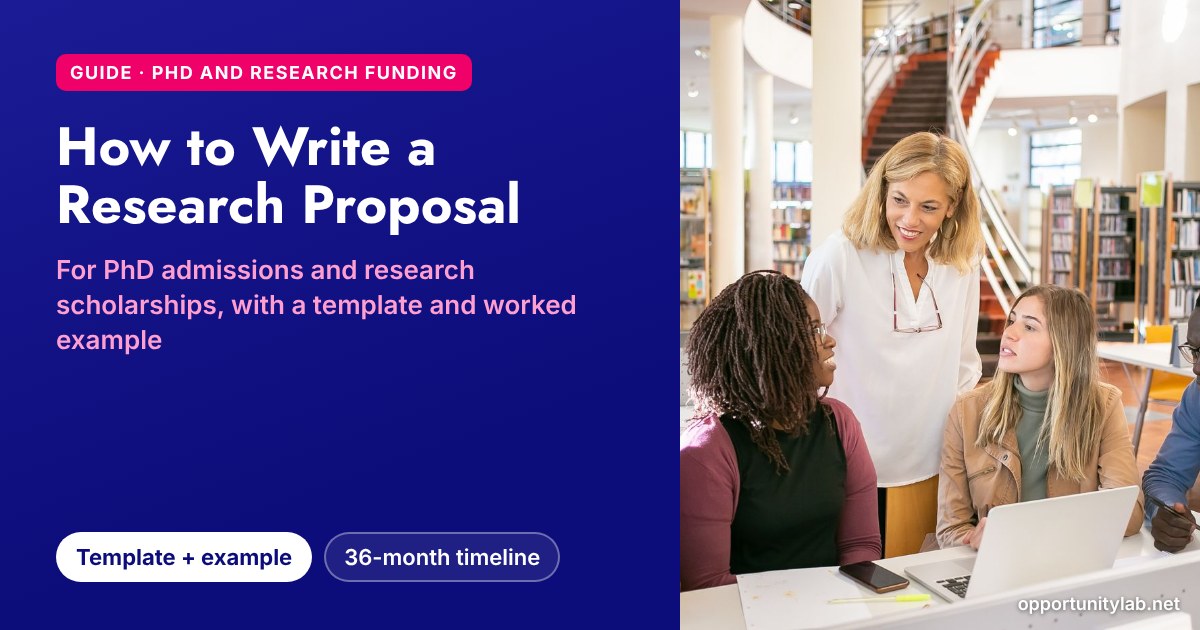
This guide is for final-year students, master’s graduates and early-career researchers in Nigeria, Kenya, Ghana, Ethiopia, South Africa and across Africa who need a research proposal for a funded PhD, a research master’s or a scholarship such as DAAD or Commonwealth. It is also for anyone whose first proposal came back with the comment “too broad” or “not feasible”.
By the end you will know what selection panels actually score, how long your proposal should be for the programme you are targeting, and how to build each section. You also get a fill-in template, a worked mini-proposal on an African topic and a timeline table you can adapt.
Quick Summary
- A proposal is judged on three things: a clear, worthwhile question; a method that can answer it; and a plan you can finish in the funded time (usually three years).
- Length rules differ widely: about 1,500–2,500 words at Exeter, up to 10 pages for DAAD, around 10 pages for UCT Commerce. Always use the limit on your programme’s own page.
- The “problem” paragraph matters most. Exeter calls the statement of what you want to work on and why “particularly important”.
- Write the proposal with, or for, a named supervisor. DAAD and the Commonwealth Scholarship Commission both expect evidence of supervisor input.
- Narrow your topic to one place, one population and one period. “Post-harvest losses in Africa” is a book; “maize storage losses among smallholders in two Kenyan counties” is a PhD.
- Methods, sampling and ethics are where most African applicants lose marks. Be specific about who, how many, where and how.
What Selectors Actually Look For
Funders publish their scoring criteria. Read them before you write a single sentence, because your proposal should answer each one directly.
DAAD (Doctoral Programmes in Germany)
The DAAD scholarship database entry for Doctoral Programmes in Germany says an independent committee of specialists assesses your qualification, the quality of your research project (including the feasibility of your study plan and schedule) and your potential. The proposal must be “prepared and formulated by yourself” and discussed with your academic adviser in Germany.
Commonwealth PhD Scholarships (UK)
The Commonwealth Scholarship Commission’s selection criteria list, as primary indicators, a clear abstract, a well-researched work programme with reference to key literature and engagement with the host supervisor, and innovation and relevance to the field and to development policy. Feasibility and the likelihood of finishing within three years are secondary indicators. Development impact is scored separately: how your research relates to development in your sector and country, who benefits and how you will apply your skills.
UK universities
The University of Exeter says the proposal shows whether you can think critically and independently and communicate clearly, and helps the university assess whether you are a good “match” for its supervisors.
Our five-question selector test
Combine these criteria and you get five questions every reviewer is silently asking. Check your draft against them:
- Is the question clear? Can I state it in one sentence after reading the first page?
- Does it matter? Is there a real gap in the literature and a real problem in the world?
- Can this method answer it? Does the design match the question, with named data, sample and analysis?
- Can this person finish it here, in this time? Is the timeline realistic and does the supervisor have the expertise?
- So what? Who will use the findings, and how?
How Long Should a Research Proposal Be?
There is no universal length. These are the rules on official pages we checked; your department’s own page always wins.
| Programme or university | Length rule | Notes |
|---|---|---|
| DAAD Doctoral Programmes in Germany | Max. 10 pages in total, including a description of your previous research work | Discussed with your academic adviser; individual projects need a schedule agreed with the supervisor |
| Commonwealth PhD Scholarships | No separate word limit stated on the page; you give a “detailed plan of study” in the online form | A named UK supervisor must provide a supporting statement |
| University of Exeter | Guide of 1,500–2,500 words | “A paragraph would not be enough and 5,000 words likely too much” |
| University of Surrey | 3,500–5,000 words excluding references (business, law, politics, sociology); 1,500–3,000 words (education); max. 10,000 characters (economics) | Shows how much limits vary inside one university |
| University of Westminster | 2,000–3,500 words (4–7 pages) | Full-time research expected to finish within three years |
| University of Cape Town, Faculty of Commerce | About 10 pages, excluding abstract, references and appendices; never more than 15 | This is the formal proposal defended in your first year, not the admission version |
Notice the difference between an admission proposal (what you send to get a place or scholarship, often 1,500–3,000 words) and a formal proposal (what many African universities, such as UCT, ask you to defend before a panel after registration). This guide focuses on the first, but the structure is the same.
The Standard Structure, Section by Section
Exeter lists six core sections: title, a statement of what you want to work on and why, background and literature, methods, strategy and timetable, and key references. UCT Commerce adds a structured abstract, hypotheses or objectives and ethical considerations. Here is the full structure most panels expect, with a rough share of your word count.
| Section | What it must do | Share of words |
|---|---|---|
| Title | Name the topic, place and approach in under 20 words | — |
| Background | Set the context in your country or region; why now? | 10% |
| Problem statement | State the specific gap: what is unknown and why it matters | 10% |
| Aims and research questions | One overall aim; 2–4 questions or objectives | 5% |
| Literature review | Show key debates and exactly where your study fits | 20–25% |
| Methods | Design, site, sample, data collection, analysis | 25–30% |
| Ethics | Consent, risks, data protection, permits | 5% |
| Timeline | Stages over 36 months, with milestones | 5% |
| Expected outcomes | Contributions to knowledge, policy and practice | 5–10% |
| References | Key sources only; check whether they count towards the limit | Often excluded |
Title
Avoid “An investigation into…”. A good title tells the reader what, where and how: “Hermetic storage adoption and maize losses among smallholders in Western Kenya: a mixed-methods study”.
Background and problem statement
The background sets the scene; the problem statement names the gap. Use a three-sentence formula: what we know, what we do not know, why that gap matters for people or policy.
Aims and research questions
Each question should map to one method and one chapter of your eventual thesis. If a question cannot be answered with the data you describe, cut it.
Literature review
Do not summarise papers one by one. Group them into two or three debates and end each paragraph by stating what is missing. Include African scholarship and local data sources, not only studies from Europe and North America; reviewers notice.
Methods
This is the section that wins or loses funding. Name the design (survey, experiment, case study, ethnography, secondary data), the site and why you chose it, the sample size and how you will select it, the instruments, and the analysis (for example, “difference-in-differences in Stata” or “thematic analysis in NVivo”). The CSC’s advice for applicants says candidates who do not give the precise methodology and sampling strategy “do not score highly”. It also says research plans must be written by the applicant, not by the intended supervisor.
Ethics
Say who will grant ethical approval (your host university’s committee) and which national permits you need. In Kenya, for example, NACOSTI states that everyone intending to undertake research in the country must apply for a research licence. Mention informed consent, anonymity, data storage and any risk to participants.
Expected outcomes
List concrete outputs: a dataset, three journal articles, a policy brief for a named ministry or agency. For Commonwealth applications, link these to development impact in your home country.
How to Fit Your Proposal to a Supervisor
A proposal that no one at the university can supervise will be rejected however good it is. Both major funders make this explicit: DAAD wants a proposal discussed with your adviser, and the Commonwealth PhD Scholarships page asks for a signed supporting statement from a named supervisor confirming they are willing in principle, have the facilities, explain how your plan fits their department’s expertise, state how much of the plan they wrote, and confirm you can finish within 36 months.
Five steps
- Shortlist 5–8 supervisors whose last five years of publications are close to your topic. Read at least two papers by each.
- Write a two-page concept note: title, problem, questions, proposed method, and one paragraph on why their work fits.
- Email with a specific hook. Reference one of their papers and say how your study extends it. Attach your CV and concept note.
- Revise using their language. If they suggest a framework or dataset, adopt it and cite their work in your literature review.
- Agree the timeline together, especially fieldwork timing. DAAD requires the schedule for individual projects to be agreed with your supervisor.
Template: first email to a potential supervisor
Subject: Prospective PhD applicant: [short topic] ([funder] 2027)
Dear Professor [Surname],
I am a [degree] graduate of [university] currently working as [role]. I read your [year] paper on [topic] and was struck by [specific finding]. My proposed PhD would extend this to [Context], asking [one-sentence question] using [method].
I plan to apply for [scholarship], which requires [supervisor statement / discussion with an adviser] by [date]. I attach a two-page concept note and my CV. Would you be open to a short call, or to comments on the note?
Yours sincerely,
[Name, phone, ORCID if you have one]
Fill-In Research Proposal Template
TITLE: [Topic] in [place/population]: a [design] study

1. BACKGROUND (150–300 words)
   Context in [country]: ...
   Why this matters now: ...

2. PROBLEM STATEMENT (150–250 words)
   We know that ...
   We do not know ...
   This gap matters because ...

3. AIM AND RESEARCH QUESTIONS
   Aim: To [verb] [what] among [who] in [where].
   RQ1: ...  RQ2: ...  RQ3: ...

4. LITERATURE REVIEW (400–700 words)
   Debate 1: ... Gap: ...
   Debate 2: ... Gap: ...
   Conceptual framework: ...

5. METHODS (500–800 words)
   Design | Site and why | Sample size and selection
   Data collection tools | Analysis per RQ | Limitations

6. ETHICS
   Approving committee | National permit | Consent | Data storage

7. TIMELINE (table, 36 months)

8. EXPECTED OUTCOMES
   Knowledge | Policy | Practice | Outputs

9. REFERENCES (key sources only)
Worked Example: An Illustrative Mini-Proposal
Example: this mini-proposal is invented for teaching. It shows the level of specificity reviewers expect. A real proposal would cite current figures, for instance from the African Postharvest Losses Information System (APHLIS), and peer-reviewed studies.
Before: the vague version
“This research will study post-harvest losses in Africa and find solutions to help farmers. Post-harvest loss is a big problem that affects food security. I will use questionnaires and interviews to collect data and make recommendations to government.”
Problems: no place, no population, no question, no sample, no analysis, no gap.
After: the focused version
Title: Why do smallholders abandon hermetic grain bags? Adoption, disadoption and maize storage losses in Kakamega and Bungoma counties, Kenya.
Problem: Hermetic storage bags reduce insect damage in stored maize in trials, and NGOs have distributed them widely in Western Kenya. We know less about why many households stop using them after one or two seasons, and whether losses return when they do. Without this, programmes risk paying for technology that is not sustained.
Aim: To explain patterns of continued use and abandonment of hermetic storage among maize smallholders in two Western Kenyan counties, and to estimate their effect on storage losses.
Research questions: (1) What share of households given hermetic bags since 2022 still use them, and what household and market factors predict continued use? (2) How do measured maize losses after four months of storage differ between continuing users, abandoners and non-users? (3) How do farmers, agro-dealers and extension officers explain abandonment?
Methods: Sequential mixed methods. A household survey of 480 farmers (240 per county), drawn by stratified random sampling from distribution lists of two county agriculture offices, with grain sampling at harvest and at four months to measure weight loss and insect damage. Logistic regression for RQ1; comparison of losses using propensity-score matching for RQ2. Then 30 in-depth interviews and four focus groups with abandoners, agro-dealers and extension officers, analysed thematically for RQ3.
Ethics: Approval from the host university’s ethics committee and a Kenyan university ethics committee; NACOSTI research licence; county authorisation; verbal and written consent in Kiswahili or Luhya; anonymised data stored on encrypted drives.
Expected outcomes: A panel dataset on storage use; three journal articles; a two-page brief for county agriculture departments on designing follow-up support rather than one-off distribution.
See how every question links to a named method, and the sample is justified by place and source. That is what “feasible” looks like on paper.
A second topic idea: mobile money and savings
The same structure works for social science: “Do mobile-money savings products change how market traders in Kumasi save? A mixed-methods study”. Specify the product, the trader population, the comparison group and the data (transaction records with consent, a survey and interviews).
Gantt-Style Timeline for a Three-Year PhD
A timeline proves feasibility. Westminster expects full-time research to finish within three years; the CSC asks your supervisor to confirm completion within 36 months. Adapt this table, shading or marking the months each task runs.
| Task | Y1 Q1–Q2 | Y1 Q3–Q4 | Y2 Q1–Q2 | Y2 Q3–Q4 | Y3 Q1–Q2 | Y3 Q3–Q4 |
|---|---|---|---|---|---|---|
| Literature review and research training | X | X | ||||
| Ethics approval and research permit | X | |||||
| Pilot survey and instrument revision | X | |||||
| Fieldwork round 1 (harvest season) | X | |||||
| Fieldwork round 2 (storage period) and interviews | X | |||||
| Data cleaning and analysis | X | X | ||||
| Paper 1 submitted; conference presentation | X | |||||
| Thesis writing and policy brief | X | X | X | |||
| Submission and viva | X |
Tip: tie fieldwork to real calendars (planting and harvest seasons, school terms, rainy seasons, elections) and say so. It shows you know the site.
What You Get From This Guide
- A five-question selector test drawn from DAAD, CSC and UK university criteria
- A comparison table of official length rules for six programmes and universities
- A section-by-section structure with word-count shares
- A supervisor email template and a five-step supervisor-fit process
- A fill-in proposal template
- A before-and-after worked mini-proposal on post-harvest losses in Kenya
- A 36-month Gantt-style timeline table
Eligibility
This advice applies to applicants for funded PhDs, research master’s degrees and research scholarships (for example DAAD, Commonwealth PhD Scholarships and university studentships) in any discipline. Science and engineering applicants should follow the same structure but expect more emphasis on experimental design and lab access; humanities applicants may be asked for a shorter, argument-led proposal. Each programme sets its own rules, so check the official page for your exact call.
Common Mistakes
- A topic, not a question. “Youth unemployment in Nigeria” is a topic. “How did the N-Power programme affect participants’ later employment in Kano and Enugu?” is a question.
- Too big for three years. Covering five countries or every sector signals you have not thought about feasibility.
- Vague methods. “I will use questionnaires” with no sample size, sampling frame or analysis plan.
- A literature list, not a review. Summarising 30 papers without saying where the gap is.
- Ignoring the word limit or the references rule. Some limits include references and some do not. The Wits Faculty of Health Sciences guidelines (15 pages for a PhD) warn that proposals far over the limit may be rejected.
- No ethics or permits. Fieldwork in Africa often needs national permits and community entry; leaving them out looks naive.
- One proposal for every supervisor. Not adapting your framing to the supervisor’s work.
- Development impact as an afterthought. For CSC, impact is scored separately; one vague line about “helping my country” will not do.
FAQ
Do I need a supervisor before I apply?
For many programmes, yes. DAAD expects your proposal to be discussed with an academic adviser, and Commonwealth PhD applicants need a supporting statement from a named UK supervisor. For structured programmes with advertised projects, the project is already defined and you show fit instead.
Can I reuse my master’s dissertation topic?
You can build on it, and it often helps feasibility. But the PhD must ask a new, bigger question. Show what your master’s found and what it left unanswered.
Should I include a budget?
Only if the call asks for one. For research grants it is usually required; for PhD admission it rarely is. If fieldwork costs are significant, a short paragraph on how they will be covered shows planning. Our CODESRIA research grant proposal guide covers budgets in detail.
How many references should I include?
Quality over quantity. For a 2,000–3,000-word proposal, 15–30 well-chosen, recent references is typical. Include African-authored work and local data sources.
Will the university hold me to every detail?
Proposals usually evolve. But the CSC notes that awards are based on the plan of study in your application and significant changes must be agreed with the Commission, so do not propose something you have no intention of doing.
Can I write in the first person?
Yes. “I will interview 30 traders” is clearer than “30 traders will be interviewed by the researcher”. Check any departmental style guide.
What if I am shortlisted for an interview?
Expect to defend your methods and timeline. Our guide to scholarship and fellowship interview questions includes research-focused questions and sample answers.
Open Opportunities to Apply For
- Makerere University Gerda Henkel PhD Scholarships 2027
- DAAD In-Country/In-Region PhD in Soil and Water Engineering at JKUAT, Kenya
- University of Ghana–University of Manchester Dual PhD Award 2027
- University of Manchester Africa Futures Doctoral Scholar Awards 2027
- Harry Frank Guggenheim African Fellow Awards 2027–2028
- University of Reading International PhD Studentships 2027
Updated 26 November 2026. Facts checked on the official pages linked above.