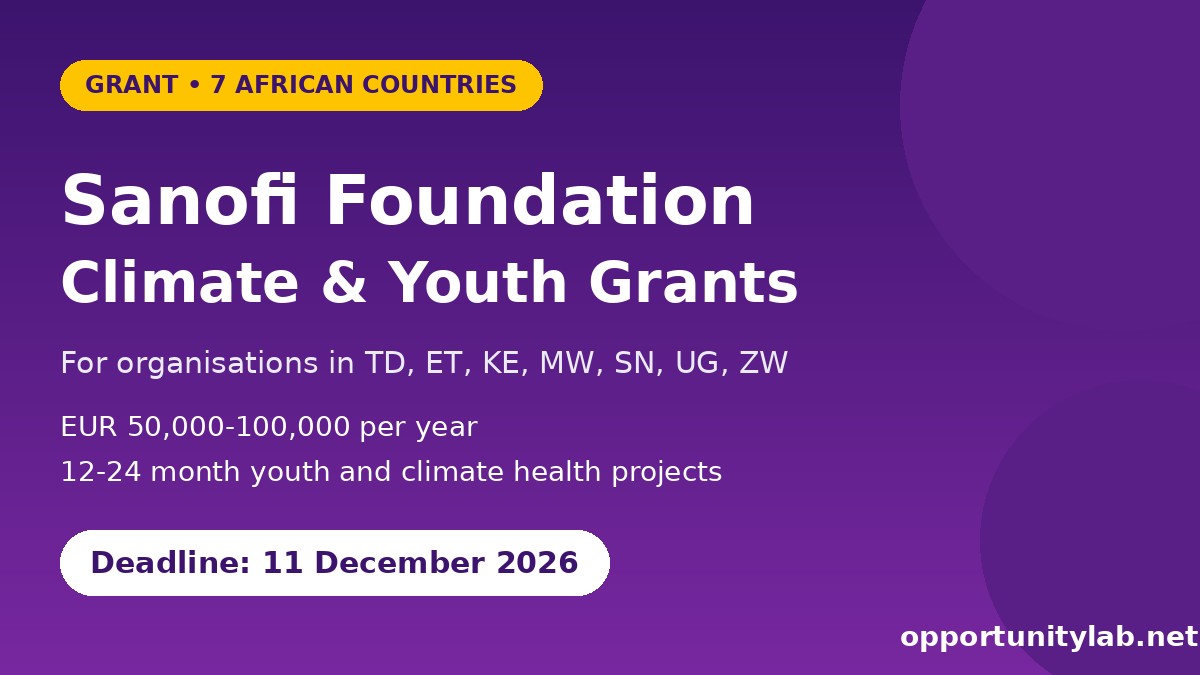



Important: this grant is only for organisations (not individuals) based in Chad, Ethiopia, Kenya, Malawi, Senegal, Uganda or Zimbabwe. Projects in any other country, including Nigeria and Ghana, will not be considered.
The Sanofi Foundation (formerly Foundation S) has opened its 2026 Climate Action & Youth Resilience Grants. It will fund locally led and youth-led projects that protect children and young people from the health effects of climate change, with €50,000 to €100,000 per project per year for 12 to 24 months.
Concept notes are due by 11 December 2026 at 23:00 CET That is 22:00 in Dakar, 23:00 in N’Djamena, midnight in Lilongwe and Harare, and 01:00 on 12 December in Nairobi, Kampala and Addis Ababa.
Quick Facts
- Funder: Sanofi Foundation
- Grant size: €50,000–€100,000 per project per year
- Duration: 12 to 24 months
- Eligible countries: Chad, Ethiopia, Kenya, Malawi, Senegal, Uganda, Zimbabwe
- Who: youth-led organisations, community-based organisations and NGOs based in the country of the project
- Concept note deadline: 11 December 2026, 23:00 CET
What the Grant Supports
Projects must tackle the health effects of climate hazards on children and young people, such as extreme heat, air pollution, drought, flooding, climate-sensitive diseases, food insecurity, displacement and disruption to health, nutrition, WASH, education and protection services. Proposals should use one or both strategies:
- Stronger community health systems: for example climate-resilient primary healthcare, support for community health workers, early warning systems, and keeping health, nutrition, WASH and mental health services running during and after climate shocks.
- Youth-led action: participatory action, research, advocacy and capacity building where young leaders co-design solutions, including AI, community data, climate and health surveillance, digital tools and climate education.
Benefits
- €50,000 to €100,000 a year per project, for up to two years
- Flexible funding for locally led adaptation work
- Joining a funder network that has supported more than 60 projects in 28 countries
- Priority for organisations that have not been funded by Sanofi Foundation before
Eligibility
- Youth-led organisations with real community engagement and a focus on climate, health and resilience
- Community-based organisations based in the district or area where the project will run
- Local NGOs or civil society networks with local, sub-national or national reach
- National, regional and international NGOs that involve local communities at every stage
- The applicant must be based in the country it is applying for
Budget rules: at least 80% of the budget must go to local activities that directly benefit children, young people and communities. Salaries, operating costs and overheads together must not exceed 20%. Co-funding is strongly encouraged.
Not eligible: government-led projects; political or sectarian religious organisations; projects that promote Sanofi products; expatriate or headquarters staff costs; mitigation projects such as CO2 reduction, carbon sequestration, biofuels or clean cooking fuels; vehicles or public buildings; and basic or clinical research.
How to Apply
- Read the full official 2026 call for proposals (PDF).
- Consult your community and gather local data on the climate and health risks children face in your target area. The foundation wants local evidence, not generic text.
- Write a concept note in English or French. The foundation warns that applications relying heavily on AI-generated text may look generic.
- Submit it with your organisation’s details on the Sanofi Foundation Cybergrants portal before 23:00 CET on 11 December 2026.
Timeline: shortlisted applicants will be invited to send full proposals by 11 January 2027. Full proposals are due on 5 February 2027, and final decisions are expected in April 2027. The foundation does not give individual feedback to unsuccessful applicants.
Not in one of the seven countries? See the GYCAF Microgrants for youth climate projects and the Africa Youth Climate Fund (AYCF) Grants.
Official source: Sanofi Foundation – Climate-Resilient Communities