


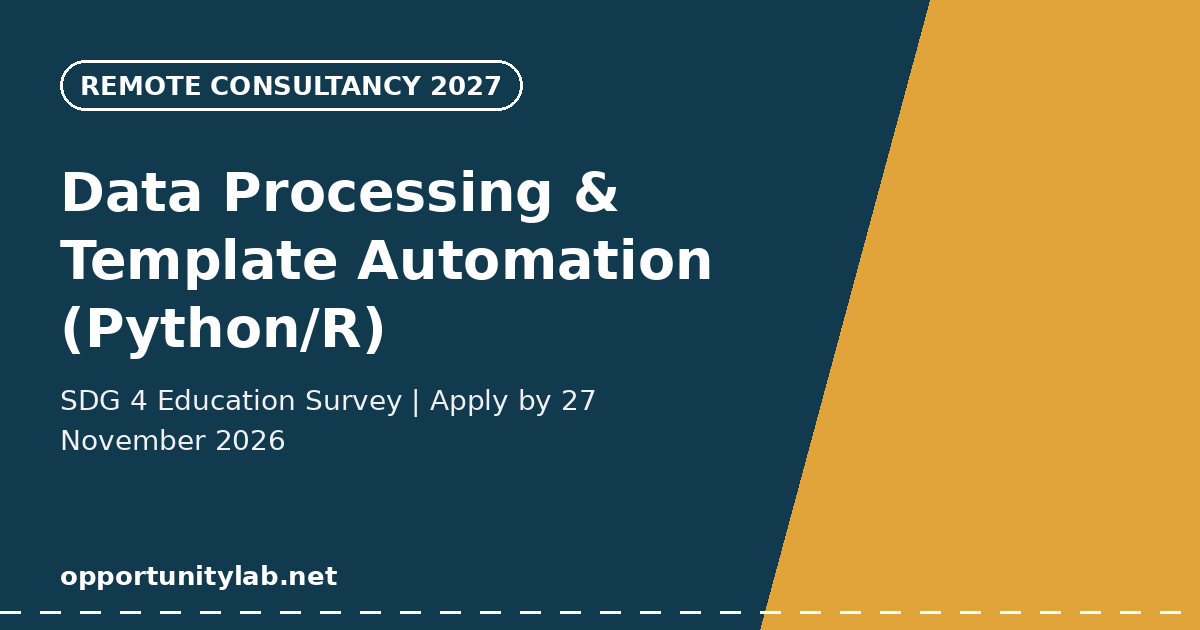
The UNESCO Institute for Statistics (UIS) is hiring a remote consultant to automate and quality-check the education data countries send in for the 2027 SDG 4 Education Survey. The consultant will update the Excel-based Multi-Year Dynamic Templates (MYDTs) that Member States use to report data, improve the Python, R and Stata scripts that process them, validate country submissions, and produce country indicator review reports for the May 2027 Data Refresh and the November 2027 Data Release.
The deadline is 27 November 2026 (midnight, UTC−5), so you have only a few days to apply.
Key Facts
- Organisation: UNESCO Institute for Statistics (UIS), the UN custodian agency for SDG 4 (Quality Education)
- Contract type: Consultant contract, Level 1 (Junior)
- Duty station: Montreal; the work is fully remote
- Workload: up to 90 working days, spread over roughly January to November 2027. The job details box also says “Duration of contract: 4 months”, so ask UNESCO to clarify if the timing matters to you.
- Open to: external candidates
- Deadline: 27 November 2026, midnight UTC−5
What the Consultant Will Do
- Prepare the 2027 survey launch (January–February 2027, 20 days): add new years to the MYDTs, update formulas, validation checks and indicator functions, test and pre-fill templates, and produce French, Spanish, Portuguese and Russian versions.
- Support data analytics (February–April 2027, 15 days): clean and compile datasets, design visualizations and contribute to methodological notes and documentation.
- May 2027 Data Refresh (26 days): run data cleaning and consistency checks based on UIS validation rules, verify indicator calculations, produce country indicator review reports and consolidate databases.
- November 2027 Data Release (June–November 2027, 27 days): repeat the validation and consolidation cycle for survey year 2027.
- Final package (November 2027, 2 days): hand over all scripts, templates, quality-control logs, documentation and a completion report.
The consultant will also join virtual meetings with UNESCO’s regional field network to explain template functions and help countries fix technical problems.
Eligibility
- An advanced university degree (master’s or equivalent) in statistics, mathematics, computer science, education, economics or a related field.
- At least three years of relevant experience in data processing, data validation or template-automation scripting.
- Proven experience in data validation, quality control or survey/statistical workflows.
- Strong programming skills in Python, R or similar languages (Stata is an asset), including processing large numbers of Excel workbooks programmatically.
- Ability to write clean, documented, reproducible code, and to explain technical tools to non-specialists.
- Excellent English, written and spoken. French and/or Spanish is an asset.
- Assets: experience with UIS dynamic templates, SDG 4 indicators, EMIS, databases or automated data pipelines, and turning scripts into apps (for example Shiny or Streamlit).
The vacancy is open to external candidates and does not limit applicants by nationality.
Benefits
- Paid consultancy with UNESCO’s statistical institute, working from anywhere.
- Pay is based on the fee you propose: a lump sum broken down as a daily rate times the number of working days (up to 90), in USD, EUR, CAD or GBP. The daily rate must fall within UNESCO’s individual consultant rates. UNESCO does not publish a fixed amount for this role.
- No travel is required.
- Hands-on experience with the global SDG 4 education database and international statistical standards.
How to Apply
- Complete the online application on the official UNESCO Careers vacancy page, including the mandatory pre-screening questions.
- Download and fill in the Employment History form (Word file) from the vacancy page.
- At the end of that Word file, add a technical proposal: an up-to-date CV, a statement of up to two pages on your understanding of the assignment and fit, a short approach and work plan for automating template updates, validation and consolidation, examples of similar work (a link to a GitHub repository or code samples if possible), and at least two references from similar assignments.
- Add a financial proposal: one lump sum, broken down as daily rate times working days, in a single currency.
- Submit before midnight UTC−5 on 27 November 2026. You can’t change an application after you submit it, and only shortlisted candidates will be contacted.
Selection is on a best-value-for-money basis, combining your qualifications and technical proposal with your proposed fee. The process may include pre-recorded video interviews, written tests, a panel interview and reference checks.
Related Opportunities
- FAO Statistician (Statistical Working System) P-3 2026
- OECD Temporary Junior Policy Analyst 2027 (Education)
- UNV Training Designers and Facilitators Roster 2027
- Stanford King Center Predoctoral Research Fellowship 2027–2028
Stay safe: UNESCO does not charge any fee at any stage of recruitment. Apply only through the official UNESCO Careers site, and ignore anyone who asks you to pay for an application, interview or contract.
How we checked this: we confirmed the role, requirements, application steps and deadline on UNESCO’s official careers page on 24 November 2026.