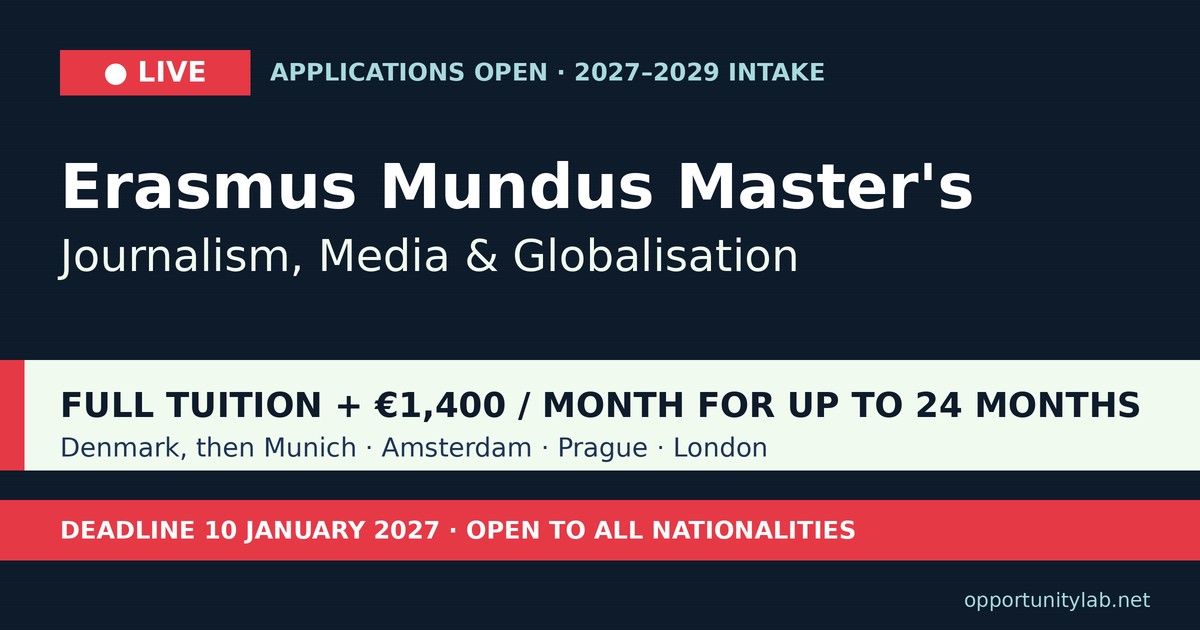
Applications are open for Mundus Journalism 2027–2029, the Erasmus Mundus Master’s in Journalism, Media and Globalisation. It’s a two-year master’s taught at leading universities in at least two European countries. The top-ranked applicants receive an Erasmus Mundus scholarship covering all tuition fees plus €1,400 a month for up to 24 months. Scholarships are open to applicants of all nationalities, including Africans.
The deadline is 10 January 2027 at 13:00 Central European Time, which is 1pm in Lagos, 2pm in Johannesburg and Cairo, and 3pm in Nairobi. You apply once, and the same application covers both admission and the scholarship.
At a Glance
| Programme | Erasmus Mundus Master’s in Journalism, Media and Globalisation (Mundus Journalism) |
| Duration | 2 years (2027–2029), taught in English |
| Year 1 | Aarhus University and the Danish School of Media and Journalism (DMJX), Denmark |
| Year 2 | A specialisation in Munich, Amsterdam, Prague or London |
| Scholarship | Full tuition waiver, €1,400 a month for up to 24 months, and health and liability insurance |
| Places | Scholarships for the 10–15 highest-ranked applicants |
| Deadline | 10 January 2027, 13:00 CET |
Where You’ll Study
Everyone starts in Denmark at Aarhus University and the Danish School of Media and Journalism. In the second year you choose one of four specialisations:
- Cultures & Contexts: Ludwig-Maximilians-Universität München, Germany
- Politics & Communication: University of Amsterdam, Netherlands
- Authoritarianism & Transition: Charles University, Prague, Czech Republic
- Crisis & Conflict: City St George’s, University of London, UK
You choose your Year 2 specialisation in the application form.
Benefits
An Erasmus Mundus scholarship covers:
- A full waiver of tuition fees for both years. Without a scholarship, non-EU students pay €9,000 for Year 1 and €12,000 for Year 2.
- €1,400 a month for up to 24 months for housing, food, travel, visas and other living costs
- Free health and liability insurance
All Mundus Journalism students can also apply for an Erasmus+ stipend for their second year. The consortium says all eligible students have received it so far, but it isn’t paid to students going to the UK, among some other exceptions.
It’s very competitive. The programme receives up to 700 applications and admits about 80–90 students, and only 10–15 receive scholarships. Most admitted students pay their own way.
Eligibility
- A bachelor’s degree (or equivalent) of at least three years of full-time study in a relevant subject, completed by 1 September 2027
- At least three months of journalistic experience
- Proof of English through an accepted test at the application stage, unless you’re exempt
- Scholarships are open to all nationalities. You’re not eligible for a scholarship if you’ve already completed a master’s of two years or more after a three-year bachelor’s, or if you’ve had an Erasmus Mundus scholarship before. You can still apply as a self-funded student.
How to Apply
- Read the application rules and the list of required documents on the official site.
- Choose your Year 2 specialisation.
- Complete the online application form, including the Application Reflections section. No separate motivation letter is needed.
- Upload your degree certificates, transcripts, proof of journalistic experience and English test results.
- Submit before 10 January 2027, 13:00 CET. Only complete applications are considered.
Results are emailed on 1 March 2027.
Official Mundus Journalism application page · Tuition, stipends and scholarships
Tips for African Applicants
- Put real effort into the Application Reflections. It counts towards the scholarship ranking, along with your grades and media experience.
- Document your journalism with bylines, links, broadcast clips or a letter from your editor.
- Book your English test early if you’re not exempt, so the results arrive before January.
- Consider your Year 2 city carefully. London has different visa rules and isn’t covered by the Erasmus+ stipend.
