The Erasmus Mundus Joint Master in Engineering of Data-Intensive Intelligent Software Systems (EDISS) has opened applications for its seventh intake, which starts in August 2027. This two-year master’s degree, taught in English across European universities, focuses on artificial intelligence, data science and software engineering, and is open to applicants of every nationality, including Nigerians and other Africans.
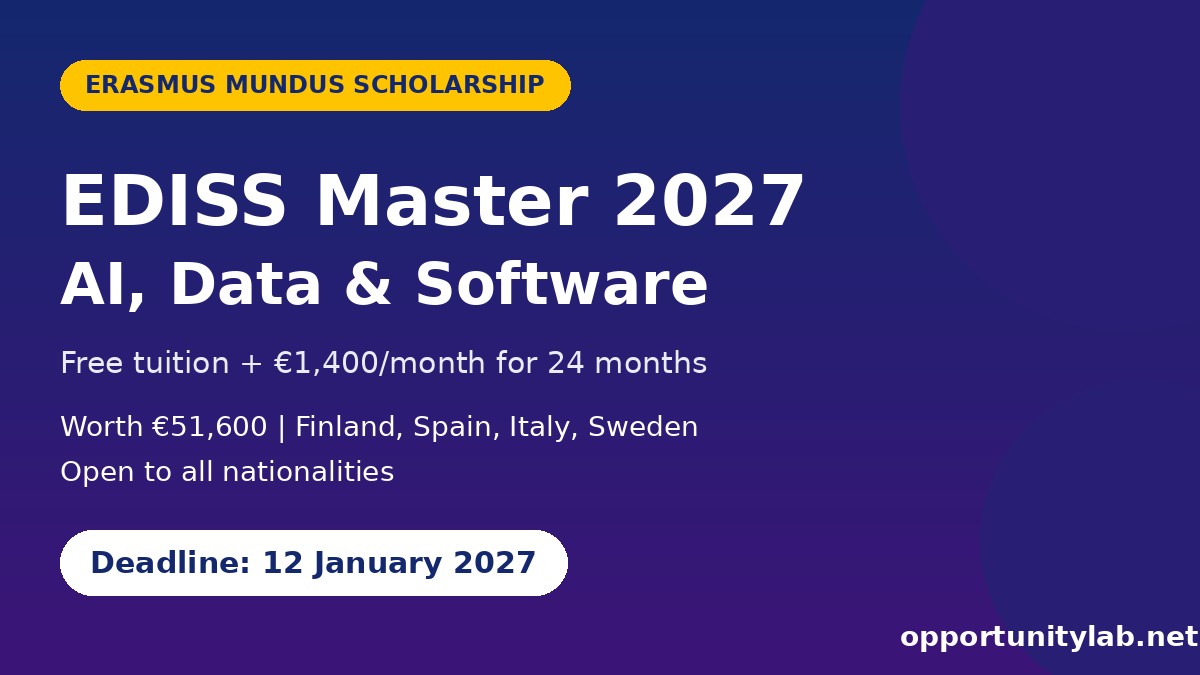
The best-funded option, the Erasmus Mundus scholarship, waives the €9,000 yearly participation cost and pays €1,400 a month for 24 months, plus health insurance. The consortium puts its total value at €51,600. A second, smaller EDISS scholarship is also offered in the same round.
Deadline: 12 January 2027, 3:00 pm Helsinki time (2:00 pm WAT, 3:00 pm CAT/SAST, 4:00 pm EAT). This is the only round in which the two living-allowance scholarships are awarded.
Key Details
- Programme: Erasmus Mundus Joint Master EDISS, intake 7 (2027–2029)
- Coordinator: Åbo Akademi University, Finland, with partner universities including the University of the Balearic Islands (Spain), the University of L’Aquila (Italy) and Mälardalen University (Sweden)
- Duration: two years (120 ECTS), starting August 2027
- Participation cost without a scholarship: €9,000 per year
- Scholarship round opens: 16 November 2026, 8:00 am Helsinki time
- Scholarship round closes: 12 January 2027, 3:00 pm Helsinki time
- Open to: all nationalities
Benefits
The programme lists three scholarship types for intake 7. The first two are awarded in the current round:
- Erasmus Mundus (EMJM) scholarship: participation costs waived (€9,000 a year), €1,400 a month for 24 months, and health insurance. Total stated value: €51,600.
- EDISS scholarship: participation costs waived, €800 a month in year one and €310 a month in year two, and health insurance. Total stated value: €31,320. In year two, holders can also get an Erasmus+ mobility grant; the programme quotes €490–540 a month, using 2024–25 rates.
- Tuition fee waiver scholarship: participation costs waived (worth €18,000) and health insurance, but no monthly allowance. This one has a separate, later round (25 February to 11 March 2027).
Students also study in at least two European countries, which builds an international network and work experience in Europe’s tech sector.
What You Will Study
EDISS trains engineers to build software that handles very large amounts of data and uses intelligent methods. Core areas include machine learning, data management, software architecture, intelligent systems and research methods. Graduates go into roles such as data engineer, machine learning engineer, software architect, or PhD research.
Eligibility
- A bachelor’s degree (at least 180 ECTS, which is equivalent to a standard three- or four-year degree) in computer science, software engineering or a closely related subject, with courses in programming, algorithms and data structures, computer architecture, networks, software engineering and mathematics.
- Final-year students may apply and be admitted conditionally, but must submit their degree certificate and transcript by 30 July 2027.
- English proficiency: IELTS Academic 6.5 (no band below 6) or TOEFL iBT (93 for tests taken before 21 January 2026; 4.5 with no band below 4 for tests taken after that date). Online and Home Edition tests are not accepted.
- Note for Nigerians and most Africans: the English test waiver only covers people who studied in English in the UK, USA, Canada, Australia, New Zealand, Switzerland or the EU/EEA. A Nigerian degree taught in English does not qualify, so you will need a valid IELTS or TOEFL score, and the result must still be valid 14 days after the round closes.
- People who have already held an Erasmus Mundus master’s or doctoral scholarship cannot get another one.
How to Apply
- Read the EDISS admission requirements and the country-specific document rules.
- Check the scholarship details on the EDISS scholarships page.
- Prepare your degree certificate and transcripts (with translations if needed), English test result, CV, passport and the other documents requested.
- Submit your application through the online system linked from the EDISS application process page before 12 January 2027, 3:00 pm Helsinki time.
- Questions can be sent to the programme at [email protected]. The intake 7 dates announcement lists all three rounds.
Tips
- Book your IELTS now. Test dates in Lagos, Abuja, Accra and Nairobi fill up in December, and you need the result before 12 January.
- Ask your university early for transcripts and an official letter stating your expected graduation date if you are still in your final year. Nigerian registries can take weeks.
- Show real technical work: GitHub projects, a final-year project on data or AI, or work experience as a developer helps your application stand out.
- Apply to two or three Erasmus Mundus programmes at the same time. You can apply to up to three each year, which raises your chances.