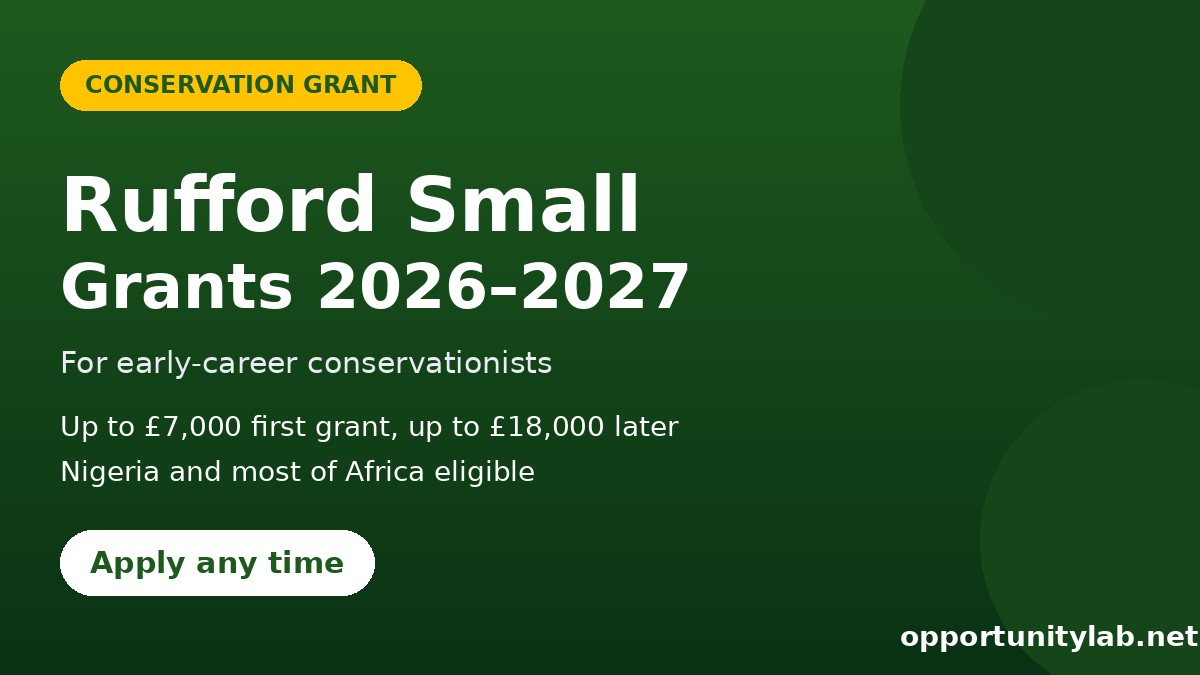


The Rufford Foundation in the UK funds early-career conservationists through the Rufford Small Grants. A first grant is worth up to £7,000, and successful grantees can move up to a second grant (up to £8,000), a Booster Grant (up to £12,000) and a Completion Grant (up to £18,000). Projects in Nigeria and almost every African country are eligible. The exceptions are Sudan and South Sudan, where Rufford says it currently cannot consider applications.
Rufford’s priority is people studying for, or who finished in the last three years, an MSc or PhD (or equivalent). Undergraduates are not funded. Deadline: none. Applications are accepted all year, but you can submit only one application in any 12-month period.
Key Details
- Funder: The Rufford Foundation (UK)
- Grants: 1st Rufford Small Grant up to £7,000; 2nd up to £8,000; Booster up to £12,000; Completion up to £18,000
- Focus: nature conservation projects in eligible countries
- Who: early-career conservationists
- Deadline: rolling, with no closing date
- Limit: one application every 12 months; if rejected, you must wait 12 months to reapply
Benefits
- Up to £7,000 for a first small-scale or pilot conservation project, covering fieldwork costs
- A clear funding ladder: complete one project and report on it, and you can apply for the next stage at least 12 months later, up to a total of four grants
- A public project page on Rufford’s website showing your updates and results, which helps you raise money from other funders
- Rufford aims to fund 50–100% of a project, so a single grant can make a project possible
What Rufford Funds
- Projects focused on threatened species (anything not listed as Least Concern on the IUCN Red List, or unassessed species thought to be globally threatened), threatened habitats, human–wildlife conflict or community conservation education
- Small-scale and pilot projects; if other funders are involved, you must show evidence of co-funding
- Not funded: pure research with no clear conservation benefit, expeditions, conferences or seminars, and book publishing
Eligibility
- Early-career conservationists: priority for current MSc/PhD students or those who graduated in the past 3 years; others may be considered if they meet the criteria, but BSc students are not funded
- Working on a project in an eligible country. Nigeria, Ghana, Kenya, South Africa, Cameroon, Uganda and most other African countries are listed; Sudan and South Sudan are currently not being considered.
- The project must have a nature conservation focus
- Only fieldwork costs are considered
How to Apply
- Read the general criteria and grant types and check your country on the country eligibility page.
- Register on the Rufford Small Grants application portal.
- Prepare your project plan, an itemised fieldwork budget, details of co-funding if any, and referees, as requested in the online form.
- Submit at any time. Remember you can make only one application in 12 months, so make it strong.
Tips
- Choose a threatened species or habitat and cite its IUCN status. Least Concern species are not eligible.
- Show local impact: community patrols, school outreach, or work with farmers on human–wildlife conflict all fit Rufford’s priorities well.
- Keep the budget to fieldwork: transport, field equipment, community meetings and local assistants. Do not include salaries for yourself or conference travel.
- Read funded Nigerian and West African projects on Rufford’s website before writing, to see the size and style that wins.