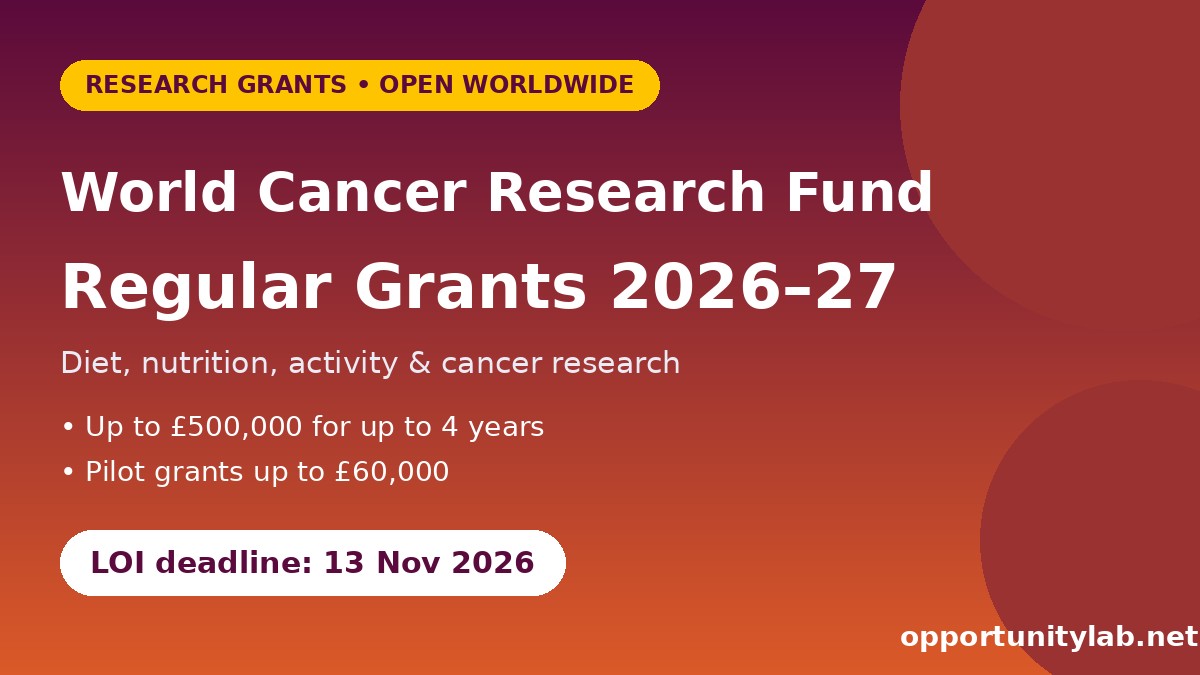
World Cancer Research Fund (WCRF) International is accepting Letters of Intent for its 2026–2027 Regular Grant Programme. It funds research on how diet, nutrition, body composition, physical activity and sleep affect cancer prevention and survivorship, with grants of up to £500,000.
For the first time, the programme is open to researchers anywhere in the world, including Africa. WCRF International now manages grants for the whole network: WCRF in the UK, Wereld Kanker Onderzoek Fonds in the Netherlands and the American Institute for Cancer Research in the US.
Deadline: Letters of Intent close on 13 November 2026 at 5pm GMT (6pm WAT, 8pm EAT). That is very soon, so start your application now.
Key Details
- Funder: World Cancer Research Fund International
- Grant types: Investigator Initiated Grants and Pilot and Feasibility Grants
- Funding: up to £500,000 (about US$650,000)
- Open to: researchers at institutions anywhere in the world
- Letter of Intent deadline: 13 November 2026, 5pm GMT
- Letter of Intent results: February 2027
- Final funding decisions: end of September 2027
Benefits: Grant Types and Funding
- Investigator Initiated Grants: up to £500,000 for up to 4 years
- Pilot and Feasibility Grants: up to £60,000 for up to 2 years; useful for testing new ideas or building early data
- support from one of the world’s leading funders of cancer prevention research
- visibility for your work within the global WCRF network
2026–2027 Research Priority Areas
Your application must focus on at least one of these six priority areas:
- integrative oncology
- lifestyle and weight-loss medications
- early-onset cancers
- early-life exposures
- ingested contaminants
- ultra-processed foods
This year, sleep is included as a main exposure alongside diet, nutrition, physical activity and body composition. Your project can cover more than one area if it is scientifically justified, but make the main area clear.
Eligibility
- the lead applicant must hold a research position at the host institution for the whole project
- host organisations can be anywhere in the world
- research must examine diet, nutrition, body composition, physical activity or sleep in cancer prevention or survivorship
- the proposal must fit at least one of the six priority areas
This is a research grant for institutions and the researchers they employ. It isn’t for students looking for personal funding.
How to Apply
- Read the details and timeline on the official Regular Grant Programme page, plus the grant guidelines and applicant FAQs.
- Create a Proposal Central account if you don’t have one, then log in.
- Find the WCRF International grant schemes and click Apply Now on the grant you want.
- Submit your Letter of Intent by 13 November 2026, 5pm GMT. Budgets are in pounds sterling.
- If your Letter of Intent is shortlisted in February 2027, you’ll be invited to submit a full application.
Note: Proposal Central works poorly in Safari, so use Chrome, Edge or Firefox. Dates on the site use the US format (MM/DD/YY). Send questions about eligibility to [email protected].
Tips for African Researchers
- Talk to your university’s research or grants office today so they can approve the submission in time.
- Link your project clearly to one priority area. Early-onset cancers and ultra-processed foods are growing issues in African cities.
- Consider a pilot grant (£60,000) if you need early data before a larger study.
- Partner with an established cancer research group to strengthen your team.