The Tools Competition 2027 is a multi-million-dollar funding opportunity for education technology innovators. It supports digital tools, data and technologies that can improve learning and contribute to learning science research. The competition is organised by The Learning Agency as a programme of Renaissance Philanthropy.
In addition, the programme welcomes applicants at different stages, from early ideas to established education technology platforms. Therefore, researchers, educators, students, innovators and organisations can explore the opportunity.
What Is the Tools Competition 2027?
The Tools Competition 2027 is an innovation funding competition focused on education technology, learning outcomes and learning science.
This year’s competition has four main tracks:
- Strengthening Teaching – tools that improve teaching effectiveness and make teaching more sustainable.
- Reimagining Assessment – tools that improve K-12 assessment and provide useful insights into student learning.
- Navigating Postsecondary Learning and Work – tools that help learners build skills and navigate education and work in an AI-driven world.
- Building Better Datasets – high-quality education datasets that support research and innovation.
Moreover, applicants need to explain how their technology can contribute to public goods or shared resources, such as datasets, benchmarks or evaluation frameworks.
Who Can Apply for the Tools Competition?
The competition is open to individuals and organisations from different backgrounds, provided they meet the requirements of their chosen track.
Eligible participants can include:
- Students
- Teachers
- Researchers
- Edtech innovators
- Small businesses
- Large companies
- Not-for-profit organisations
- Individual innovators
Importantly, the FAQ states that individuals aged 18 or older can apply. Applicants do not have to belong to a team or organisation.
Therefore, someone developing an education technology idea independently may also participate.
What Country or Region Is Eligible?
Eligibility depends on the selected track.
Strengthening Teaching: Applicants worldwide can apply.
Reimagining Assessment: Applicants worldwide can apply, although the tool must be made available to users for no more than its cost.
Building Better Datasets: Applicants worldwide can apply.
Navigating Postsecondary Learning and Work: This track is limited to entrants based in the United States who serve U.S. learners.
However, participation is prohibited in certain locations because of applicable U.S. sanctions and other laws. Applicants should therefore review the official rules before submitting.
What Does the Competition Cover?
The opportunity focuses on technology that can address important challenges in education.
Eligible technologies may include:
- Apps
- Software
- Algorithms
- Datasets
- Digital learning tools
- Other technologies that support learning
The competition is particularly interested in tools that can generate useful learning data and scale without requiring large ongoing costs.
Furthermore, the programme aims to improve learning outcomes, strengthen teaching, support learning science research and build a wider Learning Engineering community.
What Are the Academic Requirements?
There is no stated university degree requirement for the competition.
In fact, the official FAQ says that applicants can come from different backgrounds and that individuals do not need to be affiliated with a university, company or organisation. Applicants also do not need previous experience in edtech.
Therefore, this is not a scholarship or academic admission programme. The main focus is the quality and potential of the proposed technology or dataset.
What Documents Are Required?
For Phase I, applicants submit an online abstract through the official submission form.
The official submission page identifies the application as the 2027 Phase I Submission Form.
The competition rules also require submitted proposals to be original to the applicant or team and to contain accurate and complete information.
Applicants should therefore prepare information about:
- The proposed tool or technology
- The problem it addresses
- The target learners or users
- The relevant competition track
- The tool’s development stage
- Its potential impact
- How it can contribute to learning science
- How it can generate public goods or shared infrastructure
The organisers may request additional materials from applicants who advance to later stages.
When Is the Deadline?
The Phase I submission deadline is:
October 13, 2026, at 11:59:59 PM ET.
The current competition timeline is:
- Competition opens: September 10, 2026
- Phase I deadline: October 13, 2026
- Selected applicants invited to Phase II: November 24, 2026
- Phase II proposal deadline: January 21, 2027
- Finalists selected: March 18, 2027
- Finalist pitches: April 2027
- Winners notified: Early May 2027
Because the organiser can change the timeline, applicants should check the official website for updates.
How Do I Apply for the Tools Competition?
The application process is online.
First, review the available tracks and select the one that matches your technology or dataset. Next, select the appropriate prize level based on the development stage of your product.
Then, complete the Phase I submission form with accurate information about your idea or tool.
Finally, review your submission and submit it before the deadline.
The official website encourages applicants to use its eligibility information and track-specific guidance before submitting.
Where Is the Official Application?
The official Phase I application is available through the Tools Competition website.
Applicants should use the official Tools Competition website rather than relying on third-party application links.
What Are the Benefits?
The Tools Competition 2027 offers several potential benefits for selected innovators.
Funding Support
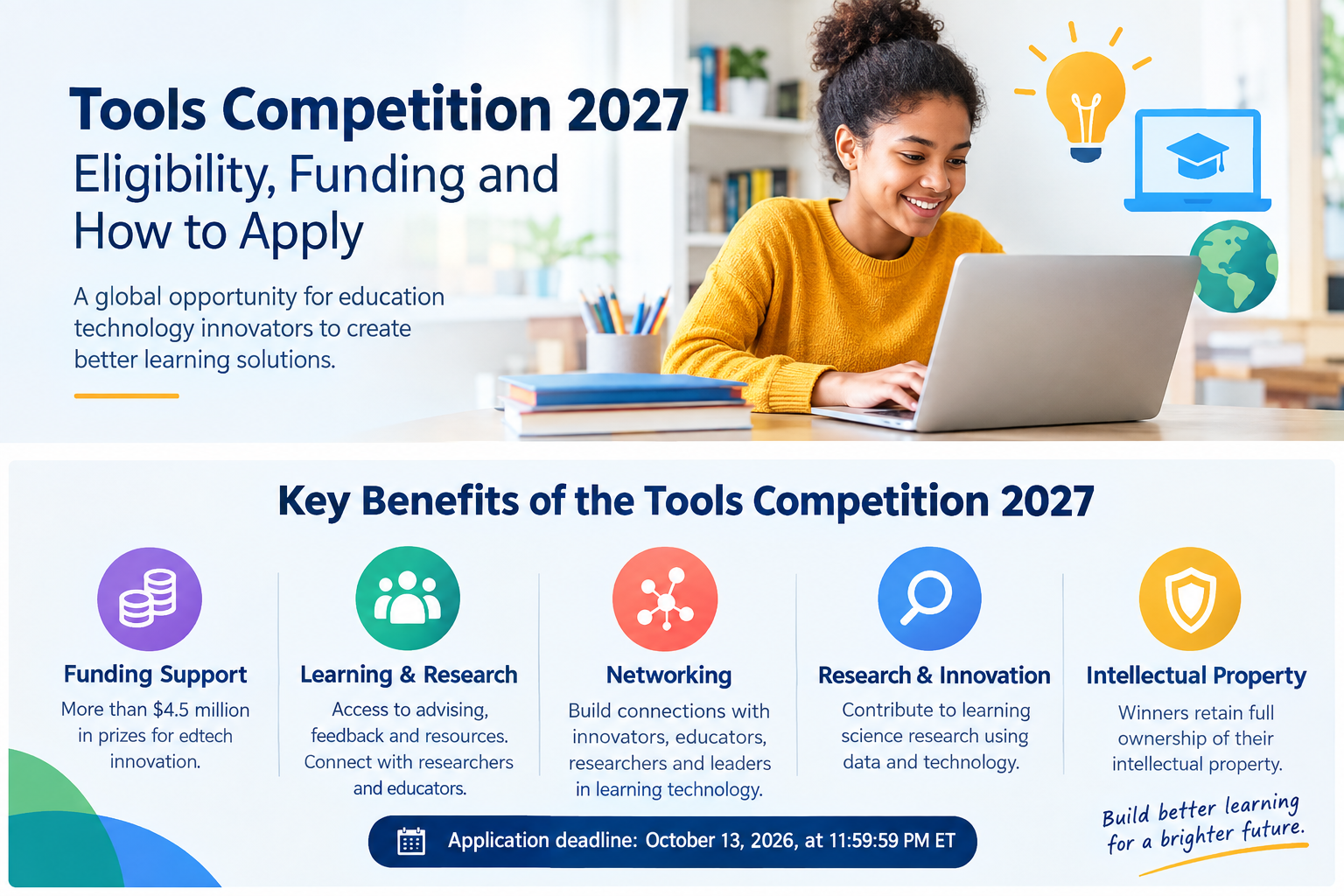
The competition is awarding more than $4.5 million for edtech innovation.
The current prize levels include:
- Catalyst Prize: $50,000 for early-stage tools
- Growth Prize: $150,000 for products with users and some scale
- Transform Prize: $300,000 for established platforms with 10,000 or more users
Learning and Research Support
Participants can also gain access to advising, feedback and resources that can help improve their ideas and proposals. The programme also aims to connect innovators with researchers and educators in the Learning Engineering community.
Networking Opportunities
Selected innovators can build connections with other edtech developers, researchers, educators and leaders working in learning technology.
Research and Innovation
The programme provides an opportunity for technology developers to contribute to learning science research by using data to better understand how people learn.
Intellectual Property
Importantly, the official FAQ states that winners retain full intellectual property ownership. The organisers do not seek equity or shares in the product or company.
For more grants, scholarships, fellowships and innovation opportunities, visit OpportunityLab.