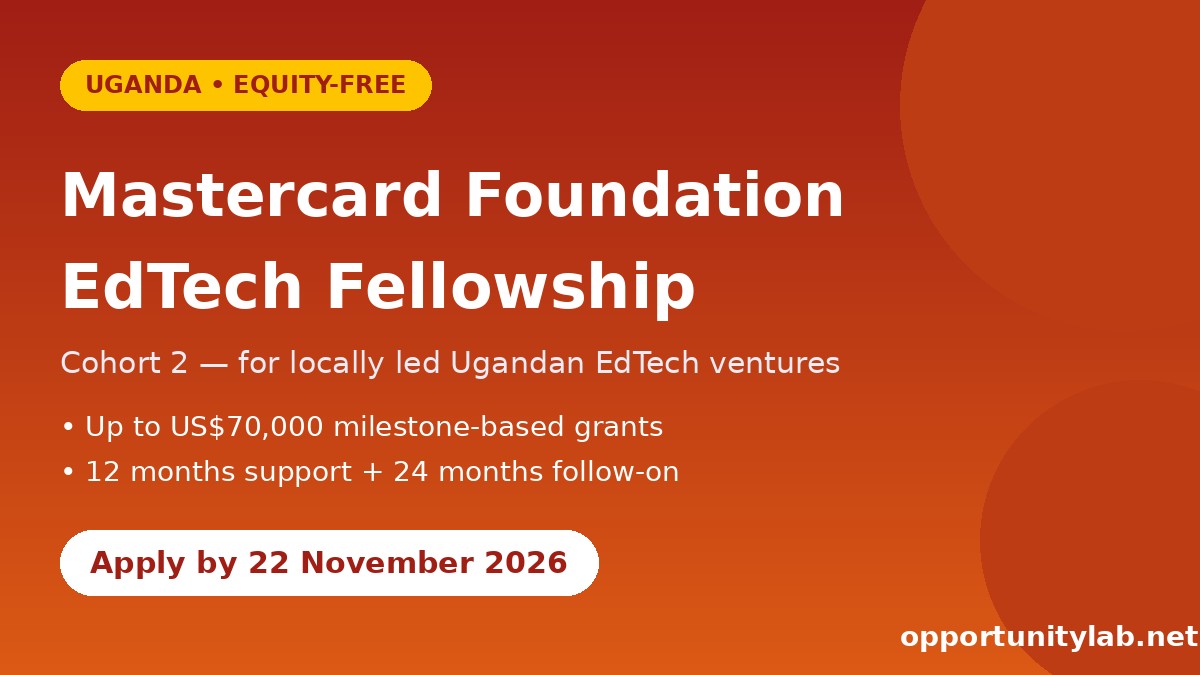



EdTech founders in Uganda: applications are open for Cohort 2 of the Mastercard Foundation EdTech Fellowship, run by Hive Colab in partnership with the Mastercard Foundation. Selected ventures can receive milestone-based, equity-free grants of up to US$70,000 (about UGX 313 million), 12 months of fellowship support and up to 24 months of follow-on help. Applications close in late November 2026.
Who this is for: locally founded and locally led EdTech businesses with leadership rooted in Uganda, a working product and real users. Idea-stage and pre-revenue ventures, and businesses from other countries without Ugandan leadership, do not qualify.
Key Details
- Implementer: Hive Colab (Kampala), with the Mastercard Foundation
- Funding: up to US$70,000, milestone-based and equity-free
- Programme: 12-month fellowship + up to 24 months of post-acceleration support
- Stage: early revenue, growth or scaling
- Cost to apply: free
- Deadline: the form shows both 22 and 26 November 2026 — submit by 22 November to be safe
Benefits
- equity-free grant of up to US$70,000, released as you hit agreed milestones
- a structured 12-month curriculum on product, inclusion, learning impact and sustainability
- one-on-one mentorship from education and venture experts
- technical assistance to improve your product and delivery
- partnerships and market access with schools, institutions and government
- learning-impact support to measure outcomes
- investor readiness: governance, metrics and fundraising strategy
- up to 24 months of post-acceleration support
Cohort 1 (2026) supported ventures such as Shule.Tv, Hi-Shule, Yiya Solutions, Mindset Coders and Visual Assistance Initiative, working on digital learning, STEM, assessment, workforce readiness and assistive technology.
Eligibility
- locally founded and locally led, with leadership and decision-making rooted in Uganda
- a working product with traction — active users, paying customers, institutional partners, revenue or sustained deployment
- a solution that improves learning outcomes or strengthens teaching in Uganda
- inclusive design for underserved learners: low-income communities, girls, refugees, learners with disabilities, rural or low-connectivity areas
- technology at the core of learning delivery — classroom-only or in-person-only models are not eligible
Documents to Prepare
- certificate of incorporation or equivalent registration
- a pitch deck: problem, solution, users, business model, traction and growth plan
- a product demo video of up to 5 minutes on YouTube, Vimeo or Google Drive, viewable by anyone with the link
- a safeguarding, gender or child-protection policy if you have one
The form also asks for details on founders, staff, revenue, users, partnerships, funding history, learning outcomes and data protection. Missing financial information may lower your score; write “N/A” with a short explanation if a question doesn’t apply.
How to Apply
- Read the programme and eligibility on the official fellowship website.
- Prepare your registration document, pitch deck and demo video link.
- Complete the Hive Colab application form: venture info, team, product, users, revenue, inclusion, learning outcomes, safeguarding and declaration.
- Submit by 22 November 2026 (the earlier of the two dates shown).
Questions: [email protected] or +256 392 177 978. Applying is free at every stage — never pay anyone for selection or funding.
Tips
- Lead with traction numbers: learners reached, schools using the product, revenue.
- Show evidence of learning impact, even small pilot results.
- Explain exactly how you reach underserved learners — offline features, local languages, accessibility.
- Keep the demo video short, clear and focused on a real user.
Related Opportunities
- WISE EdTech Accelerator 2026–2027 (Qatar Foundation)
- HP-UCL IOE Fellowship in AI in Education 2027
- Learnstar Startup Challenge 2027: ₦1.5M Grant
Deadline: 22–26 November 2026 — apply by 22 November.