
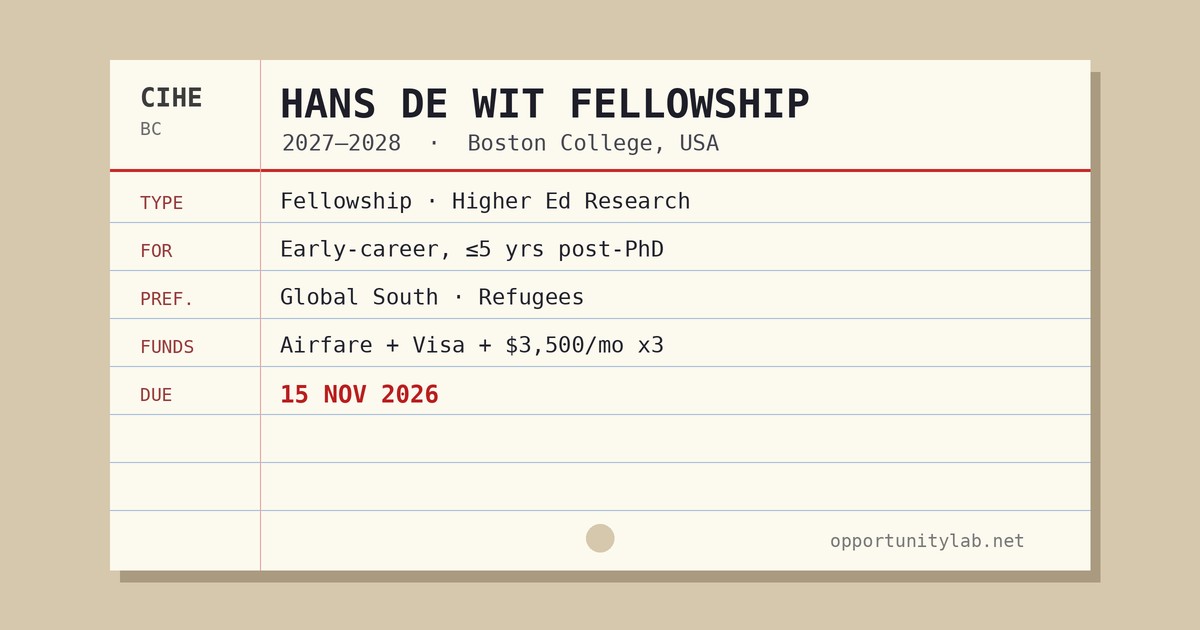
The Center for International Higher Education (CIHE) at Boston College in the United States is accepting applications for the Hans de Wit Fellowship. It’s a funded fellowship for early-career researchers in higher education studies. The fellow is affiliated with CIHE for a full academic year, from September to August, and spends three funded months in Boston. Applicants based in the Global South, including Africa, get preference.
Applications are due by 15 November, which this year is 15 November 2026, for the 2027–2028 fellowship year.
At a Glance
| Host | Center for International Higher Education (CIHE), Boston College, USA |
| Places | 1 fellow per academic year |
| Affiliation | September to August, including a 3-month visit to Boston |
| Funding | Return economy airfare, visa fees, and US$3,500 a month for the 3 months in Boston |
| Who can apply | Early-career researchers in higher education studies, within 5 years of their doctorate |
| Deadline | 15 November 2026 |
About the Fellowship
The fellowship was set up in 2022, with seed funding from World Education Services, to support the academic mobility of early-career researchers in higher education. It’s named after Professor Hans de Wit, a leading scholar of the internationalisation of higher education. Fellows take part in CIHE’s research community and share their expertise through seminars, teaching in CIHE’s MA programme, or the Center’s publications.
Benefits
- Return economy airfare to and from Boston, reimbursed
- Visa fees covered
- A monthly stipend of US$3,500 for the three months in Boston, to cover housing and medical insurance
- A desk, printing and computer access at CIHE
- Access to Boston College’s library, online and in person, for the whole year
- Links with BC’s community of international visiting scholars
Fellows find their own housing and arrange their own visa paperwork, though CIHE provides supporting documents.
Eligibility
- You’re an early-career researcher in higher education studies, within five years of finishing your doctorate.
- Preference goes to applicants from marginalised backgrounds, including those based in the Global South, people with refugee status, and people from traditionally underrepresented groups.
- Your Boston visit must take place during the academic year, between September and June.
- You’re willing to share your research through seminars, teaching or publications.
How to Apply
Email these documents to [email protected] by 15 November 2026:
- A letter of interest explaining why the fellowship would benefit you, how you’d contribute to CIHE and Boston College, and any background relevant to your eligibility.
- Your current CV, listing one referee who can speak about your scholarly work.
- The completed Visiting Scholar application form, downloadable from the CIHE page.
Finalists are invited to an interview with CIHE’s leadership in January.
Official Hans de Wit Fellowship page (Boston College CIHE)
Write It Yourself: CIHE’s Note on AI
CIHE says plainly that your application must be in your own words. It values a clear, distinctive research path over polished English, so don’t rely on AI tools to write your letter.
Tips for African Researchers
- Link your research to African higher education, for example access and equity, internationalisation, quality assurance, graduate employability or decolonising curricula.
- Be specific about what you’ll do in Boston: a paper, a book chapter, a dataset or a comparative study.
- Show how you’ll contribute, such as a seminar topic, a guest lecture or a CIHE publication.
- Plan your US visa early. Visa fees are covered, but appointment wait times in some African countries can be long.