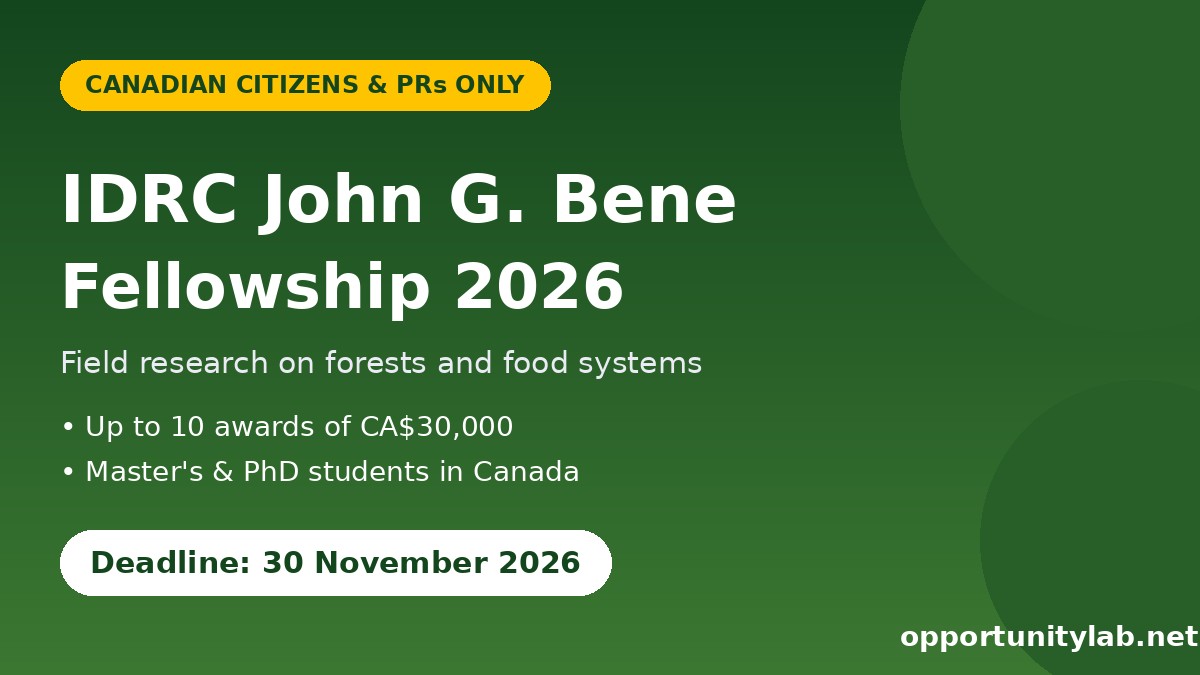
Canada’s International Development Research Centre (IDRC) is accepting applications for the John G. Bene Fellowship 2026, which funds master’s and PhD students to carry out field research in developing countries on forest restoration, agroforestry and food systems. Up to 10 awards of up to CA$30,000 are available. Applications close on 30 November 2026 at 23:59 EST.
Who can apply: only Canadian citizens and permanent residents enrolled at a Canadian university. If you are an African student studying in Canada with permanent residency, you qualify. If not, see the section below on how African institutions can still benefit.
Key Details
- Funder: IDRC and the John G. Bene Endowment Fund
- Awards: up to 10, each up to CA$30,000
- Duration: 10 weeks to 12 months of field research
- Level: master’s or doctoral students
- Research location: one or more developing countries
- Deadline: 30 November 2026, 23:59 EST (05:59 WAT / 07:59 EAT on 1 December)
Research Focus for 2026
This year’s theme is Strengthening inclusive, community-led nature-based solutions for forest restoration and food system transformation. IDRC wants practical, gender-responsive research on:
- integrated forest, landscape and food-system restoration — including fire-prone, degraded or disputed landscapes
- nature-based solutions that benefit smallholder farmers, youth, women and Indigenous communities
- social-science angles: gender and inclusion, Indigenous knowledge, biodiversity conservation and governance of nature
Proposals linked to IDRC’s REVIVE initiative on post-fire forest and food restoration are welcome. Research on genomics or genetic modification is not eligible.
Benefits
- up to CA$30,000 to fund thesis or dissertation field research
- research that directly benefits vulnerable communities in developing countries
- a link to IDRC, one of the world’s leading funders of development research
Eligibility
- a citizen or permanent resident of Canada
- enrolled in a master’s or PhD at a Canadian university (with several courses completed)
- an academic background combining forests, climate resilience, biodiversity or food systems (interdisciplinary programmes are fine)
- a proposal approved by your thesis supervisor, with proof
- fieldwork for your thesis or dissertation in one or more developing countries
- proof of affiliation with an institution or organisation in the country where you will do the research
- PhD students must have finished coursework and passed comprehensive exams before starting
- no more than one active IDRC award at the same time
Not Canadian? How African Institutions Can Benefit
Every Bene fellow needs a host institution or organisation in the developing country where the research happens. African universities, research centres, NGOs and community organisations working on forests, agroforestry or food systems can act as local partners for Canadian graduate students, bringing research, skills and funding into their communities. If you lead such an organisation, consider reaching out to Canadian universities with forestry, environment or development programmes.
How to Apply
- Read the full call on the official IDRC application portal.
- Agree your proposal with your thesis supervisor and get written approval.
- Secure a letter of affiliation from your host institution in the research country.
- Create an account and submit through the IDRC SurveyMonkey Apply form.
- Submit before 30 November 2026, 23:59 EST.
Questions: [email protected].
Related Opportunities
- World Food Forum Youth Policy Board 2027–2028
- FBIS Africa Small Grants 2026: US$5,000–10,000
- Botswana Green Value Chain Programme 2026
Deadline: 30 November 2026, 23:59 EST. Canadian citizens and permanent residents only.