
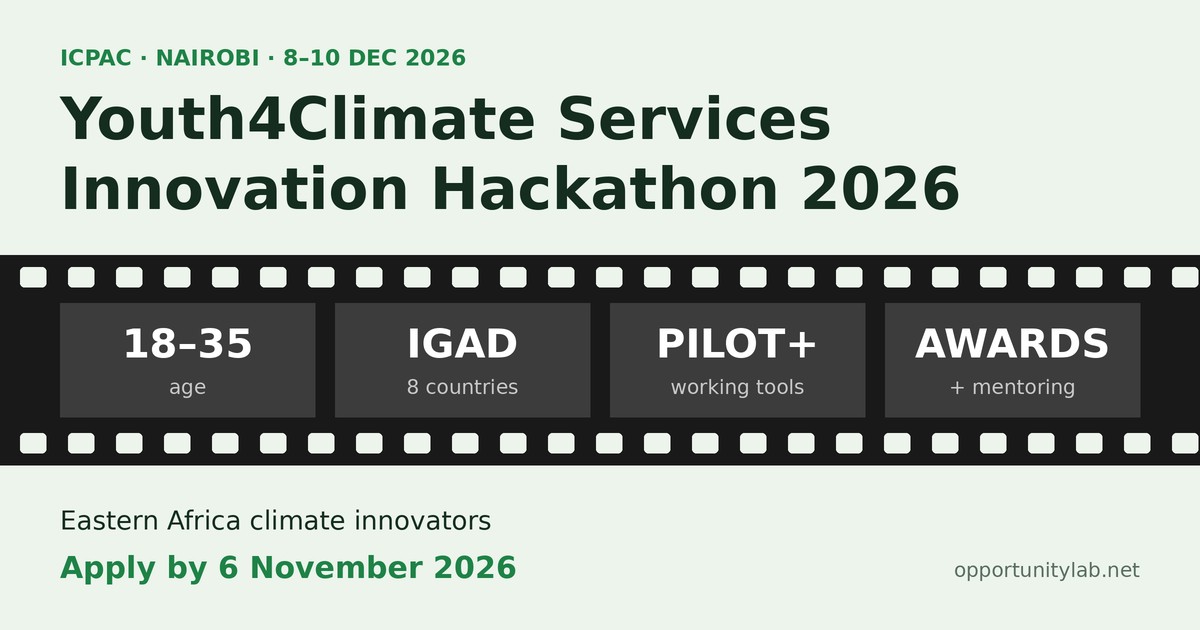

The IGAD Climate Prediction and Applications Centre (ICPAC) is inviting young innovators from Eastern Africa to the Youth4Climate Services Innovation Hackathon 2026. Selected participants will showcase their climate tools at a three-day regional event in Nairobi, Kenya, on 8–10 December 2026, get mentoring from climate experts, and compete for financial awards and follow-up support.
Applications close on 6 November 2026 (5:00pm East Africa Time).
At a Glance
| Organiser | ICPAC, the IGAD Climate Prediction and Applications Centre (a WMO Regional Climate Centre) |
| Event | 8–10 December 2026, Nairobi, Kenya |
| Participants | About 10–20 young innovators from IGAD member states |
| Age | 18–35 |
| Requirement | A working or pilot-stage climate tool (ideas alone don’t qualify) |
| Deadline | 6 November 2026, 5:00pm EAT |
About the Hackathon
The hackathon aims to identify, test and promote youth-led innovations that improve the delivery, accessibility and use of climate services across the IGAD region. Participants demonstrate how their solution tackles a real problem in the climate services value chain. Examples include:
- turning climate information into advice for specific sectors, such as farming, water or health
- tailoring services to local users
- communicating climate risks through accessible channels
- building climate information into decision-making tools
Benefits
- Financial awards for outstanding solutions to support further development. ICPAC hasn’t published the amounts.
- Technical mentoring and feedback from climate service experts and, where possible, end users
- A chance to present to an evaluation panel and potential partners
- Possible links to incubation and acceleration programmes, piloting partners and institutional collaboration
- Regional visibility for your climate innovation
Eligibility
- Aged 18–35.
- A national of, or based in, an IGAD member state: Djibouti, Eritrea, Ethiopia, Kenya, Somalia, South Sudan, Sudan or Uganda. This is subject to ICPAC’s final eligibility guidelines.
- An existing climate-related digital tool, platform, product or solution that’s working or at pilot stage. Concept-only proposals aren’t eligible.
- Able to demonstrate your solution and explain its users, stage and contribution to climate services.
- Available to attend the hackathon in Nairobi and present your solution.
Individuals and multidisciplinary teams, including developers, data scientists and entrepreneurs, are welcome.
What to Include in Your Application
- A short description of your innovation and the problem it solves
- How it contributes to climate services, and which part of the value chain it addresses
- Your intended users and how the solution meets their needs
- Evidence of development, such as a demo, prototype, screenshots, video or pilot results
- What makes it distinctive compared with existing approaches
- Information about you or your team, your skills and your motivation
- Its potential for further development and scaling
How to Apply
- Read ICPAC’s event page and concept note.
- Prepare your evidence (demo link, screenshots or video) and your answers.
- Complete the official application form before 6 November 2026, 5:00pm EAT.
Official ICPAC hackathon page · Application form · Concept note (PDF)
Tips
- Show it working. A short demo video or live link is your strongest evidence.
- Name your users, for example pastoralists, smallholder farmers, county disaster officers or water utilities.
- Link to climate information. Explain how your tool uses forecasts, early warnings or climate data.
- Think about scale. Show how it could work across several IGAD countries.