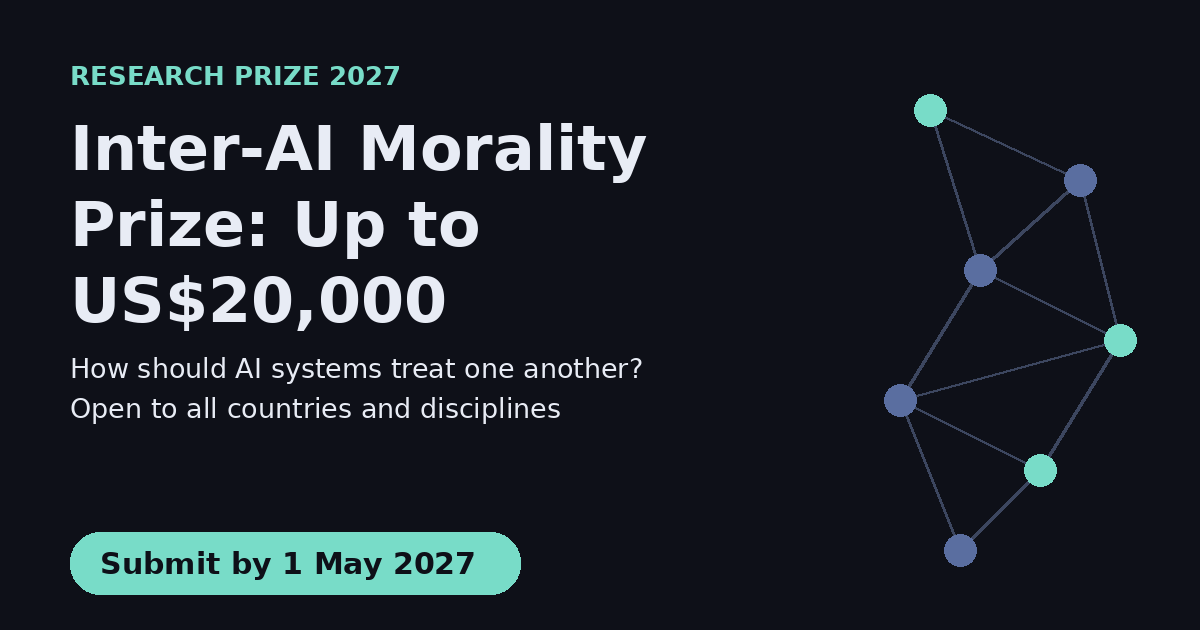


Cambridge Digital Minds, a research initiative at the University of Cambridge, has launched the Inter-AI Morality Prize. The competition rewards research on how AI systems treat one another, from pairs of agents to whole AI societies. The first prize is US$20,000, and entries are due by 1 May 2027.
The prize is run with support from PRISM. It is open to anyone aged 18 or over, from any country and any academic discipline. You do not need to be an expert in AI welfare or digital minds, but your entry should show that you understand the topic.
What the Prize Is Looking For
The organisers welcome concrete contributions to understanding inter-AI morality, including:
- empirical research on how AIs perceive and treat one another;
- methods and benchmarks for studying inter-AI behaviour;
- predictions and scenarios for inter-AI relationships and norms;
- design principles and norms for inter-AI conduct;
- institutions, infrastructure and governance for AI societies, including joint human and AI governance;
- ethical and legal analysis of inter-AI conduct and harm.
Work linking inter-AI morality to AI safety is especially encouraged. Entries can come from computer science, philosophy, psychology, economics, law, political science, the social sciences or any other field.
Eligibility
- Anyone aged 18 or over, from any country and any discipline.
- Individuals and teams of any size can enter. Each person can be an author on at most two entries and can receive at most one prize.
- Entries must be new work, not published before the call opened, and written in English.
- You may use AI tools but must say how you used them. Only humans can be listed as authors.
- Staff of Cambridge Digital Minds and PRISM, judges and their immediate families cannot enter. Prizes cannot be paid to people in countries under international sanctions.
Benefits
- First prize: US$20,000.
- Second prize: US$10,000.
- Third prize: US$2,500.
- The three finalists are invited to the CDM Workshop 2027 in Cambridge, UK (7–8 August 2027), with economy travel and accommodation covered for up to two authors per winning entry. The first-prize winner presents their work there.
- Optional follow-on funding: entrants can submit a short plan to develop their idea. The organisers expect follow-on awards of US$10,000 to US$300,000 per project, and both winners and other entrants may receive them.
Winners are responsible for any tax due on their prize. The organisers may award fewer or more prizes depending on the quality of entries.
How Entries Are Judged
The judging panel includes Lucius Caviola (University of Cambridge), Caspar Kaiser (Cambridge Digital Minds) and Jeff Sebo (New York University). Entries are assessed on originality, usefulness, rigour, clarity and relevance to AI moral status or welfare.
Timeline
- 1 May 2027: submission deadline.
- Mid-June 2027: finalists notified.
- 7–8 August 2027: CDM Workshop 2027 in Cambridge, where winners are announced.
How to Apply
Submit your entry through the official online form by 1 May 2027. Each entry must include:
- a summary of up to 250 words stating your contribution, why it matters and how it connects to AI moral status or welfare;
- the main text of 1,500 to 5,000 words (excluding references and appendices), submitted as a PDF without author names so it can be judged blind;
- for teams, the names of all authors;
- optionally, supplementary materials and a follow-on funding plan of up to 300 words.
Read the full rules and submit on the official Inter-AI Morality Prize page. Questions can be sent to [email protected].
Related Opportunities
- AIM Safety Fellowship 2027: Paid AI Safety Research Programme (apply by 18 December 2026)
- Cooperative AI PhD Fellowship 2027 (apply by 20 December 2026)
- International Programme on AI Evaluation: Capabilities and Safety 2027 (apply by 11 December 2026)
- Stanford AI Lab Postdoctoral Fellows Program 2027 (apply by 4 January 2027)